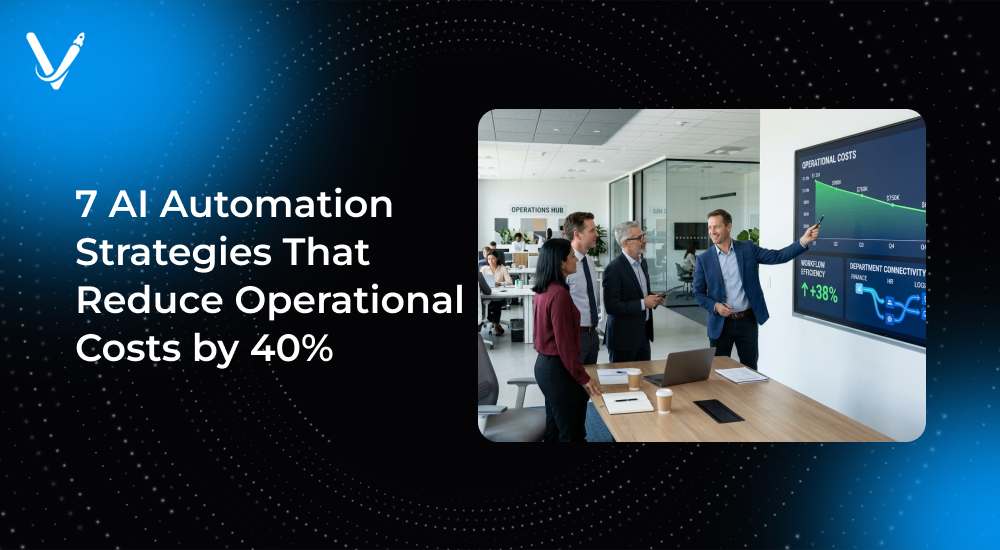
Here is a number that should grab every business owner. Companies that move past pilot projects with intelligent automation report an average cost cut of 32% (Deloitte). Some hit over 70% savings in the areas they target. Put those together, and a 40% cut in operational costs is not a dream. It is a realistic goal.
The catch is that most companies are not there yet. McKinsey found that 88% of companies now use AI in at least one business function (McKinsey). But most are stuck testing, not scaling. They get small wins, not big savings.
This guide fixes that. Below are 7 clear AI Automation strategies that reduce operational costs, with real data and simple steps. Each one is something your business can start on this quarter.
Why Operational Costs Are Quietly Eating Your Profit
Operational costs are the everyday costs of running your business. Think staff hours, manual data entry, support tickets, paperwork, and rework. None of them feel huge on their own. Together, they drain your margin.
Most of this cost comes from repeat work. People doing the same task over and over. That work is slow, it has errors, and it does not grow your business. It is also the easiest work to automate.
This is where AI and automation come in. They take over the repeat tasks and run them faster, cheaper, and with fewer mistakes. The goal is not to replace your team. It is to free your team from busywork so they can do work that matters.
How real is 40%? Deloitte found that firms past the pilot stage cut costs by 32% on average, and some cut over 70% in targeted areas (Deloitte). IBM's study of 680 IT leaders found that companies using intelligent automation are cutting costs and driving growth (IBM). So 40% sits right in the middle of what real companies report.
Strategy 1: Automate Repetitive Back-Office Work
Your back office runs on repeat tasks. Invoices, data entry, payroll, reports, and approvals. Each one eats hours every week.
Business Process Automation handles these tasks for you. Software does the typing, checking, and routing. No coffee breaks, no typos, no delay
. Here is what you can automate first:
• Invoice and expense processing
• Data entry between systems
• Payroll and HR forms
• Weekly and monthly reports
• Approval requests and reminders
The savings add up fast. When a task that took a person two hours now takes two minutes, that time goes back into real work. Good business process automation software pays for itself in months, not years. If you are not sure where to begin, business process automation services can audit your workflow and find the best tasks to automate first.
Strategy 2: Use AI Chatbots to Handle Support
Customer support is one of the biggest cost centers in any business. Phone lines, live chat, and email all need staff. And demand never stops.
AI chatbots cut this cost. They answer common questions any hour of the day. They handle returns, order status, password resets, and FAQs. Your team only steps in for the hard cases.
Gartner predicts that by 2028, at least 70% of customers will start their support journey with an AI chatbot. That is a huge load taken off your staff. A good bot can deflect a large share of tickets, which means fewer agents needed for the same volume.
The key is to keep it helpful. A bot that frustrates people costs you more than it saves. So build it to solve real problems and hand off to a human when needed.
Strategy 3: Connect Your Tools With AI Workflow Automation
Most businesses run on a dozen apps that do not talk to each other. Staff copy data from one to the next by hand. That is slow and full of errors.
AI Workflow Automation fixes this. It links your tools so data flows on its own. A new order updates your CRM, your stock count, and your accounting at the same time. No copy-paste.
Here is a simple example. A lead fills a form. The system scores the lead, adds it to your CRM, sends a welcome email, and alerts a rep. All in seconds. All with no human touch.
Modern AI automation tools like workflow builders make this easy to set up. They connect hundreds of apps with simple rules. The result is fewer manual steps and real Operational Cost Reduction across every team.
Strategy 4: Cut Waste With Predictive Analytics
Waste is money you spend that you did not need to. Too much stock. Idle machines. Wrong forecasts. Most of it comes from guessing.
AI removes the guessing. Predictive analytics looks at your past data and spots patterns a person would miss. It tells you what to order, when a machine needs service, and where demand is heading.
That means:
• Less money tied up in extra stock
• Fewer breakdowns and less downtime
• Better forecasts and less rush spending
• Smarter pricing based on real demand
McKinsey found that high performers do not just add AI. They redesign how work is done around it . Predictive analytics is a clear example. It changes decisions, not just tasks, and that is where the big savings live.
Strategy 5: Automate Document Processing
Every business handles piles of documents. Contracts, forms, receipts, claims, and IDs. Reading and sorting them by hand is slow and costly.
AI can read documents for you. It pulls out the key data, checks it, and files it in the right place. What took a clerk an hour now takes seconds.
This works for:
• Reading invoices and receipts
• Sorting and tagging contracts
• Checking forms for missing fields
• Pulling data from scans and PDFs
AI Business Automation like this cuts labor cost and speeds up every process that waits on paperwork. It also cuts errors, since the AI does not get tired or distracted.
Strategy 6: Smarter Staffing and Scheduling
Labor is often the biggest line in your budget. Overstaffing wastes money. Understaffing hurts service. Getting it right by hand is hard.
AI fixes this with smart scheduling. It looks at past demand, weather, events, and trends to predict how busy you will be. Then it builds a staff plan that matches. You pay for the help you need, not more.
This is a quiet win that many businesses miss. A small cut in wasted hours each week adds up to large savings over a year. And your team gets fairer, steadier schedules too.
Strategy 7: Catch Errors and Fraud Early
Mistakes and fraud are silent costs. A wrong invoice, a double payment, or a fake claim can slip through and cost you a lot.
AI watches every transaction in real time. It flags anything odd before it becomes a loss. It catches duplicate payments, strange spending, and patterns that look like fraud.
IBM's research found that companies using intelligent automation are cutting costs and driving growth, with the best returns coming from firms that scale AI across the business. Fewer errors means less rework, fewer refunds, and less loss. That is direct Operational Cost Reduction with very little downside.
AI Compliance: Save Money Without Breaking the Rules
Here is the part many guides skip. When you automate with AI, you handle a lot of data. That brings rules you must follow.
AI compliance keeps your savings safe. If you ignore it, one fine can wipe out a year of cost cuts. GDPR fines alone can reach 20 million euros or 4% of global revenue.
So get the basics right:
• Privacy laws: Follow GDPR, CCPA, and any local rules. Let people see, export, and delete their data.
• Transparency: Tell people when AI or a bot is involved. Be clear about how their data is used.
• Data security: Encrypt data, limit access, and log who sees what.
• Human review: Keep a person in the loop for big or risky decisions. AI should assist, not rule alone.
A good AI Automation Solutions partner builds these controls in from the start. That protects your money and your name. It also makes your Digital Transformation safer and easier to scale.
How to Start and Reach 40%
You do not get 40% overnight. You get there step by step. Here is a simple path:
1. Find your biggest repeat tasks: Look for slow, manual, high-volume work.
2. Pick two or three to automate first: Start where the pain is worst.
3. Measure time and cost before and after: Track real numbers.
4. Scale what works: Use the savings to fund the next project.
5. Add AI compliance at every step: Build it in, do not bolt it on.
McKinsey's data is clear. The companies that win do not just buy AI tools. They redesign their work around them . That is how small wins turn into a 40% cut.
The right partner makes this faster. Look for a team with real AI Business Automation experience, strong security habits, and proof of results.
Final Thoughts
Your operational costs are full of repeat work that software can do better. AI automation takes over that work. It runs faster, costs less, and makes fewer mistakes. Back-office tasks, support, workflows, analytics, documents, staffing, and fraud checks all get cheaper.
Done right, these 7 strategies can cut your operational costs by up to 40%. And they free your team to focus on growth, not busywork.





 Jun 15, 2026