AI/ML
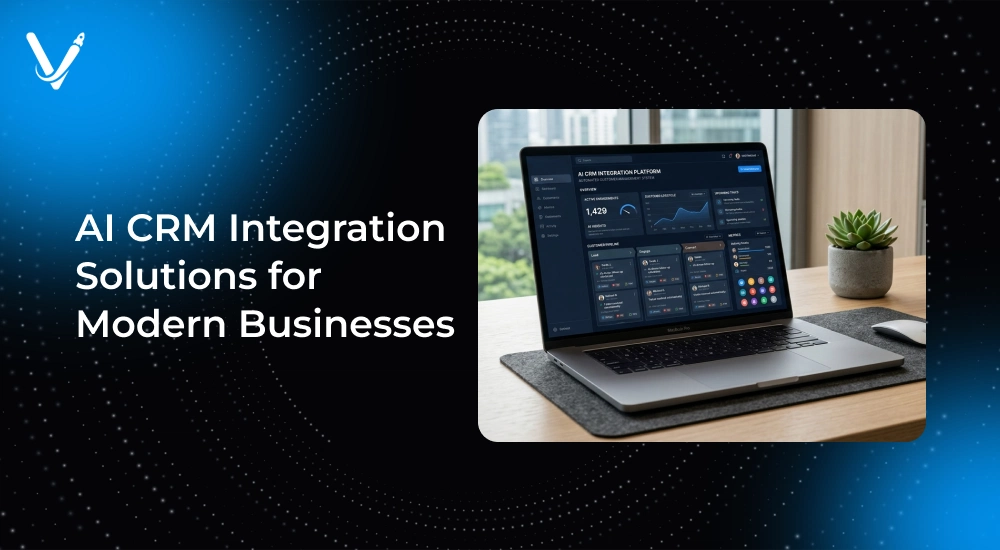
AI CRM Integration Solutions for Modern Businesses

 May 27, 2026







Most businesses already sit on a goldmine of customer data. It lives in their CRM. The problem is that much of it just sits there. Sales reps skip data entry. Follow-ups slip through the cracks. Good leads go cold while someone digs through old notes to find a phone number.
AI changes that. When you connect smart automation to the system you already use, the CRM starts doing work on its own. It scores leads, drafts replies, flags at-risk accounts, and keeps records clean without being asked. That is the heart of AI CRM integration, and it is fast becoming a standard part of how modern teams run. If you are weighing whether to build it, our AI services team works on exactly this kind of project.
This guide breaks down what AI CRM integration means, why it matters now, how it works, and what to plan for before you start.
Here is the gap worth naming. Owning a CRM is easy. Most growing companies have one. Using it well is the hard part. AI closes that gap. It turns a passive database into an active teammate that works while your staff focus on customers.
AI CRM integration is the work of adding artificial intelligence to your customer relationship management system. It is not a new app you bolt on the side. It is a layer of smarts that lives inside the tools your team already uses, like Salesforce, HubSpot, Zoho, or a custom platform.
A plain CRM stores data and waits for you to act. AI-powered CRM solutions do more. They read the data, spot patterns, and act on them. Think of the difference between a notebook and an assistant. The notebook holds your notes. The assistant reads them and tells you who to call first.
These intelligent CRM software setups can take many shapes. Some focus on sales. Some focus on support. Most blend a few jobs at once. The shared idea is simple. Let the machine handle the repeat work so people can handle the human work.
The timing is not random. The CRM market is huge and still growing fast.

Take the market first. Fortune Business Insights valued the global CRM market at about 112.9 billion dollars in 2025 and expects it to reach roughly 321 billion dollars by 2034. That is a steady climb of more than 12 percent a year. Grand View Research sees similar momentum, with the market on track to pass 160 billion dollars by 2030.
AI is the part growing fastest. The slice of the market tied to AI in CRM is already worth several billion dollars and rising quickly. Buyers are not adding AI for fun. They are adding it because the payback is clear.
McKinsey found that generative AI could lift productivity in customer care by a value equal to 30 to 45 percent of what those teams cost to run today. In one case it studied, a company with 5,000 support agents used AI and resolved 14 percent more issues per hour. Handling time dropped. Fewer customers asked to speak with a manager.
Numbers like these explain the rush. AI business automation inside the CRM is no longer a nice extra. It is becoming the baseline for teams that want to keep up.
Adoption is already wide. Most companies with more than a handful of staff now run a CRM of some kind. The open question is no longer whether to use one. It is how much of the daily work the system can take off your plate.
It helps to see the flow. Most AI for CRM systems follow the same five stages.

First comes data capture. Calls, emails, web forms, and chats all feed into one place. Nothing gets lost in a rep's inbox.
Next is enrichment. The system cleans the records. It removes duplicates, fills gaps, and tags each contact. Clean data is what makes everything after this work.
Then the AI goes to work. This is the core of AI-driven CRM automation. The model scores leads, predicts which deals may close, and flags accounts that look ready to leave. It can also draft emails and sum up long call notes in seconds.
After that comes action. The CRM fires tasks, sends follow-ups, and routes hot leads to the right rep. No one has to remember to do it.
Last is the feedback loop. The system watches what happened and learns from it. Every won deal and every reply makes the next prediction a little sharper.
CRM workflow automation ties these stages together. The result is a system that does not just store information. It moves it forward.
The stages above sound abstract until you see the daily wins. Here is where CRM automation solutions tend to pay off first.
• Lead scoring. The AI ranks new leads by how likely they are to buy. Reps stop guessing and call the best ones first.
• Data entry. The system logs calls, updates fields, and files notes on its own. This one job alone can give reps hours back each week.
• Smart follow-ups. Missed a reply? The CRM nudges the customer for you, at the right time, with the right message.
• Sales forecasting. AI customer management solutions read past deals to predict the next quarter with more accuracy than a manual guess.
• Support routing. Incoming tickets go straight to the right person, or get answered by a bot when the question is simple.
None of this removes the human. It removes the busywork that wears the human down.
The point of all this is not to look modern. It is to get results you can measure.
Teams that add AI-powered customer relationship management tend to see three things. They sell more, because reps spend time on real prospects instead of admin. They keep more customers, because at-risk accounts get caught early. And they spend less per task, because the machine handles volume that used to need more staff.
The McKinsey case study showed the pattern clearly. More issues solved per hour. Less time spent on each one. Fewer escalations to a manager. Those gains were largest for newer, less experienced staff, which means the right tools can help a whole team level up fast.
Picture a mid-size sales team. Before AI, a rep might spend half the day logging calls and chasing cold leads. After AI, that same rep opens a ranked call list each morning, with the log already filled in. Selling time goes up. Admin time goes down. That swap is where most of the value hides.
Here is the honest part. Results depend on the setup. Custom AI solutions for businesses work best when the goals are clear and the data is clean. A rushed rollout on messy data will let you down. A planned one tends to pay for itself.
• Start with one problem. Pick the task that hurts most, like slow lead response, and fix that first. Do not try to automate everything on day one.
• Clean your data. AI is only as good as what it reads. Spend time fixing duplicates and gaps before you switch anything on.
• Pick the right partner and tools. Good CRM software integration services connect your AI cleanly to the system you already run. Off-the-shelf tools fit common needs. Custom AI CRM integration fits when your process is unusual or your data is sensitive.
• Plan for the people. The biggest hurdle is rarely the tech. It is getting the team to trust and use it. Train them. Show them the early wins.
Adding AI to a CRM means handling personal data at scale. That brings rules you cannot skip.
Data privacy comes first. If you serve customers in Europe, the GDPR sets strict limits on how you collect, store, and use their data. Many other regions have their own laws. Know which ones apply to you.
Protect personal information. A CRM holds names, emails, phone numbers, and more. Keep this data encrypted. Limit who can see it. Feed the AI only the data it truly needs.
Be open about AI. If a bot is talking to a customer, or if AI is making a decision that affects them, say so. Clear disclosure builds trust, and in some places it is now required.
Keep security tight. Strong access controls, audit logs, and vendor checks all matter. A breach in a CRM can expose your whole customer base at once.
None of this needs to be scary. It just needs to be planned. A good build treats compliance as part of the design, not an afterthought.
We build AI into CRMs for a living. Our team handles the full job. We clean your data, choose the right models, connect them to your CRM, and make sure the whole thing is safe to run.
If your needs are standard, we help you get more from the tools you already own. If they are not, our custom software development team builds AI-powered CRM solutions shaped around your exact process.
Not sure where to start? That is normal. Our innovation consulting team can map the highest-value places to add AI before a single line of code is written. The goal is simple. Spend effort where it pays back, and skip the rest.
Talk to Vasundhara Infotech about custom AI CRM integration. We will help you find the highest-value place to start and build it the right way, with compliance baked in from day one.
Get in touch for a free consultation → vasundhara.io/contact-us