AI/ML
AI in Customer Service: Complete Guide to Benefits, Use Cases & Future Trends

 Feb 4, 2026







In Article:
Customer service is rapidly evolving. Overworked support staff and lengthy wait times are becoming issues of the past. Why? Artificial intelligence is changing how companies engage with their clients.
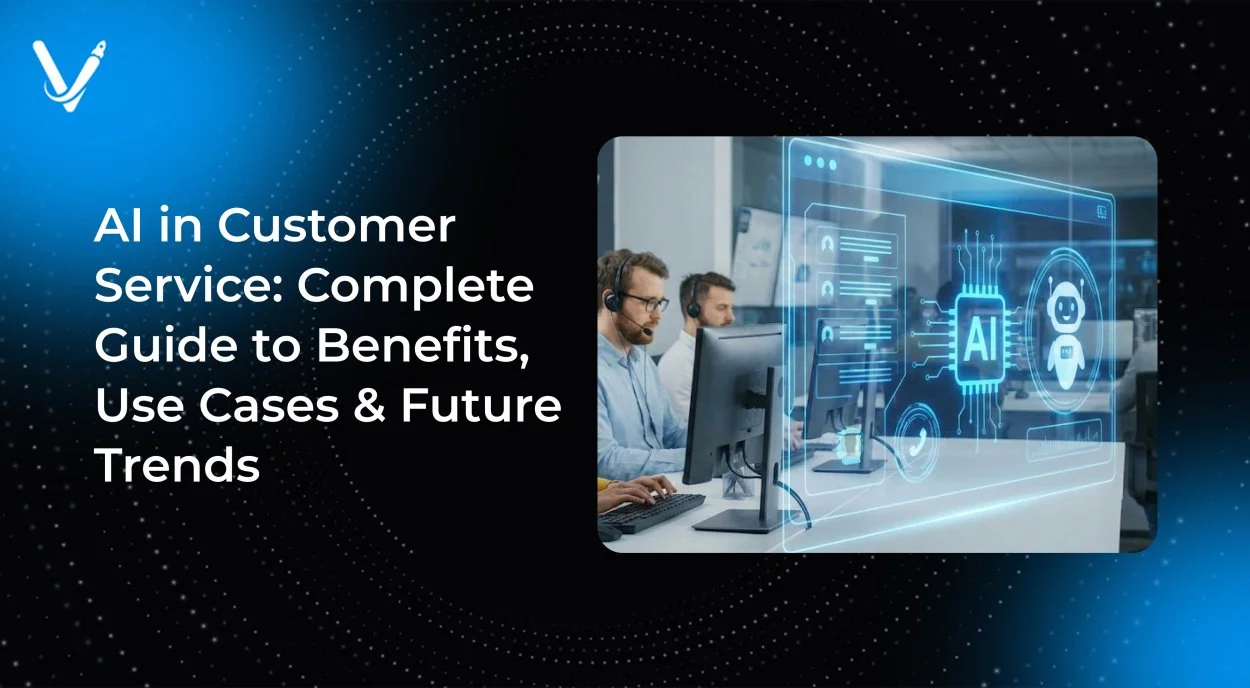
AI in customer service is becoming more than just a fad, it's becoming necessary for businesses to remain competitive. AI is making customer service quicker, smarter, and more individualized, from chatbots that respond to queries instantly to systems that anticipate what clients need before they ask.
We'll go over everything you need to know about AI in customer service in this guide. You'll learn about demonstrated advantages, practical use cases, real-world examples, implementation techniques, and prospects.
Artificial intelligence (AI) in customer service refers to the use of AI technology by businesses to improve customer support. Businesses use intelligent systems that can comprehend inquiries, respond to them, and resolve issues on their own rather than depending on humans.
AI systems combine a number of different technologies. Machine learning learns from previous conversations to make them smarter over time. They can comprehend what customers are saying, even if they use different wording, thanks to natural language processing (NLP). Conversations are handled by chatbots and virtual assistants, and predictive analytics are used to anticipate potential customer needs.
According to studies, more than 60% of businesses currently integrate AI into their customer service processes. Basic chatbots are used by small businesses to respond to frequently asked questions.
The benefits of AI in customer service go far beyond just saving money. Here are the real advantages businesses are seeing.
24/7 availability means customers get help when they need it, not just during business hours. AI-powered systems provide support around the clock without requiring night shifts or overtime pay.
Lightning-fast response times save waiting time on hold. Customers get instant responses to their questions. For simple questions like checking order status or resetting passwords, AI can solve the problem in seconds.
Massive cost reduction is a major benefit. AI reduces operational costs. One AI system can handle thousands of conversations without delay for a fraction of what it costs to staff a call center. Companies report saving 30-40% on customer service costs after implementing AI solutions.
Better customer experiences happen because AI remembers everything about your customers. Like, Past purchases, previous conversations, preferences, all instantly available. This means every interaction can be personalized, and the purchase cycle will move smoothly.
Unlimited scalability means AI handles high volume without breaking the flow. Whether you have 10 customers or 10,000 asking questions at the same time, service quality stays consistent.
Data insights come from every customer interaction. AI recalls conversations and provides insights into what customers are asking about, what problems come up most often, and how satisfied people are with your service.
Happier human agents result because AI handles repetitive questions, helping humans to focus on complex problems that actually need human empathy and creativity.
Real examples of AI in customer service show what's actually possible.
Amazon uses AI throughout in customer service. Their virtual assistant handles millions of inquiries about orders, deliveries, and returns. When you ask Alexa about your order status, you're experiencing AI in customer service.
Sephora created an AI chatbot that helps customers find the right makeup and skincare products. It asks questions about skin type and preferences, then recommends specific products.
Bank of America's Erica helps customers check balances, pay bills, track spending, and provides financial advice. Over 10 million customers use Erica regularly.
H&M's fashion chatbot helps customers find clothes that match their style. The chatbot learns from customer choices, getting better at recommendations over time.
Uber handles millions of support tickets through AI. Lost items, fare questions, and trip issues often get resolved automatically without human.
These examples of AI in customer service show that the technology works across every industry and business type.
Here are specific AI use cases in customer service you can implement.
AI chatbots handle FAQs, help customers find information, track orders, and solve simple problems. When they can't help, they smoothly transfer customers to human agents.
Virtual assistants handle voice interactions, remember conversation context, and manage multi-step processes like scheduling appointments or processing returns.
Sentiment analysis detects how customers feel from their words. If someone's angry, the system can immediately escalate to a senior.
Automated ticket reads support tickets and automatically categorizes and routes each one to the agent or team best equipped to handle it.
Predictive customer service predicts problems before they happen. If your product typically has an issue after 90 days, AI can proactively reach out to customers approaching that timeframe.
Self-service portals powered by AI let customers ask questions in plain language and get exact answers from your knowledge base.
Intelligent voice systems let customers talk naturally instead of pressing buttons through endless menus.
Email automation reads incoming customer emails and either responds automatically or drafts responses for humans to review.
Personalization engines analyze customer history and behavior to personalize every interaction with relevant recommendations.
Multilingual support breaks language barriers. One chatbot can communicate in dozens of languages without hiring multilingual staff.
Here's how to use AI in customer service effectively.
Start by identifying your needs. What questions does your team answer repeatedly? Where do customers get frustrated? AI should solve real problems, not just be technology for technology's sake.
Choose the right tools. Popular platforms include Intercom, Drift, and Zendesk. Look for tools that integrate with your existing systems.
Start small with a pilot program. Pick one clear use case to start. Maybe deploy a chatbot that only handles order tracking. Test with a small group first.
Train your AI properly. Feed it quality information from past customer conversations. The more good data you provide initially, the better your AI performs.
Integrate with existing systems. Connect AI to your CRM, order management system, and knowledge base so it can actually solve problems, not just answer questions.
Train your human team. Your staff needs to understand how to work with AI and when to take over from it.
Monitor and optimize. Track problem solution rates, customer satisfaction, and response times. Use insights to improve responses and refine the system continuously.
Best practices: Always give customers easy options to reach human agents. Make handoffs seamless. Prioritize data privacy. Be transparent about when customers are talking to AI.
Let's be honest about both sides.
The efficiency improvements are incredible. AI handles thousands of conversations easily, works 24/7, and maintains consistent quality. Support costs drop while service availability increases.
AI gives the same quality answer every single time, building trust through consistency. Instant responses to customers. Every interaction generates insights that help improve products and business decisions. Your business can scale without growing your support team.
AI has limited emotional intelligence, but you can use it for straightforward issues and forward emotional situations to humans.
There are upfront investment costs, but ROI typically comes within 6-12 months through reduced support costs.
AI can't handle every situation, but that's what humans are for. Let AI handle the 80% of routine questions, freeing up humans for the 20% that need real expertise.
Some customers prefer humans. Always provide clear paths to humans and make them smooth and quick.
AI requires ongoing maintenance, but it's far less than managing a large support team.
Every disadvantage can be effectively managed with the right approach.
The future of AI in customer service looks incredibly promising.
Hyper-personalization will become standard. AI will understand individual preferences, communication styles, and needs at a deep level.
Emotion AI will analyze tone of voice and facial expressions, knowing when you're frustrated before you say it and adjusting responses accordingly.
More natural conversations will feel completely human. You'll forget you're talking to AI.
Predictive and proactive service will solve problems before you know they exist. Products will order their own replacement parts before breaking.
IoT integration means your smart devices will communicate directly with customer service AI, diagnosing and fixing issues automatically.
The AI customer service market is expected to grow from $1.7 billion in 2026 to over $15 billion by 2030. This isn't a trend, it's a fundamental shift in how businesses support customers.
AI in customer service isn't coming, it's already here. The question isn't whether to use it, but how to use it effectively.
The benefits are clear: 24/7 availability, instant responses, major cost savings, better personalization, and unlimited scalability. Examples from Amazon, Sephora, and Bank of America show it works across every industry.
AI use cases span from simple chatbots to predictive analytics. Yes, there are disadvantages to consider, but these challenges are manageable with planning.
Here's the bottom line: AI is a tool, not a replacement for human service. Used correctly, it makes your human team more effective while providing better, faster support to customers.
Start small. Pick one use case that solves a real problem. Test it, learn from it, and expand. You don't need to transform everything overnight.
The businesses winning with customer service tomorrow are the ones implementing AI thoughtfully today. Your customers expect fast, personalized service. AI helps you deliver it profitably.
Ready to implement AI in your customer service? Contact Vasundhara Infotech for a consultation. We specialize in building custom AI solutions tailored to your specific business needs.
The future of customer service is intelligent, efficient, and puts customers first. Make sure your business is ready.
Copyright © 2026 Vasundhara Infotech LLP. All Rights Reserved.