AI/ML
The Anthropic Effect: Why One AI Company Keeps Crashing Tech Stocks

 Feb 26, 2026


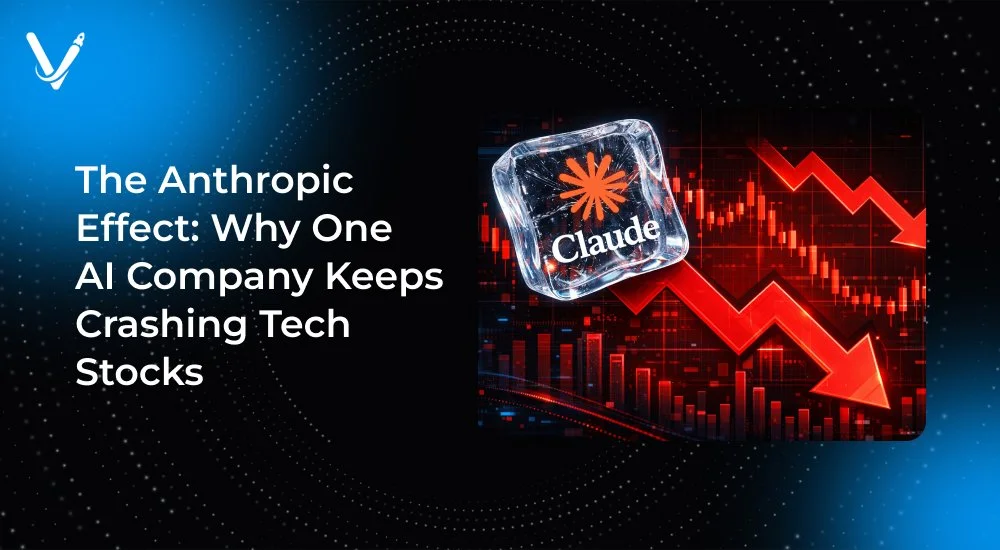
$830 billion erased from stocks over 6 Trading days. When Anthropic announces new AI capabilities, stocks collapse. Tech and service stocks have been decimated $830B from January 31 to date according to Reuters. Analysts have coined the term 'Anthropic Effect.'
Just look at what happened when Claude Code Security launched in Feb 2025, triggering a drop in the Cybersecurity sector of 11%. In Jan 2026, the Claude Cowork plugins caused a $285 billion single-day selloff in the technology sector. The price of IT stocks in India lost $50 billion(past 12 months) – due to Anthropic AI-disruptions – in 2025.
Understanding the impact of the Anthropic Effect will ultimately determine whether founders, CTOs and business owners survive in a new world driven by AI.
Anthropic does not resemble the other AI startups you have seen before. The company recently achieved a $350 billion valuation from TechMarketBriefs, which is almost double its $183 billion valuation only five months ago. Anthropic also had a revenue run rate of $9 billion and more than 300,000 business customers, demonstrating that enterprise AI is being adopted by businesses far more quickly than anyone anticipated.
Why do markets fear Anthropic more than OpenAI? Because Anthropic is focused. While OpenAI continues to pursue consumer-oriented applications of AI, Anthropic is focused entirely on the enterprise software stack. Claude AI is not just a way for a business to chat with an AI; Claude AI is a way for businesses to automate their core business functions that they currently are paying billions of dollars every year to perform manually.
ANCOR has a rapidly rising growth trajectory, which puts it on track for an initial public offering (IPO) in the second half of 2026. This could lead to another wave of volatility in the markets, as investors reconsider the entire software landscape.
When Anthropic launched Claude Code Security, cybersecurity stocks tanked—CrowdStrike dropped 11 percent, Datadog dropped 12 percent, and Palo Alto Networks dropped 3 percent—all during a single session.
The fear was rational, given that Claude Code Security scans codebases for vulnerabilities and suggests patches—directly competing with a core revenue stream for cybersecurity companies. Economic Times The tool identified more than 500 previously unidentified vulnerabilities in live, open-source codebases.
Ironically, Times of India CrowdStrike CEO George Kurtz asked Claude to build him a replacement for CrowdStrike—and Claude declined because it had no way to do real-time threat detection or runtime security—indicating that part of the panic was overblown.
The single-day software market crash generated by Claude Cowork users via plugins totaled more than $600 million in stock value decimation. Companies like Salesforce and Intuit had a drop of 25% and 31%, respectively, in their share prices.
Plugins automate various tasks within an Enterprise's business operations, which creates direct competition to the subscription model of Enterprise software. The S&P Software Index is down 17% as investors are seeing actual evidence of AI replacing traditional business applications.
Finnovate observed that the Indian IT market lost $50 billion in market capitalization in 2025 on credence of Anthropic demonstrating how AI can replace previously human-only tasks for outsourcing companies.
For many businesses in the United States, outsourcing could be a thing of the past unless AI can be created and used to complete complex, technical tasks such as coding, data analysis, and customer support.
The market is anxious about AI and how artificial intelligence will changen the way that companies function; LSEG markets are splitting up companies that will be disruptors from those that will be disrupted.
With the ability to automate software development with AI tools, many software companies are very vulnerable; software products are typically produced on a subscription basis but sophisticated technologies through cloud-based models provide no barriers to entry for competitors to penetrate into the software businesses that investors today have assigned a high premium.
A pattern has emerged: (i) announcement; (ii) swift reaction; (iii) reality check; (iv) stock prices stabilise. Based upon this pattern, software stocks have been reduced with each subsequent chain reaction; thus, the conclusion is that this will result in a fundamental re-pricing of providing a subscription-based service to the market.
According to Reuters, software companies are experiencing a higher cost of borrowing and lenders are becoming more stringent with their due diligence; thus making it very challenging for traditional software companies to raise funds as a result of lenders' broader concerns of how they themselves will adapt to the rapid change in technology resulting from AI.
Partnering with AI development firms to create a competitive edge before disruption occurs is becoming more common among smart businesses. For example, increased demand for AI compute infrastructure will keep companies like NVIDIA thriving.
Companies that are incorporating AI into their products, not just as an addition, are seeing the greatest success. When AI solutions complement human skills, they are most effective.
Software companies that have yet to devise a clear plan for using AI will be the most vulnerable to disruption. Schwab Network In 2021, disruption of economies began with all sectors, including the real estate, transportation, and banking industries, which have all experienced a significant decline in value since their peak 10% in January 2021.
The concept of AI washing — using AI for design but only changing an existing business model by making it appear to incorporate AI — will be especially weak as more savvy investors understand how AI can be successfully integrated into a business.
Machine learning development services are becoming essential for companies seeking to future-proof their operations. Rather than viewing AI as a threat, forward-thinking leaders are leveraging it for predictive analytics and automation to enhance decision-making capabilities.
Anthropic's initial public offering (IPO) expected later in 2026 will add more volatility because investors will directly compare an AI company for the first time. This IPO could create benchmarks for how the market views AI compared to traditional software companies.
One major issue that all U.S. companies must deal with is whether or not they will adapt to that disruption and survive or go extinct. AI continues to change the future of work, and therefore, workforce planning must continue to evolve as companies react to increasing levels of technology integration.
As there continues to be some uncertainty about who the winners will be, there will also continue to be volatility; however, businesses that proactively prepare for and implement AI will be well-positioned for success. Therefore, the question is no longer whether AI will disrupt your industry; instead, it is whether your company will lead the way through that disruption or fall behind.
Are you ready to prepare for the AI revolution? If you are not, partner with an experienced AI implementation consultant who can guide you through the technological and business implications of implementing AI. The current companies that are thriving during this transformation are not the ones simply utilising AI – they are re-imagining their business value offerings around intelligent automation.
The Anthropic Effect is not just a stock market phenomenon; it marks a new reality for commercial businesses, where competitive advantage is established based upon AI capabilities.
Copyright © 2026 Vasundhara Infotech. All Rights Reserved.