SaaS Solutions
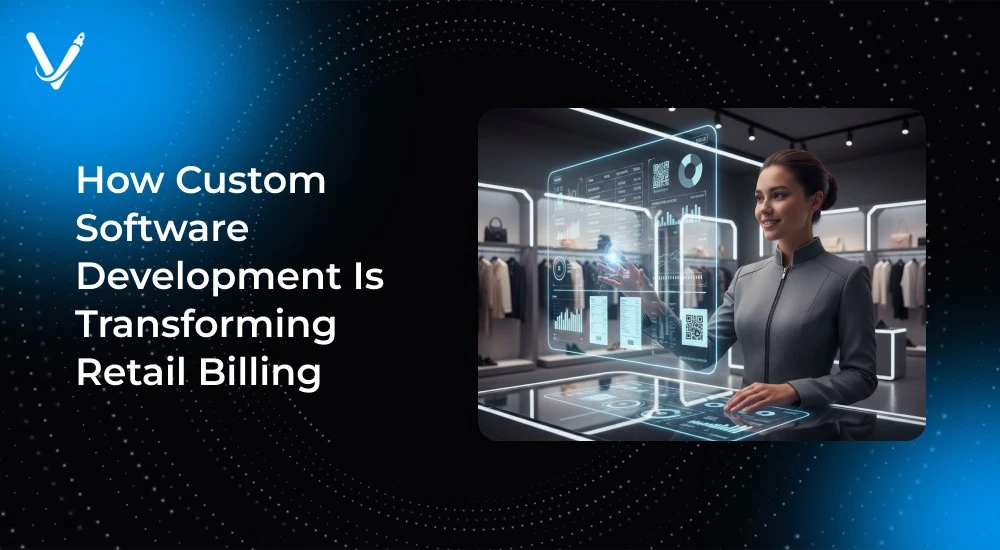
How Custom Software Development Is Transforming Retail Billing

 Feb 17, 2026







In Article:
Enterprise retail chains are moving away from generic billing solutions to custom-built systems that handle their complex operations better. This shift is happening because large retailers need seamless management across multiple locations, better integration with existing systems, and the ability to scale without limits—driving the demand for custom software development for retail industry solutions.
Here's what retail leaders should know:
In 2026, retail billing isn't just about processing sales—it's about creating systems that help businesses grow and compete better.
Small businesses do not have the same problems as large retail chains. According to Forrester, nearly half of the $113 billion that US retailers will spend on technology in 2026 will go toward software.
Overseeing Several Sites. It's difficult to keep everything in sync when you have hundreds or even dozens of stores. Prices, promotions, and tax computations must be the same at every location, but headquarters must also provide real-time updates. This complexity was not intended for standard billing software.
Linking Various Systems Large retailers use a variety of software programs, including inventory management for stock, CRM for customers, and ERP for finances. Due to incompatibilities between most retail billing software and these systems, data may be lost or duplicated.
Growing Without Breaking As retail chains expand, their billing systems need to handle more transactions and more locations. Off-the-shelf solutions often slow down or require expensive upgrades that don't match how the business actually grows.
Following Different Rules Retailers operating in multiple states or countries deal with different tax laws, payment rules, and data protection requirements. Generic billing software for retail shop operations usually can't handle these differences automatically.
Standard billing software functions well for individual stores, but when applied to large retail operations, it exhibits serious issues.
Unable to Modify Your Needs Every major retailer has unique business practices that have evolved over time. Businesses are forced by generic solutions to adapt their tried-and-true procedures to the constraints of the software rather than the other way around.
Issues with Integration Retail businesses have the most trouble with disjointed systems, according to Insight. There are typically few ways for standard retail billing software to interface with other business systems.
Reaches Growth Boundaries The majority of commercial billing systems are made to handle a certain volume of transactions or users. Retailers frequently experience significant cost increases or system lags during peak hours as they expand.
Depends on Outside Companies Using third-party billing software means depending on that company's plans, updates, and stability. Retailers lose control over critical business functions and can face problems when vendors change prices or stop supporting features.
Custom billing solutions solve enterprise problems by creating systems designed specifically for large-scale retail operations.
Built for Your Business Custom development lets retailers keep their existing workflows while making them more efficient. Instead of forcing staff to learn new ways of working, custom solutions improve what already works well.
Connects Everything Custom billing software can connect with any system from day one. This means real-time data sharing between billing, inventory, customer management, and financial systems without manual work.
Grows Without Limits Purpose-built solutions use modern cloud technology that expands with business needs. Adding new stores, processing more sales, or entering new markets doesn't slow down the system or cost extra.
You Stay in Control Retailers keep full control over their billing system, including when updates happen, what features get added, and how data is protected. This control is essential for maintaining smooth operations and competitive advantages.
A custom billing system does much more than just allow a business to process a transaction.
Each company using custom-built billing solutions can view and manage their entire company, not just one store or online store, from one dashboard.
If a business sells a product at any location, then inventory level of that item will be changed in real-time at every location.
Custom retail billing software collects the sales data from each location and generates useful business insights such as product and customer trends, inventory analysis and location performance comparison.
Custom billing systems are designed to be able to accept multiple forms of payment (credit cards, mobile payments, buy now pay later, etc.) and as new payment forms become available.
Custom billing solutions automatically handle tax calculations, regulatory reports, and compliance requirements for the user's jurisdiction/every jurisdiction, eliminating errors and ensuring that rules are consistently followed.
Custom billing solutions can be truly powerful when they connect easily to your pre-existing business systems.
By linking your financial systems together, you will have seamless flows of sales information into your accounting systems, eliminating the need for manual data-entry and allowing you to produce accurate financial reports that include updating ledgers, collecting receivables and creating financial analytics.
The connectivity between your customer system and your purchase order will allow for salespeople to use purchase history to perform more closely targeted marketing, loyalty programs and provide better service. From a salesperson perspective, they are then able to provide your customers with complete history of purchases and transactions.
By connecting the billing systems with your inventory and supply chain, you will automatically reorder inventory when stock levels reach certain thresholds. In addition, you can better coordinate deliveries from supply chains based on the location of your warehouse.
Lastly, transaction data is loaded into your reporting system in order to provide your executives with comprehensive analytical data. This data will help your executives develop better pricing, promotions, inventory level decisions, and expansion strategies.
According to the Logic ERP research, the latest technology in retail billing software provides a large number of cost saving and improvement opportunities for the retailer who uses a complete solution.
Increased Efficiency: A custom billing system will typically provide a quicker checkout (averaging approximately 40% faster) by improving the efficiency of an organization's processes and also through the increased use of automation. This results in increased productivity of staff due to the reduction of manual tasks and a general ease of use of the system.
Reduction in Mistakes: Automated calculations combined with real-time inventory updates and automated compliance checks have been found to significantly reduce billing errors (averaging approximately 60%). This improvement enhances customer satisfaction and reduces the high cost of addressing errors after-the-fact.
Increased Revenue: Better analytical data leads to better pricing decisions, enhanced identification of the retailer’s top-selling items and increased inventory turnover. Many retailers using enterprise-wide inventory systems have already achieved an increase of 15-25% in profit margins via better decision-making.
Reduced Expenses: The combination of automated reporting, compliance management, and data synchronization has greatly reduced the amount of administrative work performed by the enterprise retailer. Many retailers will notice a 30-40% reduction in billing-related expenses in the first year after implementing their wholesale billing system.
Implementing a custom billing system successfully is dependent on careful planning and the execution of steps to minimize disruption to business operations.
Defining and Documenting Requirements First, define and document your current workflows, system interfaces, compliance requirements and business goals. This will help you determine what needs to be customized and how your systems should be interfaced.
Staged Roll-Out of System Typically enterprise roll-outs begin with limited functionality at a small number of test sites to verify and refine the functions of the system before several locations are connected together. By doing this you will limit the exposure to risk and allow improvements to the processes from actual outcomes.
Staff Training With comprehensive training programmes and sufficient change management, your staff will be able to operate the new system effectively and respond positively to changes due to improvements in the way they work. Training will be about the technical operation of the system as well as on optimized workflows.
Thorough Testing of Everything Thorough testing will confirm that things are working properly within the system as well as against the various integration points and with the many different conditions the system will process under. Testing includes transaction processing, validation of integrations, and security testing.
Custom billing systems enable retailers to respond flexibly to the ongoing evolution of retail technology and consumer requirements
Custom payment processing solutions allow retailers to offer new forms of payment as they become available, such as cryptocurrencies, biometric verification systems, and payment through connected devices. By utilizing bespoke solutions, retailers are not required to rebuild their payment processing systems when they add new payment methods.
Custom payment processing systems enable retailers to utilize artificial intelligence in their payment processing systems, providing retailers with competitive advantages over off-the-shelf payment processing systems. Artificial intelligence can be applied to various uses, such as fraud detection, dynamic pricing, customer behaviour analysis, and predicting inventory.
Seamless integration of online and offline sales channels is an easement for retailers using bespoke payment processing systems. Online orders that are picked up in-store, shared customer profiles across multiple sales channels, and consistent pricing across channels are all examples of how retailers can take advantage of the seamless integration provided by bespoke payment processing systems.
Establishing sustainable business practices by utilizing a digital receipt process, eliminating paper-based reporting, and implementing energy-efficient processing methods are all benefits of utilizing sustainable payment processing systems.
Finding an experienced dev. partner is critical to achieving a successful custom-billing implementation.
Retail Experience. Check for experience in enterprise retail projects. An experienced partner will understand multi-location issues, compliance, and integration issues.
Technical Skills. The dev. team must have extensive knowledge of retail billing systems, payment processing, integration of enterprise systems with a large and scalable cloud-based solution, so that the delivered solution will work properly, be secure and perform quickly.
Integration Experience. Verify that the potential partner has experience integrating with other enterprise systems such as ERP systems, CRM systems and BI platforms. Success involves understanding both the tech. and the business side of integration.
Ongoing Support. The custom billing system will require ongoing maintenance, updates and support. You should select a partner that provides full-service support, including monitoring, troubleshooting and feature upgrades.
Custom software development is changing retail billing from basic transaction processing into a strategic business tool that drives efficiency, customer satisfaction, and competitive advantage.
Enterprise retail chains that invest in custom billing solutions position themselves for growth through:
Next Steps:
As retail continues moving toward digital-first operations, custom billing solutions become essential for enterprise retailers committed to long-term success.
In order to develop custom software applications for invoicing, an extensive knowledge of retail operations across various enterprises is necessary; however, the right company will provide a solution to either transform your business or create a financial drain on your business.
At Vasundhara Infotech LLP, we develop custom software applications for leading retailers in the United Kingdom and the United States of America. Our experience will help you develop custom software applications to manage your invoicing operations effectively so that they contribute to your bottom line.
To learn more about how Vasundhara Infotech LLP can help you transform your invoice management processes, contact us today to discuss your invoice management requirements.
Copyright © 2026 Vasundhara Infotech LLP. All Rights Reserved.