


AI/ML
Why Experience Intelligence Is Becoming Essential for AI-Driven Enterprises

 Jun 3, 2026





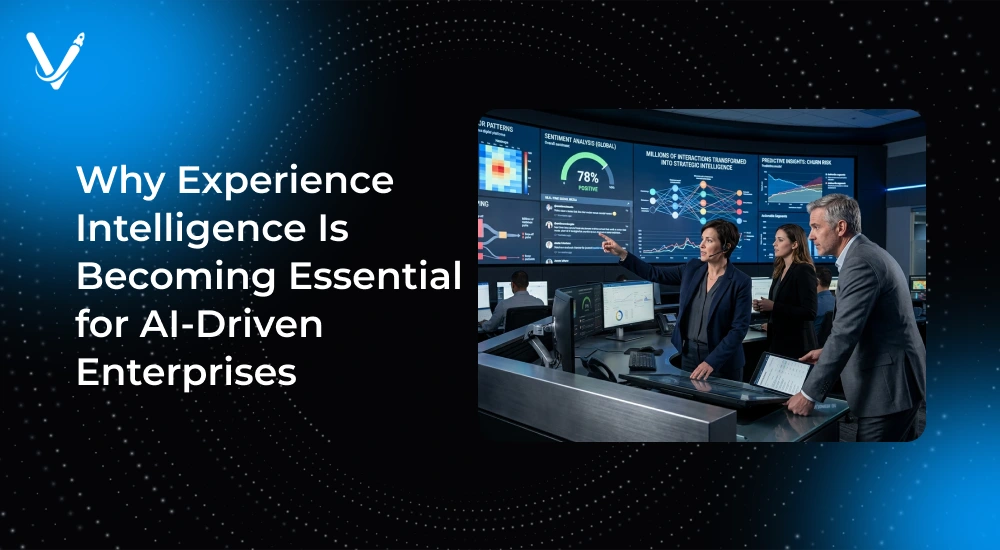
Most companies already collect a lot of data about their customers. Clicks, support tickets, survey scores, app sessions, chat logs. The problem is not a lack of data. The problem is that the data sits in different tools and rarely tells a clear story. Experience intelligence is the practice of pulling all of that together and using AI to explain what people actually feel and do. For businesses that already invest in AI services, it is quickly becoming the missing piece.
This guide explains what experience intelligence is, how it differs from old-style analytics, and why AI-driven enterprises now treat it as essential. We will also look at how it shapes both customer and employee experience, how a platform works under the hood, and what you need to keep in mind for AI compliance.
Experience intelligence is a way of measuring and improving how people experience your brand. It combines behavior data, feedback, and AI analysis in one place. Instead of looking at a single survey or one report, it connects signals from many sources and turns them into clear insights.
Think of it this way. Traditional reports tell you what happened. Experience intelligence tries to tell you why it happened and what to do next. It looks at the full journey, not just one step.
The term covers both sides of a business. On the customer side, people often call it customer experience intelligence. On the staff side, it supports the employee experience. The same idea runs through both. Use AI to understand real human behavior, then act on it.
Traditional analytics is mostly about counting. Page views, bounce rates, ticket volume, sales totals. These numbers are useful, but they are flat. They tell you the score without telling you the game.
Experience intelligence adds context. It links a drop in sales to a slow checkout page. It ties a rise in support calls to a confusing app update. It reads open-text feedback and groups the common themes on its own. This is where artificial intelligence and customer experience start to work as one system.

Here is a simple way to see the gap. Old analytics answers "how many." Experience intelligence answers "how come." That shift matters because most business problems hide in the "how come."
Another difference is speed. Manual reports take days. An intelligent customer experience setup flags issues in near real time, so teams can fix them before they spread.
The market is growing fast. The global customer experience management market was valued at around 15.55 billion dollars in 2025 and is expected to reach 47.72 billion dollars by 2033, according to Grand View Research. That growth is driven by AI, automation, and the push for personal service.
Customer patience is also thin. Zendesk found that 63 percent of consumers will switch to a competitor after just one bad experience. That number has been climbing each year. A single broken flow can cost you a customer for good.
At the same time, customers now expect smart, tailored service. The same Zendesk research found that 61 percent of people expect AI-driven interactions to feel personal to them. Meeting that bar by hand is not realistic at scale. You need artificial intelligence for customer experience to read signals and respond fast.
This is why many firms now build these capabilities with a dedicated AI development company. Stitching tools together on their own rarely works. The goal is one connected view instead of ten disconnected dashboards.
The clearest payoff is on the customer side. Artificial intelligence customer experience tools watch the full journey, from the first ad click to the tenth support chat. They spot friction early.
Say a group of users keep abandoning their cart on mobile. A customer experience intelligence system can flag the pattern, point to the likely cause, and rank it by how much revenue is at risk. Your team fixes the real problem instead of guessing.
It also makes service feel personal. AI can read past behavior and shape the next message, offer, or reply to fit each person. Done well, this builds an intelligent customer experience that feels helpful rather than pushy. The link between artificial intelligence and customer experience is no longer a nice extra. It is the baseline customers expect.
People often forget the staff side, but it matters just as much. Artificial intelligence employee experience tools track how employees move through their tools, tasks, and support systems. They find the slow software, the broken workflow, and the training gap.
This has a direct business effect. McKinsey reports that generative AI can sharply lift agent productivity in customer operations, with documented cases showing real gains in issues resolved per hour. Happier, better-supported staff tend to deliver better service, which loops back to the customer.
When you measure both sides together, the picture gets honest. A frustrated employee often sits behind a frustrated customer. Fix the internal friction and the external experience improves too.
A digital experience intelligence platform follows a simple loop, even if the technology behind it is complex. It collects, connects, analyzes, and acts.
 First it collects signals from many sources. Web, mobile, support, surveys, and product usage all feed in. Next it connects those signals so one user looks like one person, not five scattered records. Then AI analyzes the combined data to find patterns, causes, and risks. Finally it pushes clear actions to the right team, often inside the tools they already use.
Many of these platforms run as cloud software. They fit naturally into modern SaaS solutions and scale without heavy setup. The result is a steady, repeatable way to learn from every interaction and improve it.
Because experience intelligence runs on personal data, compliance is not optional. Rules like the GDPR in Europe set clear limits on how you collect, store, and use customer information. Other regions have their own versions, and they keep getting stricter.
A few practical habits go a long way. Collect only the data you truly need. Tell people what you gather and why. Give them a clear way to opt out. Keep data secure and delete it when it is no longer useful.
Responsible AI also means watching for bias and keeping a human in the loop for big decisions. AI should guide your team, not replace their judgment. Build trust into the system from day one, and compliance becomes far easier to maintain.
Experience intelligence is helping AI-driven enterprises move beyond traditional analytics by uncovering the reasons behind customer and employee behavior. By combining AI, feedback, and behavioral data, businesses can make smarter decisions, improve experiences, and create stronger relationships with their audiences.
As customer expectations continue to rise, understanding experience is becoming just as important as understanding performance. Organizations that invest in experience intelligence today will be better equipped to deliver personalized interactions, increase loyalty, and gain a lasting competitive advantage in the AI era.