The global health and fitness app market is projected to hit $120 billion by 2030, and nutrition and meal planning apps are leading the charge — with user downloads growing over 45% year-over-year. Yet, here is the brutal truth: 78% of founders who try to build their nutrition app end up either overpaying, hiring the wrong team, or watching their project stall mid-development. The reason is almost always the same — they never learned how to hire Cross-Platform Developers the right way. If you are planning to launch a nutrition or meal planning app in 2025 or 2026, this guide will show you exactly how to hire a team that delivers, without wasting time or money.
Why Cross-Platform Is the Smartest Choice for Nutrition Apps
Before we get into the hiring process, you need to understand why cross-platform development is the obvious path for nutrition and meal planning apps. Native development — where you build one app for iOS and a separate app for Android — doubles your costs, doubles your timeline, and doubles your maintenance burden. For a nutrition app that needs to reach both App Store and Play Store users on day one, that math simply does not work for most startups.
Cross-platform frameworks like Flutter and React Native let you build a single codebase that runs beautifully on both iOS and Android, cutting development time by up to 40% and overall costs by 30 to 50%.
Key Benefits of Cross-Platform Development for Nutrition Apps
- Faster time to market — ship on both iOS and Android simultaneously
- Lower development cost — one team, one codebase, one project
- Consistent user experience — identical UI across all devices
- Easier updates — push features to both platforms in one cycle
- Stronger ROI — lower maintenance costs year after year
Must-Have Features in a Nutrition & Meal Planning App
Before you start hiring, you must know what your developers will actually need to build. A modern nutrition and meal planning app goes far beyond a calorie tracker. It is a full, intelligent ecosystem of health data, AI-powered recommendations, and community engagement features.
Core Features Your App Must Have
- User onboarding with health goals — weight loss, muscle gain, maintenance, medical diets
- AI-powered meal recommendations — personalized based on allergies, preferences, and nutritional needs
- Calorie and macro tracking — real-time logging with barcode scanning
- Recipe library and meal planner — customizable weekly plans with grocery lists
- Wearable device integration — Apple Health, Google Fit, Fitbit, Garmin
- Water and hydration tracking — daily goals with smart reminders
- Progress analytics dashboard — weight, measurements, macros, adherence streaks
- Community and social features — progress sharing, challenges, influencer content
- Subscription and payment integration — Stripe, Apple Pay, Google Pay, in-app purchases
- Push notifications and reminders — personalized meal, hydration, and workout alerts
Advanced Features That Separate Winners from Losers
- AI image recognition for food logging — snap a photo, get instant nutrition data
- Voice-based meal logging — hands-free input while cooking or driving
- Integration with grocery delivery services — Instacart, Amazon Fresh, local partners
- Telehealth and dietitian consultations — in-app video with certified professionals
- Gamification — streaks, badges, and rewards to drive daily engagement
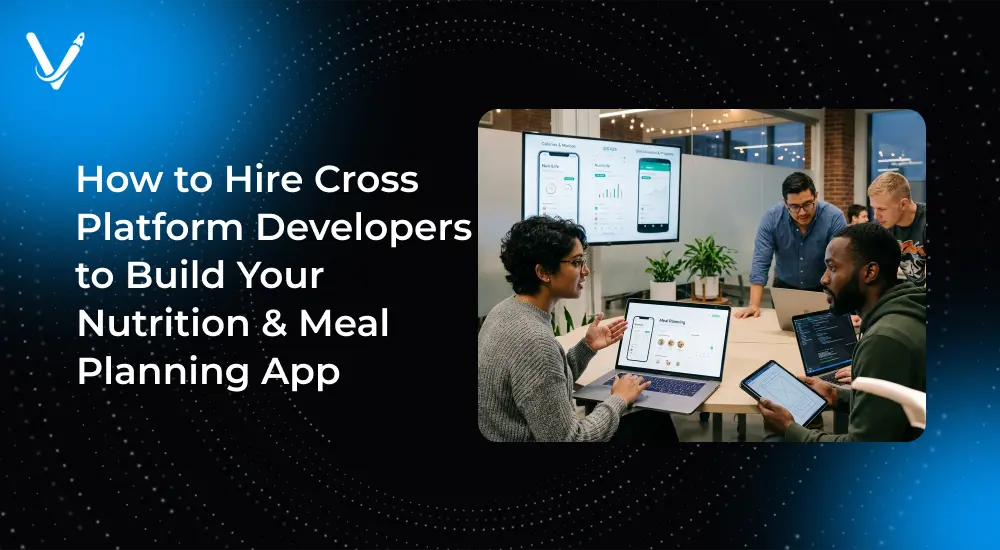
How to Hire Cross-Platform Developers: The Complete Step-by-Step Framework
Now the main part — the exact framework you need to follow to hire cross-platform developers who will actually deliver your nutrition app on time, on budget, and on vision. Skip any of these steps and you are setting yourself up for costly delays.
Step 1 — Define Your Project Scope Clearly
You cannot hire the right developer if you do not know what you are building. Before you talk to any agency or freelancer, write a detailed project brief that covers your target audience, core features, preferred tech stack, timeline, and budget. Be specific. "A nutrition app" is not a scope. "A Flutter-based nutrition app with AI meal recommendations, wearable integration, and a subscription model targeting US millennials" is a scope.
Step 2 — Choose Between Flutter and React Native
Both frameworks are excellent for cross-platform nutrition apps, but they serve different priorities. Flutter, backed by Google, delivers pixel-perfect UI with buttery-smooth animations and is ideal if your app has heavy visual components like interactive meal planners or 3D food visualization. React Native, backed by Meta, has a larger developer community and integrates more easily with existing JavaScript-based web platforms.
Quick Comparison
- Choose Flutter if: you need highly custom UI, 60fps animations, and a premium visual feel
- Choose React Native if: you have an existing web product in React or want access to a larger talent pool
Step 3 — Decide on Your Hiring Model
There are three main ways to hire cross-platform developers, and choosing the wrong one is one of the most common — and expensive — mistakes founders make.
Hiring Models Explained
- Freelancers — cheapest upfront but highest risk; best for small MVPs with $5K–$15K budgets
- In-house team — total control but 3× to 5× more expensive with long hiring cycles
- Dedicated development agency — the sweet spot for most startups; you get a full team of developers, designers, QA engineers, and project managers at a predictable monthly cost
For a serious nutrition app, hiring a dedicated agency with experience in health-tech is almost always the smartest move. You get senior developers, established processes, and a team that can scale with you.
Step 4 — Evaluate Technical Skills
When you are ready to interview candidates or agencies, focus on demonstrable skills. Do not get dazzled by buzzwords. Ask to see real production apps they have built, ideally in the health, fitness, or nutrition space.
Technical Skills to Check
- Strong proficiency in Flutter (Dart) or React Native (JavaScript/TypeScript)
- Experience with state management — Provider, Riverpod, Bloc, Redux, MobX
- Knowledge of REST APIs and GraphQL for backend integration
- Familiarity with Firebase, AWS Amplify, or Supabase for rapid backend development
- Integration experience with Apple HealthKit and Google Fit
- Proven skills in offline mode, push notifications, and in-app purchases
- Understanding of HIPAA and GDPR compliance — critical for nutrition apps handling health data
Step 5 — Check Portfolios and Case Studies
This step alone can save you from 90% of hiring disasters. Any agency or freelancer worth hiring will have a public portfolio of shipped apps. Do not just look at screenshots — download their live apps from the App Store and Play Store, use them for 10 minutes, and judge the real user experience.
Step 6 — Conduct a Technical Interview or Paid Trial
For freelancers and individual developers, always run a technical interview with coding tasks. For agencies, request a paid 2-week trial sprint where they build a small prototype or feature of your app. This is the single most powerful way to test a team's real capabilities before committing to a full project. If an agency refuses a trial, walk away.
Step 7 — Verify Communication and Project Management
Technical skill alone is useless if communication breaks down. During your evaluation, check whether your developers use structured project management tools like Jira, ClickUp, or Asana, and whether they provide daily or weekly standups, sprint reports, and transparent progress tracking. According to Atlassian's State of Agile Report, projects with structured sprint communication are 2.5× more likely to ship on time and on budget.
Cost of Hiring Cross-Platform Developers for a Nutrition App
| Hiring Model | Cost Range | Timeline | Best For |
| Freelance developer | $25 – $60/hour | 4–6 months | Simple MVPs |
| Offshore agency | $3,000 – $8,000/month per developer | 3–5 months | Full-scale apps |
| Onshore US/UK agency | $12,000 – $25,000/month per developer | 3–5 months | Premium or regulated apps |
| Fixed-price project | $25,000 – $120,000 total | 4–8 months | Defined scope builds |
Red Flags to Watch Out for While Hiring
Not every agency or developer that sounds good on a sales call will actually deliver. Here are the warning signs that must make you walk away immediately:
- No public portfolio or live app examples
- Refusal to sign an NDA or IP transfer agreement
- Upfront payment demand of more than 30%
- Vague answers to specific technical questions
- No structured project management or reporting process
- Promises that sound too good to be true — "We'll build your app in 3 weeks for $5K!"
- Zero experience in health, fitness, or nutrition apps
Why Partner with a Specialized Agency Like Vasundhara Infotech
For a nutrition and meal planning app, you are not just building software — you are handling sensitive health data, integrating with wearables, processing payments, and competing against established giants like MyFitnessPal and Noom. This is not a project to hand to the cheapest freelancer on Upwork. You need a team that has shipped production-grade mobile apps, understands cross-platform trade-offs, and can scale with you from MVP to Series A and beyond.
At Vasundhara Infotech, we provide full-stack cross-platform development teams specialized in Flutter and React Native, with deep experience in health-tech, fitness, and nutrition apps. If you want to understand the full Flutter development process end-to-end, read our detailed guide on Flutter App Development Services — or if you prefer React-based stacks, check out our ReactJS Development Services.
Conclusion
Hiring the right cross-platform developers is the single most important decision you will make when building your nutrition and meal planning app. The wrong team will burn your budget, miss your launch window, and damage your brand before you even get to market. The right team will ship a polished, scalable, and secure app that users love and investors notice. Be clear on your scope, choose between Flutter and React Native wisely, evaluate portfolios ruthlessly, and never compromise on communication and process.
Ready to Build Your Nutrition & Meal Planning App?
At Vasundhara Infotech LLP, we help founders, CTOs, and health-tech entrepreneurs launch world-class nutrition and meal planning apps with dedicated cross-platform teams. From strategy to launch, we handle it all.
Hire Cross-Platform Developers from Vasundhara Infotech and let's turn your nutrition app idea into a market-ready product.





 Apr 24, 2026