AI/ML
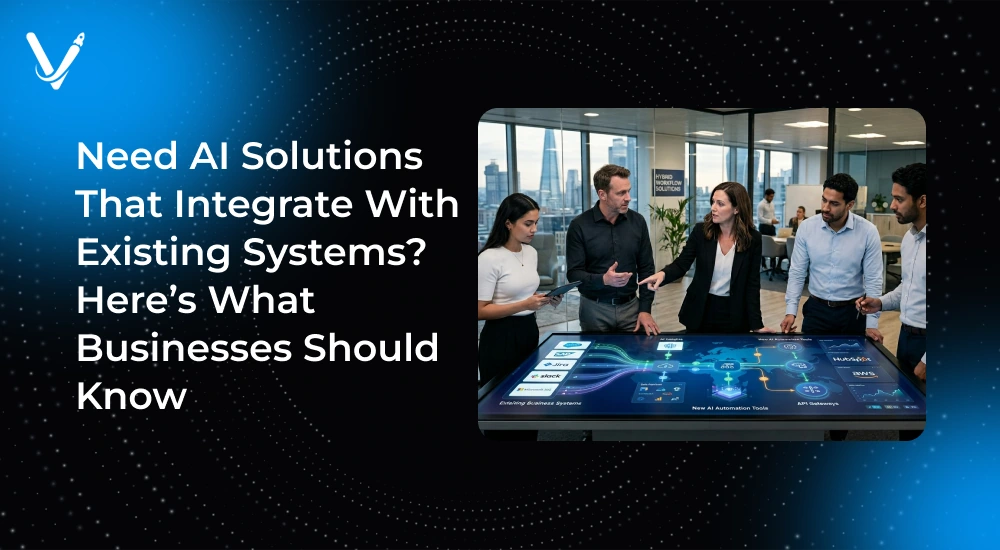
Need AI Solutions That Integrate With Existing Systems? Here’s What Businesses Should Know

 May 14, 2026






Many businesses want to adopt AI but hesitate when they realize how deeply their operations depend on existing software, workflows, and internal systems.
For many companies, replacing current infrastructure is not realistic.
Years of operational data, employee training, custom workflows, CRM systems, ERP platforms, accounting software, and internal tools are already embedded into daily business operations. Replacing everything simply to adopt AI would create unnecessary operational disruption and financial risk.
That is why businesses are increasingly looking for AI integration solutions instead of full system replacement.
In 2026, most companies are not asking:
“Should we replace our systems with AI?”
They are asking:
“How can AI work with the systems we already use?”
This shift has changed how organizations approach digital transformation. Instead of rebuilding operations from scratch, businesses now focus on AI system integration that improves workflows while preserving existing infrastructure.
From AI workflow integration to enterprise automation, businesses are adopting AI as an operational enhancement rather than a complete technology reset.
This guide explains how AI integration works, what businesses should consider before implementation, and why scalable custom ai solutions are becoming essential for modern business operations.
Most businesses already operate on complex technology ecosystems.
A single organization may use:
Replacing all of these systems would create significant operational challenges.
Full system replacement often affects:
Even short periods of downtime can impact revenue and customer experience.
This is why many companies prefer business AI integration that works alongside existing infrastructure.
Businesses have often spent years building operational workflows and collecting internal business data.
Replacing legacy systems entirely may risk:
AI software integration allows companies to improve workflows without discarding valuable operational infrastructure.
When businesses completely replace operational systems, employees usually require extensive retraining.
This affects:
AI integration services reduce this challenge because teams continue working within familiar systems while AI enhances operational efficiency in the background.
Most businesses have already invested heavily in:
AI automation integration helps organizations maximize those investments rather than replace them prematurely.
AI system integration refers to connecting AI technologies with existing business systems, workflows, and operational platforms.
Instead of replacing software entirely, AI integrates into current infrastructure to automate tasks, improve workflows, and support decision-making.
This often includes integration with:
The goal is to improve operational efficiency while maintaining workflow continuity.
Most AI integration solutions use APIs, workflow connectors, and automation frameworks to exchange information between systems.
For example:
This process happens within existing operational infrastructure.
AI workflow integration focuses on automating repetitive operational tasks across departments.
Examples include:
These workflows reduce manual workload while improving operational consistency.
Enterprise AI solutions usually involve larger operational ecosystems where multiple systems must communicate together.
This may include:
The complexity of enterprise AI integration depends heavily on existing infrastructure.
Modern AI integration services support a wide range of business systems.
AI integrates with CRM systems to:
This improves sales efficiency and customer tracking.
Businesses use AI system integration with ERP platforms for:
HR teams use AI automation integration for:
AI-powered support systems can integrate with:
This improves response times and support efficiency.
AI workflow integration supports:
Retail businesses use AI integration solutions for:
AI systems can integrate with:
to automate internal operational workflows.
Businesses invest in AI integration because operational efficiency often matters more than adopting new software systems.
AI automates repetitive operational tasks such as:
This reduces administrative workload significantly.
AI workflow integration helps businesses reduce delays and improve process consistency.
Tasks move faster between departments without requiring constant manual coordination.
AI systems can centralize and analyze information across multiple platforms.
This improves:
AI-powered analytics help businesses process operational information more efficiently.
This improves business responsiveness.
AI automation integration supports:
which improves overall customer experience.
Businesses reduce operational overhead by automating repetitive processes instead of scaling administrative teams continuously.
AI integration solutions help organizations scale operations without rebuilding infrastructure entirely.
Businesses are using AI integration across multiple operational areas.
Companies integrate conversational AI systems with support platforms to:
AI workflow automation helps businesses automate:
AI-powered reporting tools generate:
automatically.
Businesses use AI for:
Sales teams use AI integration services for:
Scheduling automation helps businesses coordinate:
more efficiently.
AI integration creates operational advantages, but businesses should approach implementation strategically.
Older systems may lack modern API support.
This often requires:
Enterprise systems often involve interconnected workflows.
Poor implementation planning can disrupt operational processes.
AI systems frequently process sensitive business information.
Businesses must ensure:
before deployment.
Operational teams may resist workflow changes if communication and training are insufficient.
Employee onboarding remains important during AI adoption.
AI systems require:
to maintain operational accuracy.
Generic automation tools may not fit specialized operational workflows.
This is especially true for enterprise environments with industry-specific requirements.
Successful AI integration starts with operational planning.
Businesses should review:
before implementation.
Focus first on repetitive operational tasks that consume significant time and resources.
Businesses should establish measurable objectives such as:
Scalable solutions support future operational growth without requiring major infrastructure replacement later.
Experienced AI integration partners help businesses:
Businesses should start with smaller AI automation integration projects before scaling across departments.
Every business infrastructure is different.
Operational workflows, reporting structures, software dependencies, and customer processes vary significantly between organizations.
This is why custom AI solutions often provide better long-term results than generic automation software.
Custom AI integration supports:
For enterprise environments, customization becomes especially important when businesses operate across multiple systems simultaneously.
Custom AI solutions also allow organizations to maintain stronger control over operational workflows and future scalability.
AI integration is evolving beyond simple workflow automation.
Businesses are increasingly adopting:
Future enterprise AI solutions will likely combine:
to automate increasingly complex business operations.
At the same time, businesses will continue prioritizing AI systems that integrate into existing operational environments rather than replacing infrastructure completely.
This approach reduces disruption while improving long-term scalability.
Businesses no longer view AI adoption as a complete infrastructure replacement project.
Instead, organizations are focusing on AI integration solutions that improve operational efficiency while preserving existing systems, workflows, and software investments.
AI system integration helps businesses:
However, successful AI integration requires careful planning, workflow evaluation, system compatibility analysis, and long-term operational strategy.
Businesses that approach AI integration strategically are more likely to achieve sustainable operational improvements without disrupting core business functions.
Companies looking to modernize operations through scalable AI integration services, AI automation integration, and custom AI solutions can work with Vasundhara Infotech to build enterprise-ready AI systems that integrate with existing business infrastructure.
Copyright © 2026 Vasundhara Infotech LLP. All Rights Reserved.