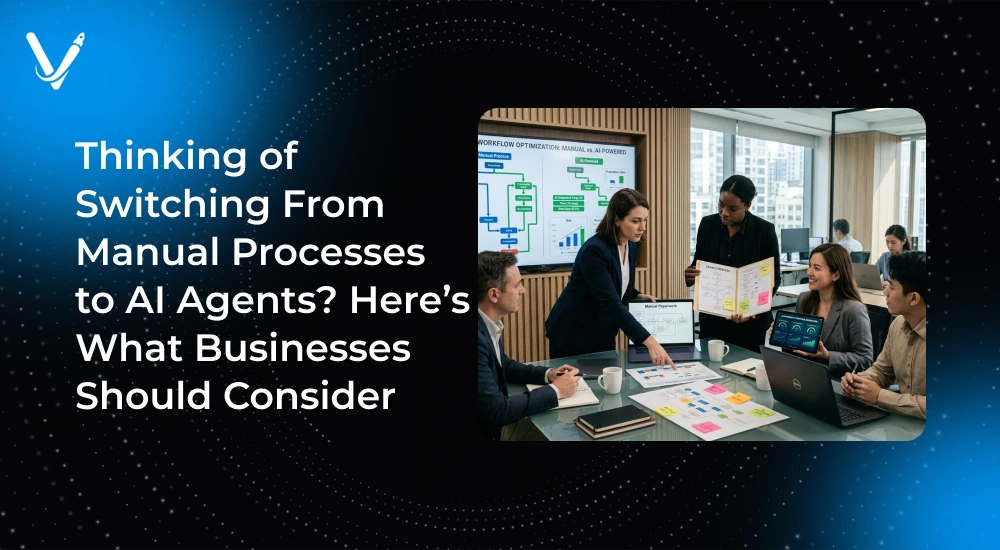
Many businesses still rely on spreadsheets, emails, manual approvals, repetitive customer support tasks, and disconnected workflows to run daily operations.
At first, these systems may seem manageable.
But as operations grow, manual processes often create delays, operational bottlenecks, inconsistent customer experiences, and rising administrative costs. Teams spend more time managing repetitive work than focusing on strategic tasks that actually drive growth.
This is one of the main reasons businesses are investing heavily in AI automation in 2026.
Instead of depending entirely on manual workflows, companies are now using AI agents for business operations, customer support, workflow management, reporting, scheduling, and internal automation.
The shift is not only about reducing workload. Businesses are adopting intelligent automation because it improves scalability, operational efficiency, response times, and decision-making across departments.
However, moving from manual operations to AI business automation requires careful planning.
Not every workflow should be automated. Not every process benefits from autonomous AI agents. And businesses that implement AI without proper operational planning often create more inefficiencies instead of solving them.
This guide explains what businesses should consider before switching from manual workflows to AI agents and how to approach AI process automation strategically.
What Are AI Agents?
AI agents are software systems designed to perform tasks, make decisions, and automate workflows with minimal human involvement.
Unlike traditional automation tools that follow fixed rules, autonomous AI agents can:
- understand context
- process information
- make decisions
- adapt responses
- automate multi-step workflows
For example, a traditional automation tool may only send an email after a form submission.
An AI agent can:
- analyze the inquiry
- categorize the lead
- update CRM records
- assign priority
- schedule follow-ups
- notify sales teams
without manual intervention.
This is what separates intelligent automation from older rule-based automation systems.
Modern AI workflow automation systems often combine:
- machine learning
- natural language processing
- workflow orchestration
- predictive analytics
- conversational AI
to automate operational tasks more intelligently.
Businesses now use AI agents for business functions such as:
- customer support
- appointment scheduling
- lead qualification
- reporting
- HR workflows
- internal operations
- email management
- sales automation
As AI agent development continues improving, businesses are moving beyond simple automation toward systems that can manage operational workflows more independently.
Why Businesses Are Moving From Manual Processes to AI Automation
Manual processes slow businesses down.
As operations scale, repetitive administrative work becomes increasingly difficult to manage efficiently.
This is one of the biggest reasons businesses are investing in AI automation services.
Rising Operational Costs
Hiring additional staff to manage repetitive tasks increases operational expenses.
Many businesses now use AI process automation to reduce dependency on manual administrative work while maintaining operational efficiency.
Workflow Inefficiencies
Manual approvals, delayed communication, disconnected systems, and repetitive data entry often create operational bottlenecks.
AI workflow automation helps businesses streamline these processes.
Customer Expectations Have Changed
Customers expect:
- faster responses
- 24/7 support
- real-time updates
- personalized interactions
Businesses relying entirely on manual support systems often struggle to meet these expectations consistently.
Scaling Manual Operations Is Difficult
As companies grow, manual workflows become harder to manage.
Businesses adopting AI business automation can scale operations more efficiently without expanding support teams at the same pace.
Repetitive Work Reduces Productivity
Employees spend significant time handling repetitive operational tasks such as:
- updating spreadsheets
- responding to repetitive emails
- processing invoices
- managing scheduling workflows
AI automation reduces repetitive workload so teams can focus on higher-value work.
Common Business Areas Where AI Agents Are Used
AI agents are now being implemented across multiple departments and operational workflows.
Customer Support Automation
Many companies use conversational AI agents to:
- answer customer inquiries
- route tickets
- provide updates
- automate support workflows
This improves response times and reduces support workload.
Appointment Scheduling
AI scheduling agents can:
- manage bookings
- send reminders
- handle cancellations
- coordinate calendars
without human involvement.
Lead Qualification
Sales teams use AI agents to:
- analyze inquiries
- qualify leads
- prioritize opportunities
- automate follow-ups
This improves sales efficiency.
CRM Updates and Data Entry
AI agents can automatically:
- update customer records
- sync data
- organize contacts
- track customer activity
This reduces manual administrative work.
Invoice Processing
Finance teams use AI process automation for:
- invoice approvals
- payment reminders
- expense categorization
- document processing
HR Operations
Businesses are also automating:
- employee onboarding
- interview scheduling
- document collection
- internal communication workflows
Internal Reporting
AI automation services help companies generate:
- operational reports
- performance summaries
- analytics dashboards
- workflow insights
in real time.
Benefits of AI Workflow Automation
Businesses investing in intelligent automation usually focus on operational improvement rather than replacing employees entirely.
Faster Operations
AI systems process tasks significantly faster than manual workflows.
This reduces delays across departments.
Reduced Manual Workload
Teams spend less time handling repetitive administrative tasks.
This improves employee productivity and operational focus.
Lower Operational Costs
AI automation helps businesses scale operations without increasing staffing costs proportionally.
Fewer Human Errors
Manual processes often create:
- data inconsistencies
- missed updates
- communication gaps
- processing errors
AI process automation reduces these issues.
24/7 Workflow Execution
Unlike manual teams, AI agents can operate continuously.
This is especially useful for:
- customer support
- lead management
- scheduling systems
- reporting workflows
Better Customer Experience
Faster communication and more consistent service improve customer satisfaction.
Improved Scalability
AI business automation allows businesses to manage larger operational volumes without creating major workflow bottlenecks.
What Businesses Should Consider Before Switching to AI Agents
This is the most important part of AI adoption.
Businesses should avoid implementing automation without evaluating operational readiness first.
Workflow Complexity
Not every process should be automated immediately.
Businesses should identify:
- repetitive workflows
- predictable tasks
- rule-based operations
- time-consuming administrative processes
before implementing AI agents.
Integration Requirements
AI systems often need integration with:
- CRM platforms
- ERP systems
- internal databases
- communication tools
- scheduling software
Poor integration planning can create operational disruption.
Employee Adoption
Employees may resist automation if they feel uncertain about workflow changes.
Businesses should:
- provide training
- explain operational benefits
- involve teams during implementation
to improve adoption.
Implementation Costs
AI automation services require investment in:
- software
- infrastructure
- development
- integrations
- optimization
Businesses should evaluate long-term ROI rather than only short-term costs.
Data Privacy and Compliance
AI systems often process sensitive operational and customer information.
Companies must ensure compliance with:
- privacy regulations
- data protection policies
- security standards
Human Oversight Still Matters
Autonomous AI agents should not operate entirely without supervision.
Businesses still need:
- monitoring
- workflow auditing
- escalation systems
- operational oversight
to maintain quality control.
AI Limitations
AI systems are improving rapidly, but they still have limitations.
Businesses should understand:
- contextual inaccuracies
- automation risks
- workflow limitations
- decision-making boundaries
before deployment.
Challenges of AI Process Automation
AI automation creates operational advantages, but implementation challenges remain common.
Integration Difficulties
Older systems may not support modern AI workflows easily.
Custom integrations are often necessary.
Poor AI Training
AI agents require:
- workflow optimization
- training data
- operational testing
- continuous refinement
Without proper training, automation quality declines.
Over-Automation Risks
Some businesses attempt to automate too many workflows too quickly.
This often creates:
- poor customer experiences
- workflow confusion
- operational dependency
- process inefficiencies
Customer Trust Concerns
Customers still prefer human support in certain situations.
Businesses should maintain clear escalation paths for complex interactions.
Ongoing Maintenance Requirements
AI workflow automation requires:
- monitoring
- updates
- retraining
- optimization
Automation is not a one-time deployment process.
How to Successfully Implement AI Agents in Business
Businesses usually achieve better results when they approach AI implementation gradually.
Identify Repetitive Workflows First
Start with repetitive, high-volume operational tasks.
These usually deliver the fastest ROI.
Audit Current Operations
Review:
- bottlenecks
- delays
- repetitive tasks
- manual dependencies
before introducing AI systems.
Start Small
Pilot smaller automation projects before scaling across departments.
This reduces operational risk.
Define Clear KPIs
Track measurable outcomes such as:
- response times
- processing speed
- operational cost reduction
- workflow efficiency
- customer satisfaction
Choose the Right AI Automation Services
Different businesses require different automation strategies.
The right AI automation services should align with operational goals and workflow complexity.
Work With Experienced AI Development Teams
Strong AI agent development partners can help businesses:
- build custom workflows
- optimize automation
- improve integrations
- reduce deployment risks
Optimize Continuously
AI systems improve through ongoing optimization and workflow refinement.
Businesses should regularly monitor operational performance.
The Future of AI Business Automation
AI business automation is moving beyond basic workflow automation.
Businesses are now adopting systems capable of:
- predictive decision-making
- operational forecasting
- intelligent workflow routing
- autonomous task management
- conversational support systems
Future AI workflow automation systems will likely combine:
- business analytics
- operational data
- customer behavior
- workflow intelligence
to automate increasingly complex business operations.
However, human oversight will remain important for strategic decisions, customer relationships, and operational governance.
The businesses that benefit most from AI automation will likely be those that combine automation efficiency with strong operational management.
Conclusion
Businesses are increasingly moving away from manual operational workflows because repetitive processes slow growth, increase costs, and reduce efficiency.
AI automation helps organizations improve:
- operational scalability
- workflow efficiency
- customer response times
- administrative productivity
- business performance
But successful AI adoption requires more than simply deploying automation tools.
Businesses need:
- clear operational strategy
- workflow planning
- integration readiness
- employee adoption
- continuous optimization
before implementing AI agents at scale.
Companies that approach AI business automation strategically are more likely to achieve sustainable long-term operational improvements.
Businesses looking to modernize workflows and implement scalable AI automation solutions can work with Vasundhara Infotech for AI agent development, intelligent automation systems, and custom workflow automation services tailored to business operations.



 May 13, 2026