


AI/ML
AI Servers & the Water Crisis: 5 Hidden Costs for Startup company

 Jun 18, 2026





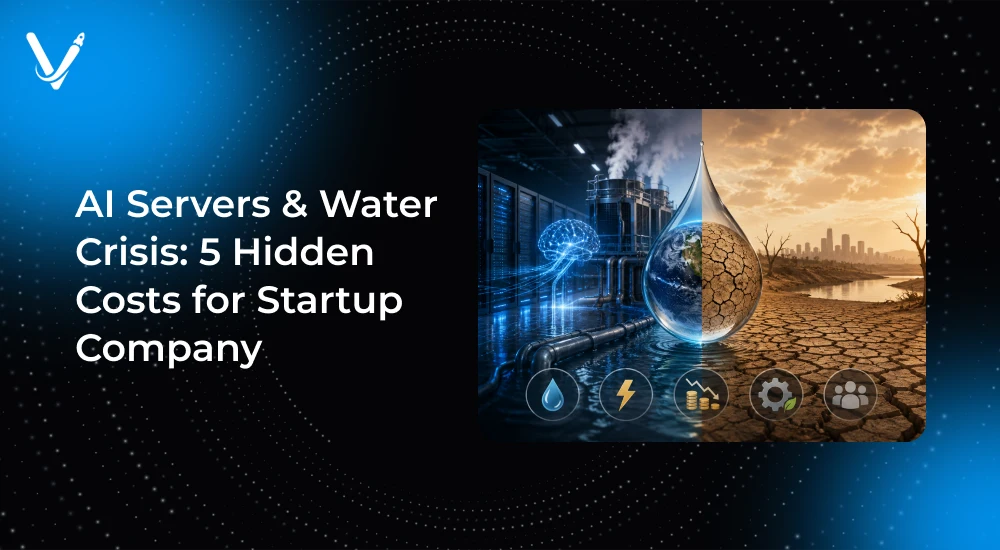
AI data centers drank about 264 billion gallons of water in 2025. That is roughly the yearly water use of 1.8 million people. Every AI server you rely on has a water bill, and most startups never see it.
Here is the part that surprises people. A short chat with an AI tool can use around 500 milliliters of water, about one bottle. That water cools the AI Servers running the model, and more is used to make their power. As AI grows, this hidden cost grows too.
This guide is for startup founders and CTOs who build on AI. We break down the Water Crisis behind AI infrastructure, the five hidden costs it creates for your business, and what you can do. We also cover a fascinating fix that big tech tried and China is now reviving. If you run on the cloud, our DevOps and cloud hosting page is a good place to start. First, the data.
AI runs on huge Data Centers packed with servers. These servers run hot, so they need constant cooling. The most common way to cool them is with water, and that water adds up fast.
The numbers are striking. Per a University of California, Riverside study, training a single large AI model can use about 700,000 liters of fresh water just for on-site cooling. A single large data center can use 1 to 5 million gallons of water a day, the same as a town of tens of thousands of people. About 30% to 40% of a data center's energy goes to Server Cooling alone.
There is also a hidden layer most people miss. The power plants that feed AI Data Centers use water too, often 3 to 4 times more than the cooling water itself. So your AI usage has a water footprint you cannot see on any bill. This is the real Water Crisis side of the AI boom.

So why does this matter for a startup that just uses cloud AI? Because these costs flow downhill to you. Here are the five hidden costs every founder should know about your AI Infrastructure.

Your AI usage drinks water, even though you never see it. Every model you call runs on servers cooled by water and powered by plants that use more. As your usage scales, so does your share of that footprint. It is a real cost to the planet, and increasingly to your brand.
Water and power are getting scarce and costly in many regions. As that strain grows, the cost of Cloud Computing rises with it. Providers pass higher cooling and energy costs down to you. For a startup watching every dollar, this is a quiet but real pressure on your budget.
New rules now require data centers to report their energy and water use. As these rules spread, the pressure moves up the chain to the companies that use them. Soon, customers and investors may ask you to report your own AI footprint. Not being ready is a risk.
Customers care about Tech Sustainability more than ever. If your product runs on AI with a heavy, hidden water cost, that can become a reputation problem. Investors ask too. A clear, honest story about your footprint is becoming part of doing business.
Many big data centers sit in dry, water-stressed regions. Some areas have started to push back, with new limits and slower approvals for water-heavy sites. If your provider faces these limits, you could see higher costs or service strain. Where your compute lives now matters.
Here is where it gets interesting. Years ago, Microsoft tried a bold fix for this exact problem. The project was called Project Natick. The idea was simple but daring: put the servers in sealed pods on the sea floor and let the cold ocean cool them.
It worked well. Microsoft started the project in 2013 and sank a test pod off the coast of Scotland in 2018. After two years underwater, only a handful of servers had failed. The failure rate was about 0.7%, against 5.9% for the same servers on land. The cold seawater cooled the servers naturally, which cut cooling power. Just as important, it used seawater, not fresh water, so it did not add to the freshwater Water Crisis.
So why did Microsoft stop? As Data Center Dynamics reported, the company confirmed in 2024 that it is no longer building underwater data centers. The sealed pods were hard to service and could not be upgraded easily. For the fast-growing needs of modern AI, where you swap in new chips often, fixed sealed pods did not fit. Microsoft kept the lessons but moved on to other cooling ideas, like liquid immersion.
The story did not end there. China has picked up where Microsoft left off. A Chinese firm has deployed a large commercial underwater data center off the coast of Hainan island, and the country has even built one powered by offshore wind. So the underwater idea is not dead. It is being tested again, at scale, as a real answer to the cooling and water problem of AI Servers.
This brings us to compliance, and it is moving fast. Governments now want to know how much energy and water AI infrastructure uses. For startups, this is becoming a real part of doing business with AI.
In the European Union, the rules are already live. Under the EU Energy Efficiency Directive, data centers above a set size must report their energy and water use each year, including a water efficiency score. Some countries, like Germany and France, set the bar even lower. A new EU rating scheme for data centers is due in 2026.
There is also growing pressure from investors. Big cloud firms like Amazon, Microsoft, and Google now face calls to disclose their water and power use. That pressure flows down to the companies that build on them.
Here is what this means for your startup:
• Know your providers. Ask your cloud vendor about their water and energy efficiency scores.
• Track your footprint. Start measuring your AI usage so you can report it later.
• Plan for disclosure. Expect customers and investors to ask about sustainability soon.
The simple message is this. AI compliance is no longer just about data privacy. It now includes the environmental cost of your AI Infrastructure. Getting ahead of it is smart business.
The good news is you have real options, even as a small team. You do not control the data centers, but you do control your choices.
Here are practical steps:
• Pick efficient providers. Choose cloud regions and vendors with strong water and energy scores.
• Right-size your AI. Use smaller models when you can. Not every task needs the biggest one.
• Cache and batch. Reuse results and group jobs to cut wasted compute and cooling.
• Choose greener regions. Run heavy workloads where power is clean and water is plentiful.
• Be transparent. Share your sustainability efforts honestly. It builds trust with buyers.
None of this means avoiding AI. It means using it with care. A good development partner can help you build AI Infrastructure that is both powerful and efficient. Smart choices cut your costs and your footprint at the same time.
AI is changing the world, but it runs on real servers that use real water and power. The water crisis behind AI is a hidden cost, and it lands on startups through higher bills, new rules, and rising scrutiny. The companies that plan for this now will be in a far stronger spot than those that ignore it.
The underwater data center story shows the industry is searching hard for answers, and some are coming back to life. For your startup, the move is simple: understand the cost, pick efficient AI Data Centers and providers, track your usage, and be honest about it. Sustainability is now part of smart engineering.
Want to build AI that is powerful and efficient? Vasundhara Infotech helps startups design lean, scalable, and responsible AI systems. Explore our DevOps and cloud hosting, our AI development services, and our custom software development. Get in touch for a free consultation and a plan built for cost and sustainability.