


AI/ML
Custom Healthcare AI Chatbot Development Services in the USA

 Jun 18, 2026





More than half of U.S. patients now get their health information from a chatbot. And about 68% of healthcare organizations already use AI chatbots in some form. The shift is clear. Patients want fast, around-the-clock answers, and providers need help handling the load.
That is where Custom Healthcare AI Chatbot Development Services come in. A custom chatbot fits your workflow, protects patient data, and works the way your clinic or hospital actually runs. This guide is for healthcare leaders, clinic owners, and healthtech founders in the USA. We cover what these chatbots do, the compliance you must get right, how to choose a partner, and what it costs. Every figure comes from a primary source.
If you want to see how we build these tools, our AI development services page shows our approach. First, let us look at why this market is growing so fast.
The growth is real and well documented. Per Fortune Business Insights, North America holds about 45.6% of the global healthcare chatbots market, the largest share in the world. The U.S. market is growing more than 23% a year. This is one of the fastest-moving parts of digital health.
A few forces are driving it. The U.S. faces a deep shortage of healthcare workers, with millions of staff set to retire this decade. At the same time, patients expect instant, digital-first service. A Healthcare Chatbot fills both gaps. It handles routine work so staff can focus on care, and it answers patients any time of day.
The results back it up. Some U.S. facilities report up to a 40% boost in operational efficiency after adding chatbots. Across the industry, AI tools save about $3.6 billion a year. That is why AI Chatbot Development has moved from a nice idea to a real priority.
A good chatbot does far more than answer simple questions. A custom build, made by an experienced Healthcare Chatbot Development Company, can support patients and staff across the whole care journey. Here are the most common uses.

The chatbot asks about symptoms and guides patients to the right level of care. This helps reduce unneeded visits and points urgent cases to a human fast. About 37% of patients who use healthcare chatbots use them for symptom checks.
Patients can book, change, or cancel visits any time, with no hold music. The chatbot also sends reminders to cut no-shows. This is one of the most popular and useful features of any AI Chatbot Development project in healthcare.
The chatbot reminds patients to take medication and checks in after a visit. This improves adherence and helps with chronic disease care, which keeps patients healthier and out of the hospital.
Chatbots answer routine billing and admin questions, which frees up staff. Some also offer mental health support between visits. These AI Healthcare Software Development features make care more accessible without adding to the team's workload.
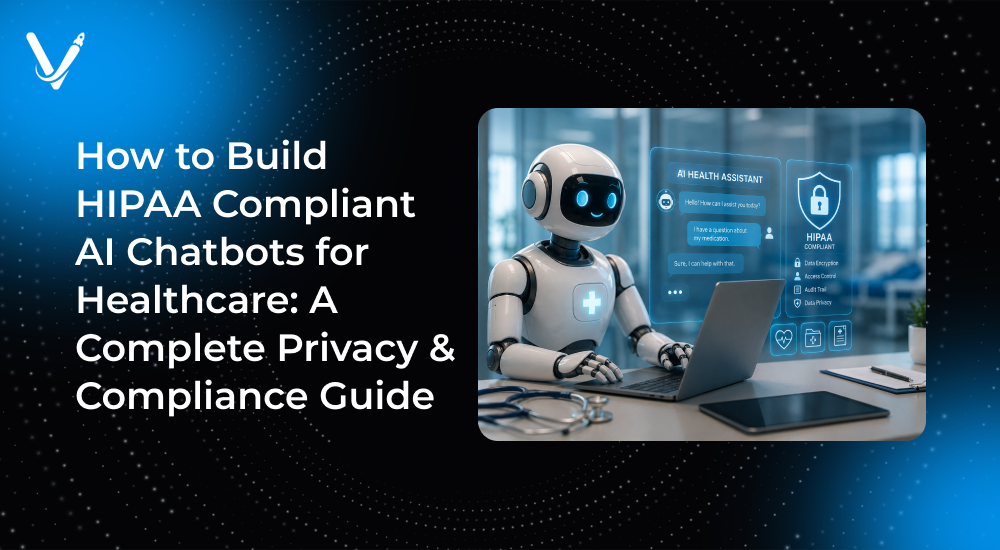
This is the part you cannot get wrong. In the USA, any tool that touches patient data must follow HIPAA. A healthcare chatbot handles names, symptoms, and health records, so compliance is not a feature. It is the starting line. One mistake can mean huge fines and broken patient trust.

A strong AI Healthcare Software Development partner builds these safeguards in from day one:
• HIPAA compliance: Protect all patient health data, with signed agreements in place.
• Encryption: Secure data both in transit and at rest.
• Access control and audit trails:Limit who sees what, and log every action.
• Human escalation. Route urgent or sensitive cases to a real person right away.
There is also a newer risk to manage: AI accuracy. A chatbot must not give unsafe medical advice. Studies have flagged that AI answers can be inconsistent, so a good build keeps the bot inside safe limits and hands hard cases to humans. You can learn the rules straight from the U.S. Department of Health and Human Services. The simple test for any vendor is this: if they cannot explain their compliance clearly, walk away.
Picking the right partner is the most important step. Not every Chatbot Development Company understands healthcare. Use a clear checklist instead of a sales pitch.
Look for these things:
• Healthcare experience: Real medical projects, not just generic chatbots.
• Compliance know-how: Deep, fluent understanding of HIPAA and data security.
• Custom approach: A tool shaped around your workflow, not a one-size template.
• Integration skill: It must connect to your EHR and the systems you already use.
• Support and training: Help for staff to adopt the tool, plus care after launch.
A partner that checks every box is rare and worth the search. As a Healthcare AI Development Company USA clients trust, Vasundhara builds exactly this kind of secure, custom tool. The right team matters far more than the flashiest demo.
Real cases show what is possible. Outside healthcare, Bank of America's assistant, Erica, has handled more than 2 billion interactions and resolves most queries in under a minute. It proves that a well-built chatbot can work at massive scale. Healthcare is now following the same path.
In healthcare itself, large U.S. facilities that added chatbots have reported up to a 40% lift in operational efficiency, per Statista. Some care-plan programs using chatbots have seen engagement rates above 90%. Hospitals use them to ease call center loads, speed up scheduling, and answer common patient questions day and night.
The lesson is clear. The goal is not the flashiest bot. It is one that is safe, accurate, and built for real patient needs. That is what strong Custom AI Chatbot Development Services deliver.
There is no single price. The cost of an AI Chatbot Development project depends on how smart and connected the bot needs to be. A simple FAQ bot costs far less than a custom AI assistant tied into your EHR.
Here is what drives the cost:
• Complexity: a scripted FAQ bot versus a smart AI assistant that understands intent.
• Integrations: linking to your EHR, scheduling, and billing systems adds work.
• Compliance: HIPAA security and audit work is real effort, and it is not optional.
• Support: training, updates, and hosting after launch.
The smart move is to start with one high-value use case, like scheduling or symptom triage, and prove the savings. Then expand. A good ai chatbot development company gives you a clear, written quote before any work starts.
Healthcare AI chatbots are no longer a test. They are a proven way to ease staff workload, cut costs, and serve patients around the clock. The U.S. market is growing fast, and the benefits are real. But patient data is at stake, so the way you build matters more than anything.
Put compliance first. Choose a partner with real healthcare experience. Start small, prove the value, then grow. Do that, and a custom chatbot becomes a safe, powerful tool for your organization. The right Custom Healthcare AI Chatbot Development Services make all the difference.
Ready to build a secure, compliant healthcare chatbot? Vasundhara Infotech builds custom, HIPAA-ready chatbots for U.S. clinics, hospitals, and healthtech startups. Explore our AI development services, our healthcare software development, and our AI development team. Get in touch for a free consultation and a clear plan built around your patients.