AI/ML
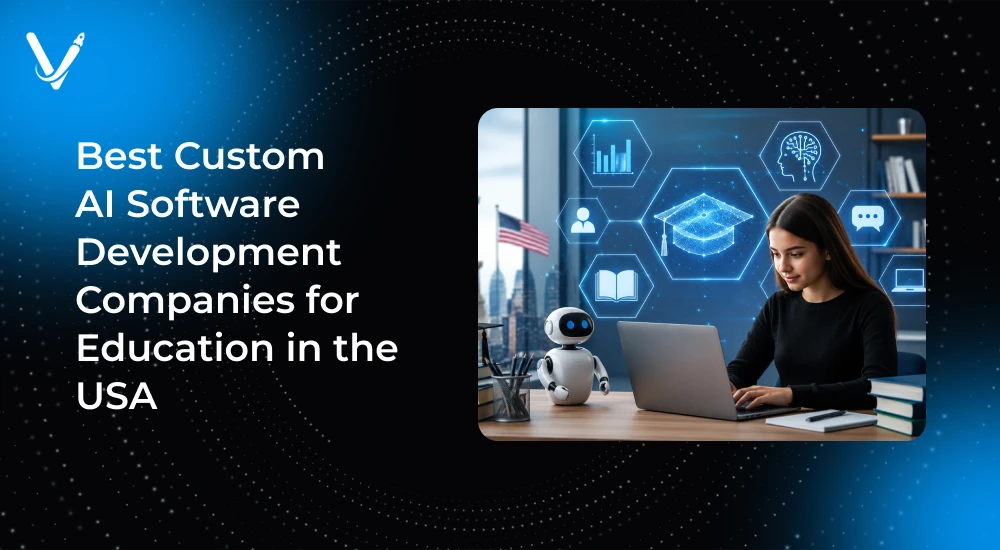
Best Custom AI Software Development Companies for Education in the USA

 Jul 16, 2026






Schools and universities are adopting these tools quickly, and the money shows it.
The AI in education market was worth about $8.3 billion in 2025, according to Grand View Research. It is projected to reach $57.2 billion by 2033, growing at roughly 25.9% a year. North America holds the largest share, and the United States leads inside it.
That growth is why the right build partner matters. A good AI Development Services team ships a product that is accurate, compliant, and easy to run. The wrong one burns your budget and leaves you with a demo that never reaches students.
This guide helps you choose. It covers why AI is changing education, what to look for in a partner, twelve companies worth knowing in the USA, the compliance rules you cannot skip, and real cost ranges.
The platform adjusts to the learner instead of the class average. Weak areas get more practice. Strong students skip ahead. This is the single biggest driver of the market's growth.
AI tutors give one-to-one help at a cost no school could match with human staff. They explain a concept as many times as a student needs, without losing patience.
Every click becomes a signal. Teachers and administrators can see which modules confuse people and which students are drifting, then act before it is too late.
Quizzes grade themselves. Written work gets a first-pass score and feedback in seconds. Staff review the edge cases instead of the whole pile.
Reminders, nudges, and instant answers keep learners moving. Dropout is often a timing problem, and a system that notices silence early can step in.
This shift is global. UNESCO tracks how countries are bringing AI into classrooms, and its work stresses that the technology should support teachers, not replace them. The OECD Digital Education Outlook makes a similar point: AI works best when it sits on clean data and clear rules.
Not every software shop can build for education. The mix of AI skill, data privacy, and classroom reality is specific. Here is what separates a real Education AI Development Services partner from a generic vendor.
Ask what they have shipped in education. A team that has built an LMS or a tutoring app already knows the traps around grading, rosters, and parent access.
Look for real work with language models, recommendation engines, and analytics, not just a landing page that says 'AI'. Ask to see how they handle accuracy and testing.
Student data is sensitive. Encryption, access control, and audit logs should be standard, not add-ons you have to request.
They should raise FERPA and COPPA before you do. A partner who treats compliance as an afterthought will cost you later.
A pilot for 500 students and a platform for 500,000 are different builds. Ask how the system holds up when traffic spikes at exam time.
Most schools already run Canvas, Moodle, or a similar system. Your new tool has to connect to it, or nobody will use it.
AI systems are not projects that end at launch. Models drift, content ages, and rules change. You want a partner who sticks around.
These twelve companies all serve the US education market, either from a US base or through a strong US presence. Details change often, so treat this as a starting shortlist and confirm the current fit with each vendor before you commit.
A quick note on how to read the list. No single company is best for everyone. A funded startup building a consumer app has different needs than a university replacing its LMS. So each entry below lists the kind of client it suits best. Match that to your own project before you shortlist.
For each company you will find a short overview, its core education AI services, its main strengths, and the clients it fits best.
A custom software and AI company. It builds web, mobile, and AI products. That includes learning platforms, tutoring tools, and education chatbots. It has a US office in New Jersey and a delivery team abroad.
Core education AI services: Custom AI development, generative AI, LMS and EdTech app development, AI chatbots, and analytics.
Strengths: Fast delivery, clear pricing, and end-to-end ownership from idea to launch.
Ideal clients: EdTech startups and institutions that want a full-service build partner without enterprise overhead.
A large app and digital product firm that works across industries, including education, on mobile-first learning products.
Core education AI services: Mobile app development, AI integration, and product design for EdTech.
Strengths: Strong design and mobile delivery at scale.
Ideal clients: Funded startups and mid-market companies planning a polished consumer app.
An AI-focused development company known for generative AI and enterprise AI builds across sectors.
Core education AI services: Generative AI, LLM apps, AI tutors, and custom model integration.
Strengths: Deep AI engineering and experience with language-model products.
Ideal clients: Teams that want an AI-first partner for a complex, model-heavy build.
A US-based product engineering firm that builds cloud and AI software for many industries.
Core education AI services: Cloud apps, AI features, and platform engineering.
Strengths: Solid engineering practices and cloud architecture.
Ideal clients: Companies that need a scalable platform with strong DevOps.
A long-established software company with a US presence and a wide services catalogue, including education.
Core education AI services: Custom software, data analytics, and AI development.
Strengths: Breadth of services and a mature delivery process.
Ideal clients: Institutions that value a stable, process-driven vendor.
A US-headquartered digital transformation firm serving enterprise and education clients.
Core education AI services: Custom software, mobile apps, and AI solutions.
Strengths: Enterprise experience and account management.
Ideal clients: Larger organizations running a bigger transformation program.
A product design and development firm with a strong reputation for UX and AI-enabled products.
Core education AI services: Product design, web and mobile builds, and AI features.
Strengths: Design quality and collaborative product work.
Ideal clients: Startups that care deeply about user experience.
A full-service software company with education among its many domains.
Core education AI services: Custom software, e-learning platforms, and AI integration.
Strengths: Wide capability across the software lifecycle.
Ideal clients: Institutions wanting one vendor for a broad scope.
A nearshore development firm focused on AI, data, and web applications for US clients.
Core education AI services: AI and data engineering, web app development.
Strengths: Nearshore collaboration and AI and data focus.
Ideal clients: US teams that want close time-zone overlap.
An AI and product development company that builds generative AI and custom software.
Core education AI services: Generative AI, AI agents, and product development.
Strengths: Focus on newer generative AI use cases.
Ideal clients: Teams exploring AI agents and generative features.
A large software engineering firm with deep technical bench and enterprise clients.
Core education AI services: Custom software, data science, and AI engineering.
Strengths: Strong engineering depth for complex systems.
Ideal clients: Enterprises with demanding technical requirements.
A software company with a background in video, e-learning, and media platforms.
Core education AI services: E-learning platforms, video solutions, and AI features.
Strengths: Experience with learning and video-heavy products.
Ideal clients: Providers building content or video-driven learning tools.
Here is the shortlist in one view, grouped by the kind of team each one fits best.
| Company | Best Fit | Main Strength |
| Vasundhara Infotech | EdTech startups and institutions | Full-service, end-to-end build |
| Appinventiv | Consumer app builders | Design and mobile at scale |
| LeewayHertz | Model-heavy AI products | Generative AI engineering |
| Simform | Cloud platforms | Engineering and DevOps |
| ScienceSoft | Process-driven buyers | Broad, mature services |
| Intellectsoft | Larger enterprises | Transformation programs |
| Netguru | UX-focused startups | Product design quality |
| Itransition | Broad single-vendor scope | Full lifecycle coverage |
| Azumo | US teams wanting overlap | Nearshore AI and data |
| Markovate | Generative AI and agents | Newer AI use cases |
| ELEKS | Complex enterprise systems | Deep engineering bench |
| Oxagile | Video and content learning | E-learning and video |
Use this table to narrow the list to two or three names. Then run a small paid pilot with each before you pick one for the full build. A pilot tells you more than any sales call.
Education handles data about children and young adults, so the compliance bar is higher than in most industries. Get this right from the start, not the week before launch.
In the US, FERPA protects student education records. Any vendor that touches those records needs the right agreements and access controls in place.
COPPA covers data from children under 13. If your product reaches younger students, you need parental consent and strict limits on what you collect.
Collect the minimum you need. Store it only as long as required. Ask whether the vendor trains models on your students' work, and get the answer in writing.
A model trained on one group can misjudge another. Grading and recommendation systems should be tested across different student groups before launch, then checked again over time.
Tell students and parents when AI is involved, especially when it influences a grade. Hidden AI destroys trust fast.
No grade, admission, or disciplinary decision should rest on a model alone. A person signs off on anything that affects a student's record.
The guidance from UNESCO on AI in education is practical: keep humans in control, protect data, and make sure AI narrows gaps between students rather than widening them. It is a good checklist to hold any vendor against.
Cost depends on scope, AI features, integrations, and compliance work. These are working ranges for a competent team, not fixed quotes.
| Solution | Estimated Cost | What Drives It |
| MVP | $20,000 to $80,000 | One core feature, tested with real users |
| AI Chatbot | $15,000 to $50,000 | Number of intents, languages, integrations |
| AI Tutor | $80,000 to $180,000 | Subject depth, feedback quality, testing |
| Learning Analytics | $50,000 to $150,000 | Data sources, dashboards, prediction models |
| Enterprise Platform | $250,000 and up | Scale, governance, multi-tenant, custom AI |
Two things move every range: how clean your data is, and how many systems you have to connect. Budget for the monthly run cost too, because model usage and content review never stop after launch.
One more tip on budgeting. Do not compare a subscription tool's monthly fee to a custom build's project fee. They are different things. Compare the total cost of serving one student over three years. A cheap tool that never fits your workflow often costs more in the end than a custom build that does.
If cash is tight, start with an MVP. Pick the one feature that solves your most painful problem, ship it, and learn from real users. Then spend the rest of the budget on what you know works, not on a wish list copied from a competitor's website.
Vasundhara Infotech builds custom software and AI products for clients across more than 25 countries, with a US office in New Jersey. For education teams, that means one partner who can take an idea from first sketch to a running product.
Its AI Development Services cover what schools and EdTech teams need most. That means adaptive learning, AI tutors, chatbots, and analytics. Each one is built with privacy and testing in mind.
Want language-model features? Its Generative AI Development Services build them. That covers content generation, tutoring assistants, and question banks. Each one ships with the guardrails and human review that education demands.
Sometimes the project is broader than AI alone. Its Custom Software Development Services cover the rest. That means the LMS, the mobile app, and the integrations that hold a learning platform together.
The practical draws are simple: clear pricing, direct communication, and a team that owns the whole build rather than handing you a demo and walking away. For an EdTech startup or an institution taking its first serious step into AI, that end-to-end ownership lowers the risk.
Copyright © 2026 Vasundhara Infotech LLP. All Rights Reserved.