


AI/ML
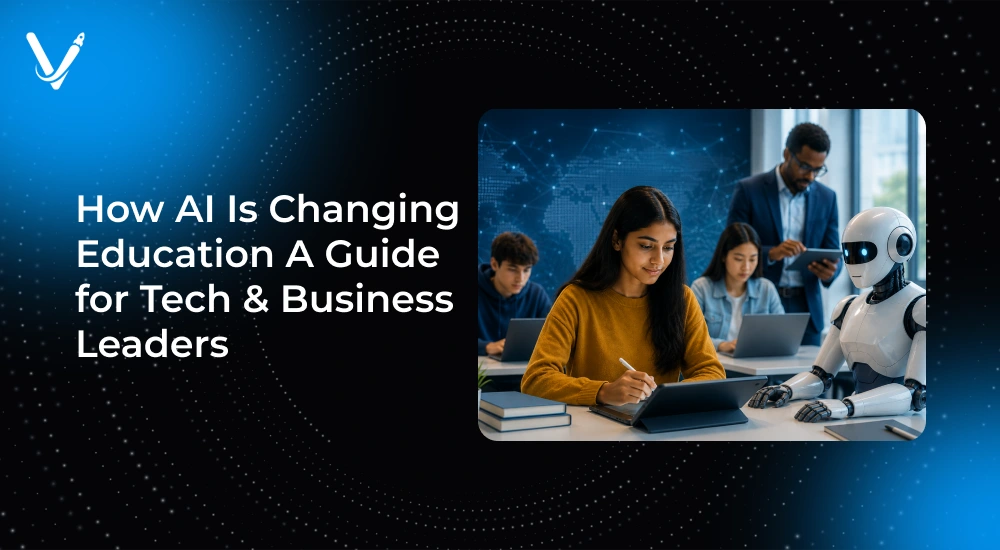
How AI Is Changing Education: A Guide for Tech and Business Leaders

 Jul 13, 2026





Teachers moved too. A Gallup and Walton Family Foundation survey found 60% of K-12 teachers used an AI tool during the 2024 to 2025 school year. RAND put teacher adoption at 53%, up from 25% the year before.
Adoption is no longer the story. What people build next is. Schools, universities, and training providers are already asking software teams for adaptive learning, auto-grading, and analytics, and many are turning to AI development services to get there.
Business leaders should care for one simple reason. The tool that shapes a maths lesson also runs staff onboarding, compliance training, and certification.
Education and workforce development are converging. If your company trains anyone, at any scale, this shift lands on your desk.
The gap between using AI and governing it is still wide. Only about 13% of schools report having a formal AI policy. That gap is a risk and an opportunity.
This guide explains what AI education means, what it changes, what it costs, and what to do about it.
It also means teaching people about AI itself. Both meanings matter to a business leader, because you have to build the tools and train the people who use them.
Older educational technology solutions were digital filing cabinets. They stored courses, tracked completion, and produced a certificate at the end. Every learner saw the same screens in the same order.
AI changes the logic. The system now responds to the individual instead of the syllabus.
• Adaptive learning: the content changes based on what the learner gets right and wrong.
• AI tutoring: a always-available assistant that explains a concept as many times as needed.
• Personalized learning: pace, difficulty, and format tuned to the individual.
• Intelligent content generation: quizzes, summaries, and lesson drafts produced in minutes.
Put together, these four turn a static course into a system that learns about the learner.
The system spots a weak area and serves more practice on it. A strong student skips ahead instead of sitting through material they already know.
Quizzes grade themselves. Written answers get a first-pass score and feedback in seconds. Teachers review the edge cases instead of the whole pile.
A tutor that answers at 11 p.m. costs almost nothing per student. Research published in Nature Scientific Reports found students learned more, in less time, with AI tutors than in comparable class sessions.
Lesson plans, question banks, worked examples, and summaries. In the Gallup survey, teachers using AI weekly reported saving close to six weeks of work across a school year.
Nudges, reminders, and progress feedback keep learners moving. Dropout is often a timing problem, and a system that notices silence early can act on it.
Every click becomes a signal. Institutions can see which modules confuse people, which cohorts fall behind, and which interventions actually work.
AI-powered learning platforms do four things that older systems could not do well.
The platform builds a separate path for each learner from the same course library. One course, many routes through it.
Based on role, skill gaps, and past performance, the platform suggests what to learn next. This is the single biggest driver of completion rates in corporate training.
Difficulty rises and falls with performance. Struggling learners get scaffolding. Fast learners get harder problems instead of boredom.
Instructors and L&D managers see risk early. A dashboard that flags a learner in week two is worth far more than a report card in week ten.
The business case is simple. Educational technology solutions with AI improve outcomes on one side and cut administrative hours on the other. Grading, scheduling, reporting, and support all shrink.
AI grades work and drafts lesson plans. It supports reading practice. It warns teachers early when a child starts to fall behind.
AI sorts applications and helps with research. Chatbots answer student questions. Analytics show which students may drop out.
Role-based learning paths, compliance refreshers, and skill assessments tied to real job tasks.
Adaptive practice exams, question generation at scale, and fraud detection during proctored tests.
The platform suggests the next course. Support runs on its own. Content moves into new languages without a big translation team.
AI is now the product, not a feature. Tutoring apps, writing coaches, and assessment engines are built AI-first from day one.
The market pull is real. The World Bank has spent years documenting how digital learning expands access in places where classrooms and teachers are scarce. Where the infrastructure exists, the software becomes the bottleneck.
People want to learn on a phone, when they choose, with content that fits them. Old platforms cannot do that. So firms replace them.
Skills are aging faster than careers. OECD research on skills and the future of work keeps landing on the same point: reskilling is now continuous, not a one-time event. That turns training into permanent infrastructure.
Large employers now run internal academies. They need learning platforms that track skills, not just course completions.
This is why firms hire an EdTech software development company instead of buying a stock tool. A stock platform rarely fits a real training model. AI application development services let teams build only the parts that differ.
A modern LMS is no longer a content library with a login page. It is a data platform that happens to serve courses.
• Recommendation engine that decides the next best lesson for each learner.
• Automated assessment with instant, specific feedback.
• Student analytics that flag risk before a learner drops out.
• Content generation tools for instructors, with human review built in.
• Learning automation: enrolment, reminders, certificates, and reporting.
Learning management system development today starts with the data model. If the platform cannot track skills and behaviour cleanly, no amount of AI on top will help.
Use this learning management system development requirements checklist when you scope a build or evaluate a vendor.

If a vendor cannot answer all ten in a first call, budget for surprises.
Education handles data about minors. That raises the bar on everything. UNESCO published the first global guidance on generative AI in education, and it is blunt: most countries still lack national rules, which leaves student data exposed and institutions unable to validate the tools they buy.
Collect the minimum. Know where the data sits. Understand whether a vendor trains models on your learners' work, and get it in writing if they do not.
Set rules before rollout. Which tasks may AI do, which need a human, and what happens when a student uses AI to cheat.
Tell learners when they are talking to an AI. Tell them when AI influenced a grade. Silence here destroys trust fast.
A model trained on one population can misjudge another. Test grading and recommendation systems across different groups before launch, then keep testing.
No high-stakes decision, such as a final grade or an admission, should rest on a model alone. UNESCO's guidance also suggests age limits for independent use of generative AI tools.
Depending on where you operate, that may mean GDPR, FERPA, COPPA, or the EU AI Act. Rules are moving. Build the audit trail now so you can prove compliance later.
Parents, unions, and boards will ask hard questions. A clear data policy is not optional, and most institutions do not have one yet.
Student records, HR systems, video tools, and payment gateways all have to talk to each other. Integration usually costs more than the AI itself.
Roughly 70% of teachers worry AI weakens critical thinking. That concern is reasonable. Training and clear boundaries matter more than another feature.
Model usage, storage, and support all cost money every month. Budget for run cost, not just build cost.
AI-generated content can be wrong and still sound confident. Every generated item needs a human reviewer before it reaches a learner.
Course drafts, question banks, and localization in hours instead of months. Teams building this into a product usually work with generative AI development services so the guardrails and review steps are designed in, not bolted on.
Assistants that know a learner's history and stay with them across a whole program, not just one lesson.
Curricula assembled per learner from a bank of modules, based on goals and current skills.
Models that predict who will drop out, weeks before it happens, so support arrives while it can still help.
The LMS becomes the brain rather than the shelf. Most organizations get there through custom software development, because the workflows that matter are the ones no off-the-shelf product ships with.
None of this is science fiction. The pieces exist today. Execution and governance decide who benefits.
List the tasks that eat the most hours. Ask which ones AI can genuinely take. Ignore the rest for now.
Any demo looks good. Ask how the vendor handles your student records, your reporting, and your compliance evidence.
Decide what AI may do, what it may never do, and who reviews its output. One page is enough to start.
Do not rebuild everything. Add personalization and analytics to what you have, prove the value, then expand.
Budget for model costs, content review, and retraining every year. AI systems are not projects that end.
AI has moved from experiment to default in education. Students adopted it first, teachers followed, and institutions are now trying to catch up on policy.
The gains are real. Learning fits the student. Grading runs on its own. Data shows up in real time. Admin work drops. The problems are just as real. Privacy, bias, the cost of linking systems, and teacher trust all need work.
This reaches well past the classroom. The same platforms that shape a school lesson will shape staff training, onboarding, and certification.
Organizations exploring AI-powered learning platforms and educational technology solutions should focus on scalability, personalization, security, and measurable learning outcomes.
If you are planning an LMS build or an AI upgrade to an existing platform, our team can help you scope it around those four things.