


trending blog
Claude Fable 5 vs Claude Mythos 5: 11 Business Challenges CEOs Must Solve Before Adopting Next-Gen AI

 Jun 10, 2026





Both models are not just upgrades. They represent a shift in what enterprise AI can do. But with that power comes real responsibility. CEOs must think carefully before adoption. This guide breaks down 11 core business challenges and how each model fits into real enterprise strategy.
If your business is exploring AI integration, Vasundhara Infotech's AI services can help you plan a smart and safe rollout from day one.
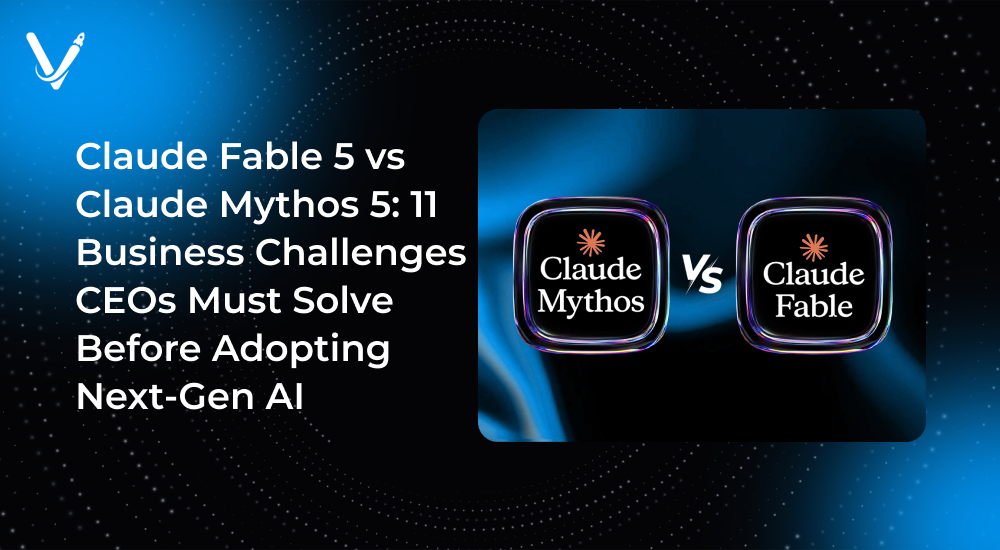
Claude Fable 5 is Anthropic's first broadly available Mythos-class model. It excels at software engineering, knowledge work, vision tasks, and complex reasoning. It has built-in safety limits in high-risk areas like cybersecurity, biology, and chemistry. In those zones, it falls back to Claude Opus 4.8.
Claude Mythos 5 is the restricted version. It remains available only to verified organizations through Project Glasswing. This includes critical infrastructure providers, major software maintainers, and cyber defenders. Mythos 5 is more capable in sensitive domains but requires a higher level of trust and compliance.

Pricing for both models sits at $10 per million input tokens and $50 per million output tokens. That places them at the high end of the market, but below the earlier Mythos Preview pricing.
Many CEOs confuse capability with suitability. Claude Fable 5 is great for internal automation, customer support, and software development. Claude Mythos 5 is built for organizations that need top-tier cybersecurity analysis and critical infrastructure management.
Real Example: Cognizant deployed Claude across 350,000 employees for coding, documentation, and DevOps work. They used Claude Code to speed up engineering workflows. That is a Fable 5 use case, not a Mythos 5 one.
Anthropic has introduced a 30-day data retention policy on all traffic, even for enterprises that previously had zero-retention agreements. The company states this data will not be used for training. It is used only to defend against novel attacks and reduce false positives.
For regulated industries like healthcare, finance, and legal, this matters. Review your contracts and compliance obligations before switching models. Ask your legal team to evaluate whether this policy fits your data governance framework.
AI Compliance Note: Businesses operating under GDPR, HIPAA, SOC 2, or India's DPDP Act must audit how Claude Fable 5 or Mythos 5 handles, stores, and processes sensitive data. The 30-day retention window and hard safety blocks in restricted domains are compliance-relevant design choices.Both models come with built-in hard limits. For Claude Fable 5, responses in high-risk categories like cybersecurity exploits or bioweapon synthesis are automatically blocked. This is a compliance feature, not a bug. It reduces liability for the enterprise deploying the model.
Businesses must also check local AI regulations. The EU AI Act now covers high-risk AI applications. India's draft AI governance framework is gaining speed. Ignoring these adds legal exposure.
Vasundhara's innovation consulting services can help your compliance team evaluate which model tier fits your regulatory environment.
At $50 per million output tokens, these are not cheap models. A CEO must map the use case to the cost before committing. High-volume customer service bots, for example, may be better served by Claude Haiku 4.5 at a fraction of the price.
Claude Fable 5 makes the most sense when the task requires deep reasoning, multi-step work, or persistent memory over days or weeks. Finance agents updating models, sales operations tracking account research, and engineering teams managing migrations all qualify.
Both models support Anthropic's Model Context Protocol (MCP) and the Agent SDK. This means they can connect to your existing data, tools, and applications. But integration is not automatic. Your IT team needs to plan the connection layer.
Real Example: IBM partnered with Anthropic to embed Claude into its integrated development environment (IDE). The rollout started with a select group of customers before scaling. That phased approach kept integration risk low.
Claude Mythos 5 is only accessible through Project Glasswing. If your organization wants access, you must apply through Anthropic's vetting process. This includes proving your role in critical infrastructure or cyber defense. It is not a standard enterprise purchase.
For most businesses, Claude Fable 5 is the right entry point. But access control within your own organization also matters. Decide which teams can use the model, what prompts are allowed, and how outputs are reviewed.
Relying on a single AI provider carries risk. Anthropic is preparing for a major IPO and has a revenue run rate crossing $47 billion. That signals stability. Still, a smart CEO evaluates alternatives and avoids deep architectural lock-in.
Use abstraction layers in your tech stack. Build your internal workflows so that swapping the underlying model does not require a full rebuild. This also gives you leverage in vendor negotiations.
Deploying Claude Fable 5 for business use cases means your people need to know how to prompt it well. Bad prompts produce bad results. This is not an IT problem alone. It requires HR, operations, and leadership alignment.
Real Example: Deloitte rolled out Claude to nearly 500,000 employees globally. That required structured onboarding, prompt guidelines, and ongoing support. Without training, enterprise AI adoption stalls or produces inconsistent output.
Claude Fable 5 shows 3x better use of persistent memory compared to Claude Opus 4.8. This means it performs significantly better in long-running agentic tasks. Tasks that span days or weeks, such as managing a software migration or tracking a sales pipeline, become more accurate with Fable 5.
However, agentic AI needs human oversight checkpoints. Define where the model acts alone and where a human must review. This is both a risk management step and a compliance requirement under emerging AI governance frameworks.
Claude Code Mythos is Anthropic's command-line coding tool that works with both Fable 5 and Mythos 5. For developer-heavy organizations, this is a major productivity lever. It handles coding tasks, testing, documentation, and DevOps workflows.
Real Example: ServiceNow deployed Claude to power customer-facing applications and boost internal productivity. Developer velocity and code quality both improved after integrating Claude Code into their engineering workflow.
Looking to build AI-powered software faster? Explore Vasundhara's web development services to see how our engineers integrate tools like Claude Code into production systems.
Every major AI rollout that has succeeded started with a controlled pilot. Define your use case, pick a small team, measure output quality, and then expand. IBM, Cognizant, and Deloitte all followed this path.
For Claude Fable 5 business use cases, a good pilot might involve a legal research assistant, a customer support responder, or an internal knowledge base agent. Measure accuracy, time saved, and user satisfaction before rolling out across departments.

AI compliance is no longer optional. With Claude Fable 5 and Mythos 5 entering enterprise systems, governance must catch up. Here is what matters most in 2026.
• The EU AI Act classifies certain AI uses as high-risk. Hiring, credit scoring, and medical diagnosis all fall under this. If your Fable 5 deployment touches any of these, you need a conformity assessment.
• India's Digital Personal Data Protection Act (DPDP) requires clear consent for personal data processing. AI agents that access customer records must comply.
• Anthropic's built-in safety blocks for Claude Fable 5 reduce some compliance burden. The model will not produce outputs in cybersecurity attack planning, biology, or chemistry without restrictions. This reduces liability but does not replace your internal AI policy.
• Document your AI usage. Keep logs of what the model does, what it is asked, and what it outputs. This is a core requirement under most emerging AI governance frameworks.
• Appoint an AI governance lead if you do not have one. This person owns the policy, monitors model behaviour, and manages regulatory communication.
Anthropic has also stated that the 30-day data retention applies even to previous zero-retention enterprise customers. This is a critical compliance change. If you had zero-retention agreements, review them now.
Claude Fable 5 and Claude Mythos 5 are not just better AI models. They are the beginning of a new era in enterprise AI adoption. The difference between a business that benefits and one that struggles is not the model chosen. It is the preparation that happens before deployment.
Solve the 11 challenges outlined in this guide. Understand your compliance obligations. Start with a pilot. Train your people. And partner with experts who have done this before.
Vasundhara Infotech has been building intelligent digital products since 2013. Reach out through our contact page to start your AI adoption journey today.