Introduction
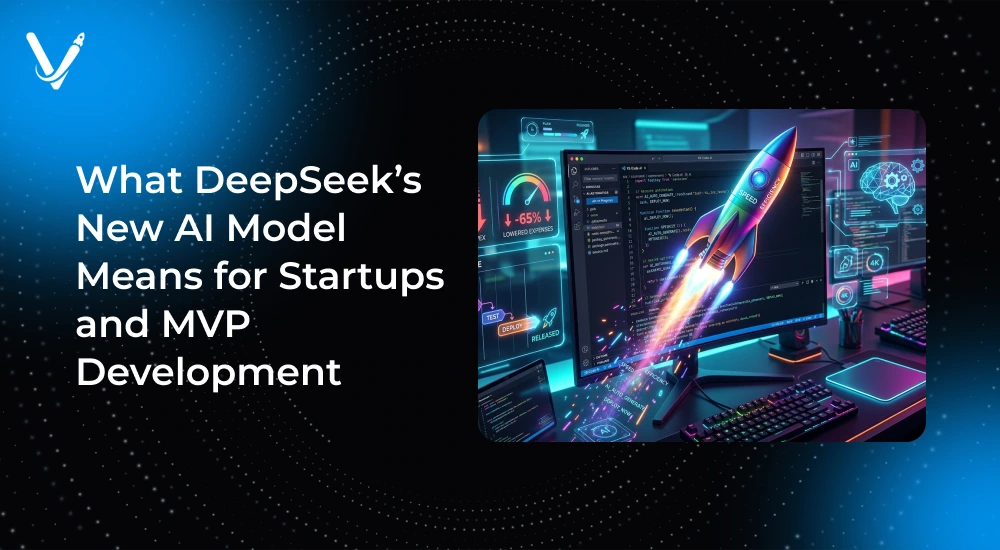
The release of a new model from DeepSeek is more than another update in the AI race. It signals a shift in how startups can build, test, and launch products. For years, advanced AI capabilities were limited to companies with large budgets and strong infrastructure. That gap is now shrinking.
For founders and product teams, this matters at a practical level. Faster development, lower costs, and more flexibility are no longer future promises. They are becoming standard expectations. The DeepSeek AI model for startups is part of this shift, and it is already influencing how MVPs are built in 2026.
Understanding DeepSeek’s New AI Model
DeepSeek’s latest model focuses on efficiency and accessibility rather than just raw performance. While many AI companies compete on benchmark scores, DeepSeek is competing on cost-to-performance ratio, which is far more relevant for startups.
Key Features
- High-level reasoning capabilities comparable to leading models
- Lower inference and training costs
- Open or semi-open approach for developer access
- Strong coding and automation support
These features make it easier for small teams to integrate AI into their products without heavy infrastructure investment.
What Makes It Different
Unlike platforms such as OpenAI, which operate largely in closed ecosystems, DeepSeek leans toward openness and cost efficiency. This allows startups to experiment more freely and avoid vendor lock-in early in their journey.
The result is a model that is not just powerful, but usable at scale for early-stage companies.
Why This Matters for Startups
Startups operate under tight constraints. Every decision impacts runway, growth, and survival. AI models that reduce friction can significantly change outcomes.
Speed
AI integration that once took months can now be implemented in weeks. Teams can prototype features like chatbots, recommendation engines, or automation workflows quickly.
This directly improves time-to-market, which is critical in competitive spaces.
Cost
The cost of AI development has historically been a barrier. With newer models like DeepSeek, startups can reduce spending on APIs, infrastructure, and engineering time.
Lower costs also mean more room for experimentation without risking the entire budget.
Flexibility
Startups need freedom to pivot. Open or flexible AI models allow teams to customize solutions instead of relying on rigid APIs. This flexibility supports faster iteration and better product-market fit.
Impact on MVP Development
The biggest shift is happening in how MVPs are built. AI is no longer an add-on feature; it is becoming a core component of product strategy.
Faster Validation
Startups can now test ideas quickly using AI-powered prototypes. For example, a SaaS tool can launch with built-in automation or AI insights from day one, rather than adding them later.
This speeds up feedback loops and helps founders validate ideas earlier.
Reduced Development Cycles
Traditional development cycles required separate teams for backend logic, automation, and user experience. AI reduces this complexity by handling multiple layers of functionality.
This leads to shorter build cycles and faster releases.
Lower Risk
When costs and time are reduced, the risk of failure decreases. Startups can afford to test multiple ideas instead of betting everything on one product.
This is why AI for MVP development is becoming a standard approach rather than an advanced strategy.
Cost Advantage and AI Accessibility
One of the most important aspects of DeepSeek’s model is affordability. AI is no longer limited to well-funded startups.
Traditional AI Cost Structure
In the past, startups had to deal with:
- High API costs
- Expensive cloud infrastructure
- Large engineering teams
This made AI adoption difficult for early-stage companies.
New Cost Dynamics
With models like DeepSeek, costs are significantly lower. This changes how startups plan their budgets.
Instead of allocating a large portion of funds to AI infrastructure, teams can invest more in growth, marketing, and user acquisition.
Accessibility Impact
Affordable AI tools are democratizing innovation. Smaller startups can now compete with larger companies by building intelligent features from the start.
This shift is redefining AI in startups 2026, where access matters more than scale.
Open-Source vs Closed AI Models
The debate between open and closed AI systems is becoming more relevant for founders.
Strategic Comparison
Open models offer flexibility and control, while closed models provide stability and managed services. Each approach has its place depending on the startup’s goals.
- Open models allow customization and cost savings
- Closed models offer reliability and ease of use
When Startups Should Choose What
Startups building highly customized products may benefit from open systems like DeepSeek. On the other hand, teams that need quick deployment with minimal setup might prefer platforms like OpenAI.
The decision should depend on technical capability, budget, and long-term vision.
Compliance and Risk Considerations
As AI adoption grows, compliance becomes a critical factor. Many startups overlook this in early stages, which can lead to serious issues later.
Data Privacy
Startups must ensure that user data is handled responsibly. This includes following general principles similar to GDPR, such as data minimization and transparency.
Even at the MVP stage, collecting unnecessary data can create legal risks.
AI Transparency and Ethics
Users should understand how AI is being used in a product. Lack of transparency can reduce trust and lead to ethical concerns.
For example, if AI is making recommendations or decisions, users should be aware of it.
Security Risks
Using external or open-source models introduces security considerations. Startups need to ensure that data is not exposed or misused.
This includes secure API usage, proper access control, and regular monitoring.
Why Compliance Matters Early
Ignoring compliance during MVP development can create long-term problems. Fixing these issues later is often more expensive and complex.
Building compliance into the product from the start ensures smoother scaling and better investor confidence.
Challenges and Limitations
While DeepSeek’s model offers many advantages, it is not without challenges.
First, open or flexible models may require more technical expertise. Startups without strong engineering teams may struggle to implement them effectively.
Second, performance consistency can vary. Closed platforms often provide more stable outputs, which can be important for certain applications.
Finally, the ecosystem around newer models is still evolving. Documentation, tools, and community support may not be as mature as established platforms.
Understanding these limitations helps startups make informed decisions rather than chasing trends.
Strategic Takeaways for Founders
To make the most of this shift, founders need a clear strategy.
- Focus on solving real problems, not just adding AI features
- Use AI to accelerate MVP development, not complicate it
- Balance cost savings with reliability and performance
- Plan for compliance from the beginning
- Continuously test and iterate based on user feedback
The goal is not to adopt AI for the sake of it, but to use it as a tool for faster growth and better products.
Conclusion
The rise of DeepSeek reflects a broader change in the AI landscape. Advanced capabilities are becoming more accessible, affordable, and flexible.
For startups, this creates new opportunities to build smarter products with fewer resources. The DeepSeek AI model for startups is not just a technical upgrade; it is a shift in how products are designed and launched.
Teams that adapt early can move faster, reduce costs, and gain a competitive edge. Those that ignore these changes may find themselves struggling to keep up.
For founders looking to turn these opportunities into real products, working with an experienced development partner can make a significant difference. Vasundhara Infotech helps startups build AI-powered MVPs that are scalable, cost-efficient, and aligned with compliance requirements so you can move from idea to launch with confidence.




 Apr 24, 2026