AI/ML
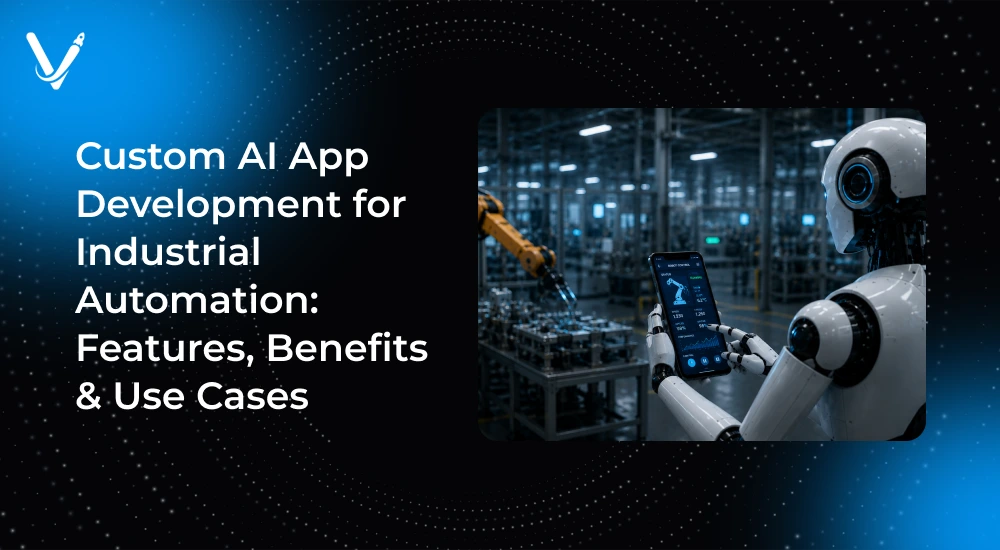
Custom AI App Development for Industrial Automation: Features, Benefits & Use Cases

 Jul 24, 2026







Unplanned downtime now drains about $1.4 trillion a year from the world's 500 largest companies. That is 11% of their total revenue, up from 8% in 2019. The figures come from the Siemens True Cost of Downtime 2024 report. In car plants, a single idle line can cost up to $2.3 million per hour.
Those numbers explain the rush into factory AI. But most plants do not need one more dashboard. They need software that matches their machines, their data, and the way their teams already work. That is the case for custom AI app development. Our
Deloitte surveyed 600 manufacturing executives in 2025. Only 29% had AI or machine learning running at facility or network level. Yet 80% said they plan to put a fifth or more of their improvement budget into smart manufacturing. The gap between interest and real use is where the money is.
This guide covers what custom industrial AI apps are, where they pay off, how to build one, what they cost, and which rules apply.
Custom AI app development for industrial automation means building software around one plant's machines, data, and workflows. It uses machine learning, computer vision, and predictive analytics. Unlike packaged tools, a custom app connects to existing SCADA, MES, and ERP systems and solves problems those systems cannot handle on their own.
Most factories already run software. They have a SCADA system, a historian, maybe an MES, and an ERP. What they lack is a layer that reads all that data and tells someone what to do next. A custom app fills that gap.
Packaged industrial software assumes clean data and standard equipment. Real plants rarely look like that. A 22-year-old press sits next to a machine bought last year. Tag names differ by line. Quality logs live in a spreadsheet.
Here is how the two options compare in practice.
| FACTOR | OFF-THE-SHELF PLATFORM | CUSTOM AI APP |
| Fit to your process | Generic rules and fixed models | Built on your own failure and defect data |
| Legacy machine support | Often needs newer controllers | Retrofit sensors and protocol bridges |
| Cost model | Licence per asset or per user, forever | One build cost, then support |
| Data ownership | Vendor cloud, vendor terms | Your servers or your cloud account |
| Change speed | Wait for the vendor roadmap | Change when the process changes |
Off-the-shelf tools are fine for standard needs like basic monitoring. Custom industrial AI software development earns its place when the problem is specific and expensive.
The AI is only useful if it can read machine data and write back to the systems people already use. In most builds, that means these links.
• PLC and SCADA data pulled through OPC UA, Modbus TCP, or MQTT.
• Historian records for months of past machine behaviour.
• MES and ERP for work orders, batches, and cost data.
• Edge gateways so models keep running when the network drops.
• Vision cameras mounted on the line for defect checks.
• Machine learning: learns normal machine behaviour and flags drift.
• Computer vision: reads parts, labels, welds, and safety gear from camera feeds.
• IoT integration: collects live signals from sensors and controllers.
• Predictive analytics: turns past data into a forecast of what breaks next.
• Intelligent automation: raises the work order without waiting for a person.
Industry 4.0 solutions link machines, data, and people into one loop. Sensors and networks form the base. Custom AI apps sit on top as the decision layer. Without that layer, most plants collect data they never act on.
The push is not about technology fashion. It is about four cost lines that keep rising: downtime, scrap, energy, and labour. AI automation services target all four.
The World Economic Forum tracks a group of advanced factories called the Global Lighthouse Network. Sites in the latest group reported an average 40% rise in labour productivity and 48% shorter lead times. Across the wider network, the World Economic Forum reports gains above 50% in productivity and above 80% in defect reduction.
Predictive maintenance is the clearest win. McKinsey operations research reports that predictive maintenance typically cuts machine downtime by 30% to 50% and extends machine life by 20% to 40%. Siemens data shows the shift is already visible. Large plants now average 25 downtime events a month, down from 42 in 2019.
Human inspectors miss defects on fast lines. They also disagree with each other. Computer vision for manufacturing checks every part the same way, at line speed, on every shift. It also logs each decision, so quality teams can trace a customer complaint back to a specific hour of production.
Skilled operators spend hours copying numbers into forms. AI takes over the reading, sorting, and reporting. That matters because staffing is tight. Close to half of the manufacturers in Deloitte's 2025 survey reported real trouble filling production and operations roles.
Smart manufacturing solutions put OEE, scrap, energy, and order status in one place. A plant head can see a problem during the shift rather than in next month's report. That change alone often pays for the build.
Take a mid-size injection moulding plant. Cycle times drift as tools wear. Scrap climbs slowly, then a tool fails and a line stops for a day. A custom app watches cycle time, pressure, and part weight, then warns the tool room two weeks early. The fix moves from emergency to planned.
These are the use cases that plants fund most often. Each one starts with a cost, not with a technology.
Business challenge: Machines fail without warning and stop the line.
AI solution: Predictive maintenance software reads vibration, temperature, current, and sound, then flags the patterns that lead to failure.
Operational outcome: Fewer emergency repairs, longer asset life, and planned shutdowns.
Business challenge: Manual checks are slow and miss small defects.
AI solution: Vision models inspect every unit for cracks, gaps, colour drift, print errors, and bad welds.
Operational outcome: Lower scrap, fewer returns, and a full record of what shipped.
Business challenge: Schedules break the moment one order changes.
AI solution: Models forecast demand, machine availability, and changeover time, then suggest a workable sequence.
Operational outcome: Better throughput and fewer late deliveries.
Business challenge: Too much stock ties up cash. Too little stops production.
AI solution: Forecasting models set reorder points by part, supplier lead time, and usage.
Operational outcome: Lower carrying cost with fewer stock-outs on critical spares.
Business challenge: Robots repeat fixed paths and cannot handle variation.
AI solution: Vision and learning models let robots find, sort, and place parts that sit off position.
Operational outcome: More tasks automated without retooling the whole cell.
Business challenge: Energy bills are large and poorly understood.
AI solution: Models tie consumption to specific machines, shifts, and product runs, then flag waste.
Operational outcome: Lower cost per unit and clearer sustainability reporting.
Business challenge: Supplier delays surface too late to react.
AI solution:
.Models score supplier risk and predict late shipments from past performance.
Operational outcome: Fewer stoppages caused by missing material.
Business challenge: Unsafe acts are only found after an incident.
AI solution: Vision models watch for missing safety gear and restricted zone entry.
Operational outcome: Fewer incidents and better evidence for safety audits.
These overlap. A vision system that finds defects also feeds the maintenance model, since many defects start with a worn machine. We cover the full set on our industrial automation solutions page.
Different plants need different models. The application shell around those models looks fairly similar.
• Real-time analytics: live machine data processed in seconds, not overnight.
• AI dashboards: one view per role, from operator to plant head.
• Predictive alerts: warnings with a confidence score and a likely cause.
• Automated reporting: shift, quality, and energy reports built without manual entry.
• Machine monitoring: asset health, run hours, and OEE tracked per line.
• AI vision systems: camera feeds scored at line speed with defect images stored.
• Workflow automation: alerts that raise work orders and route approvals.
• ERP and MES integration: two-way links so AI output lands in systems people already use.
This is the sequence we follow on enterprise AI development services projects. Skipping steps two and five causes most failures.
1. Business discovery. Pick one costly problem. Agree the metric you will move and the number you must beat. Two to three weeks.
2. Data collection and audit. Check what sensors exist, what the historian stores, and how clean the quality logs are. Many plants find gaps here. Fixing them early is cheaper than fixing them later.
3. AI model selection. Match the method to the problem. Anomaly detection for machine health. Classification for defect types. Forecasting for demand and spares.
4. Application development. Build the interface, alert logic, user roles, and reporting around the model. This is standard custom software development work with an AI core.
5. Industrial system integration. Connect to PLCs, SCADA, MES, and ERP. Decide what runs at the edge and what runs in the cloud.
6. Testing. Run the model beside the current process for four to eight weeks. Compare its calls against what actually happened. Do not go live on a model nobody has checked.
7. Deployment. Start on one line. Keep a human in the loop for any decision that touches safety or scrap.
8. Continuous optimization. Retrain on new data. Track false alerts. Roll out to more lines once the first one holds up.
A single-line pilot usually takes three to five months. A plant-wide rollout takes twelve to eighteen.
The table below sets out the benefits that show up most often, with the ranges reported by published research.
| Benefit | What it looks like on the floor | Reported range |
| Less machine downtime | Failures caught days or weeks early | 30% to 50% lower (McKinsey) |
| Longer asset life | Repairs done before damage spreads | 20% to 40% longer (McKinsey) |
| Higher productivity | More output from the same shift pattern | Up to 40% at leading sites (WEF) |
| Better quality control | Every unit checked, not a sample | Large defect reductions at Lighthouse sites (WEF) |
| Lower operating cost | Less scrap, less overtime, less rush freight | Varies by plant and baseline |
| Faster decisions | Problems seen during the shift | Varies by plant and baseline |
| Improved worker safety | Unsafe acts flagged in real time | Varies by plant and baseline |
Be careful with the ranges. They come from plants that had a poor baseline and strong execution. A site with a mature maintenance programme will see smaller gains. Build your business case on your own downtime cost per hour, not on someone else's percentage.
This section is short on theory and long on what you actually have to do. Set the rules before the first model goes live, not after an auditor asks.
Plant networks were never built for internet traffic. Keep OT and IT networks separated. Use IEC 62443 as the reference standard for industrial control system security. Any AI gateway on the plant floor is a new attack surface, so treat it like one.
Decide who can see machine data, who can change a model, and who can override an alert. Log every model decision with a timestamp and the input data. If an AI call contributes to a bad batch, you will need that record.
Two references cover most of what a manufacturer needs. ISO/IEC 42001 sets out an AI management system, similar in structure to ISO 27001. The NIST AI Risk Management Framework gives a practical way to map, measure, and manage AI risk. Neither is mandatory in most countries. Both make audits far easier.
Any decision that affects safety, product release, or a person's job needs a human sign-off. Models should also explain themselves in plain terms. "Bearing temperature and vibration both moved outside normal range over six days" is useful. A confidence score alone is not.
The EU AI Act came into force in August 2024 and sorts systems by risk level. Some industrial uses fall into the high-risk group, including AI built into regulated machinery and safety components. The timeline has shifted. Under the Digital Omnibus agreement reached in May 2026, high-risk duties for stand-alone Annex III systems now apply from 2 December 2027, and for AI embedded in regulated Annex I products from 2 August 2028. Transparency duties under Article 50 still apply from 2 August 2026.
These dates have moved once and could move again. If you sell into the EU, check the current position with your legal team before you plan a compliance budget.
• Write down which decisions the AI can make alone and which it cannot.
• Keep a model inventory with owner, purpose, training data, and last review date.
• Test models for drift on a fixed schedule, not only when someone complains.
• Know where plant data is stored and which country it sits in.
• Tell operators how the system works. Hidden AI creates resistance.
Older machines have no data ports. Retrofit sensors and protocol converters solve most of it. Budget for that in the pilot.
Missing tags, wrong units, and gaps in history are common. A simple model on clean data beats a strong model on bad data.
Operators ignore alerts they do not trust. Bring maintenance and quality staff into testing and let them mark false alerts. That feedback improves the model and builds trust.
Cameras, edge devices, and network upgrades add up. Start with one line so the spend stays bounded and the result is measurable.
Models decay as products and machines change. Treat retraining as a running cost, like calibration.
Every new connection widens exposure. Segment networks, restrict remote access, and patch on a fixed schedule.
The technology is rarely the hard part. Shift routines and escalation rules change too. Name an owner on the plant side who is accountable for the result.
Plenty of firms build AI. Fewer have stood on a plant floor. Use these criteria.
• Manufacturing experience: ask for projects on real production lines, not demos.
• AI expertise: ask how they handle imbalanced defect data and model drift.
• Industry 4.0 knowledge: they should discuss OPC UA, historians, and edge deployment without prompting.
• Integration capability: check that they have connected to SCADA, MES, and ERP before.
• Security standards: ask about OT and IT separation and their own security practices.
• Long-term support: confirm who retrains models and what that costs each year.
1. What data do you need from us before you can commit to a number?
2. What happens if the pilot does not hit the target metric?
3. Who owns the model and the training data at the end?
4. How do you handle a plant that has no historian?
On cost, a single-process automation build often lands between $50,000 and $150,000. Mid-level projects with predictive maintenance and live dashboards usually run $150,000 to $500,000. Plant-wide programmes go beyond that. The range is wide because scope, integration depth, and data condition drive it.
Agents that plan and act, not only predict, are entering scheduling and maintenance work. Deloitte reports that 22% of manufacturers plan to use physical AI within two years, up from 9% today. Full autonomy is still rare. Narrow autonomy inside one process is already real.
A digital twin mirrors a line in software. Teams test a schedule change or a new part before touching the real machine.
Inspection and safety models are moving onto devices at the line. Decisions land in milliseconds and survive a network drop.
The next step joins demand signals, plant capacity, and supplier risk into one plan. Analytical AI and machine learning now make up around 62% of solutions at Lighthouse sites, with generative AI at 23%.
Custom AI app development is no longer a research project for large manufacturers. Downtime costs keep climbing. Skilled staff are hard to hire. Packaged tools do not fit older plants. Custom industrial AI software development answers all three, but only when it is aimed at one measurable problem.
Start small. Pick the line that costs you the most when it stops. Clean the data. Run a pilot beside the current process. Set governance rules before go-live, not after. Then scale what works.
Manufacturers planning Industry 4.0 initiatives should invest in custom AI applications that solve specific operational challenges, integrate with existing industrial systems, and deliver measurable business outcomes over the long term.
If you want a second opinion on where AI would pay off first in your plant, our team is happy to look at your data and scope a pilot. Start with our industrial automation solutions page.
Copyright © 2026 Vasundhara Infotech LLP. All Rights Reserved.