AI/ML
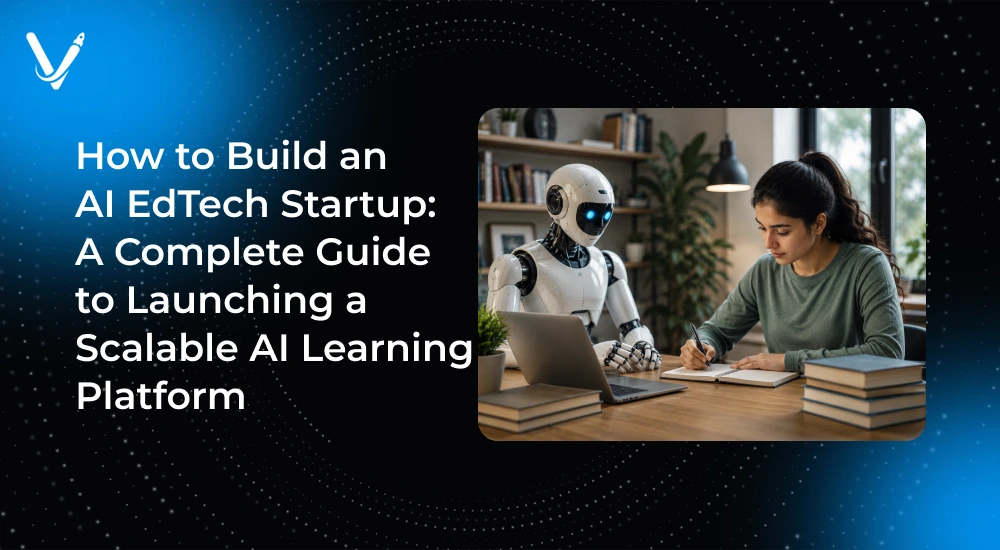
How to Build an AI EdTech Startup: A Complete Guide to Launching a Scalable AI Learning Platform

 Jul 24, 2026







In Article:
The AI in education market hit $7.05 billion in 2025. By 2035, it is expected to cross $136 billion. That is not a slow trend. That is a massive shift in how the world thinks about learning. Investors are writing bigger checks for AI-first education startups. Schools, universities, and corporate training teams are actively looking for platforms that adapt to each learner instead of treating everyone the same.
If you are a founder thinking about building an AI-powered learning platform, the timing is right. But the execution is hard. Most EdTech startups fail not because the idea is bad, but because the product does not solve a real problem, or the technology does not scale. This guide walks you through every step, from validating your idea to choosing the right AI development services, building an MVP, and scaling your platform.
We will cover market data, feature planning, technology choices, development costs, compliance rules, and the mistakes that kill early-stage EdTech products. Whether you need generative AI development services for content generation or custom software development for a full learning management system, this guide gives you a clear path forward.
The numbers tell the story. Global EdTech spending reached $189 billion in 2025, and the AI segment is growing at a 34% compound annual rate. North America accounts for 38% of the AI education market. Asia-Pacific is the fastest growing region. Corporate training, K-12, and higher education are all moving toward AI-first solutions.
Investor interest is strong. EdTech funding bounced back after the post-pandemic dip. Deals are now focused on AI tutoring, adaptive assessments, and personalized learning paths. Companies like Duolingo, Khan Academy, and Squirrel AI have shown that AI-powered educational technology solutions can reach millions of users while keeping learning outcomes measurable.
The demand side is equally strong. Teachers are overwhelmed. Classrooms have 30 students with different learning speeds, different gaps, and different goals. AI is the only way to deliver personalized instruction at scale. That is the core opportunity for anyone building AI development services for education.
Start by picking one audience. K-12 students? University learners? Corporate employees? Test prep candidates? The mistake most founders make is trying to serve everyone at once. A math tutoring app for middle school students is a clearer product than a "learning platform for all ages."
Talk to teachers, students, and administrators. Find out what is broken. Is it grading? Is it student engagement? Is it the lack of personalized feedback? Your AI features should fix something specific, not add complexity for the sake of technology.
Map out what existing platforms do well and where they fall short. Look at pricing, features, user reviews, and retention rates. If three competitors already do what you are planning, find a gap they are missing.
Run surveys, build a landing page, or offer free workshops. Get 50 to 100 people to tell you they would pay for your product before you write a single line of code.
Your minimum viable product does not need every feature. It needs one AI-driven capability that proves your idea works. An AI tutor that explains math concepts. A chatbot that answers student questions. A quiz engine that adapts to performance. Start small and iterate.
When planning AI-powered learning platform development, these are the features that matter most to users and investors:
• AI Tutors: Virtual tutors that explain concepts, answer follow-up questions, and adjust explanations based on the student's level. AI tutoring platform development is now the most funded category in EdTech.
• Personalized Learning Paths: The system analyzes each student's strengths and weaknesses and creates a custom study plan. This is the core of personalized learning platform development.
• AI Chatbots: 24/7 student support for enrollment questions, assignment help, and administrative tasks. AI chatbot development for education reduces support costs by 40% to 60% in most deployments.
• Adaptive Assessments: Tests that get harder or easier based on how the student is performing, giving more accurate results than fixed-format exams.
• Learning Analytics: Dashboards that show teachers which students are struggling, which topics need more coverage, and how the class is progressing.
• AI Content Generation: Tools that help instructors create quizzes, summaries, flashcards, and lesson plans from existing material.
• Student Progress Tracking: Visual timelines showing completed modules, scores, time spent, and predicted outcomes.
• Instructor Dashboard: A control center where teachers manage courses, review AI recommendations, and override automated decisions when needed.
Your technology choices affect how fast you can build, how well you can scale, and how much it costs to maintain. Here is a practical breakdown:
| Layer | Recommended Tools | Why It Matters |
| Frontend | React, Next.js, Flutter | Fast, responsive interfaces for web and mobile |
| Backend | Node.js, Python (Django/FastAPI) | Handles API logic, user management, data flow |
| AI Models | OpenAI API, Hugging Face, TensorFlow | Powers tutoring, content generation, assessments |
| Cloud | AWS, Google Cloud, Azure | Scalable hosting, storage, and compute |
| Database | PostgreSQL, MongoDB, Redis | Stores user data, learning records, session states |
| LMS Integration | xAPI, LTI, SCORM | Connects with existing learning management systems |
| Security | OAuth 2.0, AES-256, SOC 2 | Protects student data and meets compliance rules |
Pick tools your team knows well. A Django backend with PostgreSQL is a solid choice if your engineers are Python developers. If your team is stronger in JavaScript, go with Node.js and MongoDB. Do not pick a stack because it sounds impressive. Pick it because you can ship fast with it.
Define your audience, learning objectives, and competitive advantage. Interview at least 20 potential users. Document their pain points.
Design wireframes and prototypes. Test them with real users before building anything. A confusing interface kills EdTech products faster than bad AI.
Build one core feature with AI. Deploy it to a small test group. Measure engagement and learning outcomes. This is where custom AI development services matter most. The team building your MVP needs to understand both education workflows and AI model integration.
Connect your AI models to the platform. This could mean plugging in a large language model for tutoring, training a recommendation engine for content suggestions, or deploying a computer vision model for handwriting recognition. Education software development services should include model testing with real student data.
If your platform needs to work with existing school systems, add LTI or SCORM support. This lets teachers use your AI tools inside their current LMS without switching platforms.
Run automated tests, load tests, and user acceptance testing. Test AI outputs for accuracy, bias, and edge cases. An AI tutor that gives wrong answers will destroy your reputation overnight.
Deploy to production. Start with a limited rollout. Monitor performance, error rates, and user feedback closely for the first 30 days.
Collect data, retrain models, and ship updates every two weeks. The best EdTech platforms treat launch as the starting line, not the finish line.
Costs depend on scope, team location, AI complexity, and infrastructure choices. Here is a realistic breakdown:
| Component | Estimated Cost (USD) | Notes |
| MVP (3-4 months) | $25,000 - $60,000 | One AI feature, basic UI, core backend |
| Full Platform (6-12 months) | $80,000 - $300,000 | Multiple AI features, dashboards, integrations |
| AI Model Development | $15,000 - $80,000 | Custom training, fine-tuning, testing |
| Cloud Infrastructure (yearly) | $5,000 - $30,000 | Hosting, storage, compute for AI workloads |
| Third-Party APIs (yearly) | $3,000 - $20,000 | LLM APIs, speech-to-text, analytics tools |
| Maintenance (yearly) | $10,000 - $40,000 | Bug fixes, updates, model retraining |
Offshore development teams in India or Eastern Europe typically cost 40% to 60% less than US-based teams, with comparable quality for most EdTech projects. The biggest cost driver is AI model complexity. A simple chatbot costs far less than a fully adaptive learning engine.
Challenge: Teachers cannot give individual attention to 30 students with different skill levels. Solution: AI tutors that adapt explanations in real time. Platforms like Khan Academy's Khanmigo already do this. Outcome: Students learn at their own pace with instant feedback.
Challenge: High dropout rates and low engagement in large lecture courses. Solution: AI-powered study assistants that summarize lectures, generate practice questions, and flag at-risk students. Outcome: Better retention and higher course completion rates.
Challenge: One-size-fits-all training programs that waste employee time. Solution: Personalized learning paths based on role, skill gaps, and career goals. Outcome: Faster onboarding and measurable skill development.
Challenge: Students do not know which topics they are weakest in. Solution: Adaptive practice tests that focus on weak areas and skip mastered topics. Outcome: Higher test scores with fewer study hours.
Challenge: Lack of conversational practice outside the classroom. Solution: AI conversation partners that simulate real-world dialogue and correct pronunciation. Outcome: Faster fluency with daily practice.
Challenge: Certification exams are expensive and failure rates are high. Solution: AI-driven study plans that predict readiness and recommend when to take the exam. Outcome: Higher first-attempt pass rates.
If you are building an AI platform that handles student data, compliance is not optional. It is a requirement from day one. Here is what to plan for:
UNESCO has published AI competency frameworks for students and teachers, calling for human-centered and rights-based approaches to AI in education. Their 2025 report warns that without proper safeguards, AI in education risks deepening the digital divide rather than closing it.
The OECD Digital Education Outlook 2026 found that generative AI can support learning when guided by clear teaching principles. But it also warned that outsourcing tasks to AI without pedagogical guidance leads to performance gains with no real learning. In short, AI should help students think, not think for them.
The World Bank reported that as of 2025, over 94% of its education projects included an EdTech component. Their focus on digital readiness highlights how important it is for AI education platforms to work across different infrastructure levels, including low-bandwidth environments.
• Student Data Privacy: Collect only what you need. Encrypt it in transit and at rest. Let parents and students control their data.
• FERPA (US): If you serve US schools, you must comply with the Family Educational Rights and Privacy Act. Student records are protected.
• GDPR (EU): If you serve EU users, you need explicit consent, data portability, and the right to delete.
• Human Oversight: AI should recommend, not decide. Teachers must be able to override AI-generated grades, feedback, and assessments.
• Transparency: Students and parents should understand how AI makes decisions about learning paths and performance predictions.
• Bias Reduction: Test your AI models across demographics. If your tutor works better for native English speakers than for ESL students, that is a product defect, not a feature.
• Building too many features: Ship one feature that works. Then add the next. Feature bloat kills early-stage products.
• Ignoring user feedback: Talk to your users every week. If teachers say the dashboard is confusing, fix it before adding new AI models.
• Poor AI data quality: Your AI is only as good as your training data. If you train a tutor on low-quality content, it will give low-quality answers.
• Weak scalability: Build for 10x your current user count from the start. Rearchitecting later is expensive and slow.
• Underestimating compliance: A single data breach involving student records can end your company. Budget for security from day one.
• Lack of product validation: If you skip user research and jump straight to development, you will build something nobody wants.
• Multi-Tenant Architecture: Build your platform so each school or organization gets its own workspace without needing a separate deployment.
• Cloud Infrastructure: Use auto-scaling groups and container orchestration (Kubernetes or ECS) so your platform handles traffic spikes without crashing.
• AI Optimization: Cache frequent AI responses. Use smaller, faster models for common queries and larger models for complex ones.
• Analytics: Track user engagement, learning outcomes, and feature usage. Data-driven decisions beat gut feelings at scale.
• Monetization: Start with a freemium model or per-seat pricing. Enterprise deals come later when you have case studies and proof of outcomes.
• Global Expansion: Add multi-language support, localize content, and ensure your platform works on slow connections.
• Continuous Product Improvement: Release updates every two weeks. Each release should fix at least one user complaint and add one small improvement.
If you are not building in-house, choosing the right development partner can make or break your startup. Here is what to look for:
• AI Expertise: Can they build and deploy AI models, not just integrate APIs? Ask for examples of custom model training, fine-tuning, and deployment.
• EdTech Experience: Have they built learning platforms before? Understanding LMS workflows, student data models, and instructor tools is not something generic developers pick up quickly.
• Product Development: Do they help with product strategy, UX design, and user research? Or do they just write code to spec? The best partners challenge your assumptions.
• Security: Do they follow SOC 2, GDPR, and FERPA best practices? Ask about their data handling, encryption standards, and access controls.
• Scalability: Can they build architecture that handles 10,000 users today and 500,000 tomorrow? Ask about their cloud infrastructure experience.
• Long-Term Support: What happens after launch? You need a partner who will monitor, maintain, and improve your platform for years, not disappear after the handoff.
The AI in education market is growing fast. The demand for personalized, scalable learning platforms is not slowing down. But building a successful AI EdTech startup takes more than a good idea. It takes a validated problem, the right technology, a clear development process, and a commitment to compliance and continuous improvement.
Start with one use case. Build an MVP. Test it with real learners. Fix what is broken. Then scale.
Founders planning to launch an AI EdTech startup should focus on solving real education challenges, building scalable AI-powered learning experiences, and creating products that deliver measurable value to learners and educators.
Copyright © 2026 Vasundhara Infotech LLP. All Rights Reserved.