Phone lines are busy. Front desk staff repeat the same answers all day. Patients wait on hold, then wait for a callback that never comes.
Every healthcare leader knows this pressure. Patient communication is getting harder, support costs keep rising, and people expect faster answers than a call centre can give.
AI has stepped in to help. Text chatbots came first and took some load off websites. Now voice-based AI is changing how patients reach a provider, because most patients still pick up the phone. Many teams start by exploring AI development services and quickly hit one question: voice or text?
This guide answers it. You will learn what Healthcare Voice AI is, what chatbots do well, how the two compare, and how to pick the right one for your organization based on cost, patient needs, and compliance.
What Is Healthcare Voice AI?
Healthcare Voice AI is software that talks to patients out loud. A patient speaks, the system understands, and it replies in a natural voice.
Three pieces work together. Speech recognition turns speech into text. Natural language processing works out what the patient means. An AI model decides how to respond, then converts the answer back into speech.
The result is a Healthcare Voice Assistant that can hold a real phone conversation instead of forcing the patient through a phone menu.
Common Use Cases
• Appointment booking, rescheduling, and cancellations by phone.
• Patient reminders for visits, medication, and lab tests.
• Insurance verification and coverage questions.
• FAQ handling, such as hours, directions, and preparation instructions.
• Call centre automation that answers routine calls so staff handle the hard ones.
The main draw of Voice AI for Healthcare is simple. It meets patients on the channel they already use, and it never puts them on hold.
What Are Healthcare Chatbots?
A healthcare chatbot is a text assistant. Patients type a question and get a written answer, usually on a website or in an app.
This is Conversational AI for Healthcare in its most common form. It reads the message, finds the right answer, and replies in seconds.
Common Use Cases
• Website support that answers visitor questions any time of day.
• Patient FAQs about services, billing, and locations.
• Appointment scheduling through a web form or portal.
• Basic health information and next-step guidance.
Chatbots are quiet, cheap to run, and easy to add to a site. They shine when the patient is already online and happy to type.
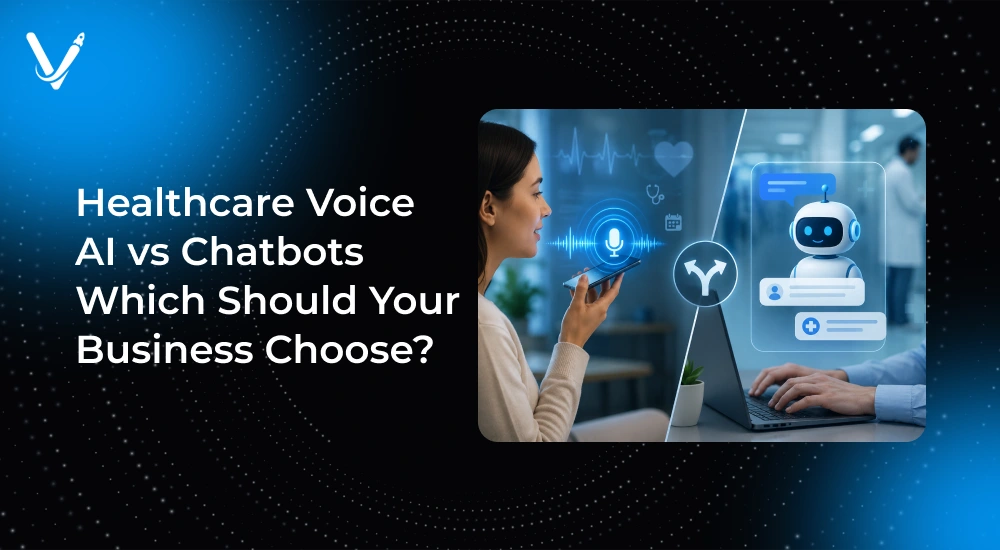
Healthcare Voice AI vs Chatbots: Key Differences
Both tools automate patient communication. They just do it on different channels, for different people.
| Feature | Voice AI | Chatbots |
| Communication Method | Spoken conversations by phone | Typed text on web or app |
| Patient Experience | Personal, hands-free, natural | Fast, self-service, visual |
| Availability | 24/7 on the phone line | 24/7 on digital channels |
| Use Cases | Calls, reminders, elderly patients | Website help, FAQs, portals |
| Integration | Telephony plus hospital systems | Website plus hospital systems |
| Cost | Higher to build and run | Lower to start and maintain |
| Scalability | Adds phone capacity instantly | Adds web chat capacity instantly |
Read the table and the split is clear. Voice AI wins on the phone and with people who find typing hard. Chatbots win online, at a lower cost.
How Voice AI Improves Patient Engagement
Faster Responses
The assistant picks up on the first ring. No hold music, no queue. Routine calls are answered the moment they come in.
24/7 Availability
Patients call at night, on weekends, and on holidays. A voice assistant covers every hour without paid overtime.
Shorter Waiting Times
When the assistant handles booking and FAQs, human staff are freed for the calls that truly need a person. The whole queue moves faster.
Better Access for Elderly Patients
Many older patients struggle with apps and web forms. Talking is easy. Voice AI reaches people that a chatbot never will.
More Personal Conversations
A voice assistant can confirm details, adjust its pace, and repeat information. It feels closer to a real call than a menu ever did.
This matters more than it sounds. A large share of patient calls are simple and repetitive: what time is my appointment, can I move it, what do I need to bring. When a voice assistant clears those in the first few seconds, the caller never feels stuck in a system. That small win, repeated thousands of times a month, is what moves patient satisfaction scores.
Less Work for Staff
Health systems worldwide face staff shortages, and global health bodies such as the World Health Organization point to AI as one way to ease routine load. Automating repeat calls is a direct example of that.
When Should Healthcare Organizations Choose Voice AI?
Voice AI earns its cost in specific situations.
• Hospitals with high call volumes that overwhelm the front desk.
• Clinics managing a steady flow of appointment requests by phone.
• Providers that need automated phone support outside office hours.
• Organizations whose patients simply prefer to call rather than type.
If the phone is your busiest channel, Voice AI Software for Healthcare is usually the stronger investment. Picking the right build partner matters here, so it helps to look closely at a vendor's AI solutions for businesses before you commit.
When Are Healthcare Chatbots a Better Choice?
Chatbots are the smarter pick in plenty of cases too.
• Website assistance for visitors browsing your services.
• Patient portals where people are already logged in and typing.
• Simple, repetitive FAQs that need a quick written answer.
• Low-cost automation when budget is tight and needs are basic.
If most of your patient questions are text-based and online, a chatbot delivers most of the value at a fraction of the cost. Both tools have their place.
AI Compliance and Security Considerations
Any healthcare AI touches sensitive patient data, so security is not optional. In the US, the rules published by the HHS Office for Civil Rights set the baseline for how that data must be handled.
HIPAA Compliance
Any vendor that handles protected health information needs a signed Business Associate Agreement. Ask for it before anything goes live.
Patient Data Protection
Collect the minimum data needed. Store it only as long as required. Know exactly where it lives.
Encryption
Data should be encrypted both while moving and while stored. This covers call recordings and chat logs alike.
Access Control
Only the right staff should see patient data. Roles and permissions decide who sees what.
Audit Logs
Log every interaction and every data lookup. If someone asks what the system did, you need a clear record.
Human Oversight
Keep a person in the loop for anything close to medical advice. The AI should hand off, not guess.
Responsible AI Usage
Tell patients they are talking to an AI. Give them an easy way to reach a human. AI systems that handle patient data need proper governance, so evaluate vendors carefully before you deploy. None of this is legal advice; check your own obligations with counsel.
Future of Healthcare AI: Voice AI and Chatbots Working Together
The real answer is not voice versus text. It is both.
Most healthcare organizations will run the two side by side. The voice assistant handles phone calls. The chatbot handles the website and the portal. A patient can start on chat and finish on a call without repeating themselves.
Digital health is moving toward connected patient experiences across every channel, a shift documented widely, including by the World Economic Forum. Teams that want that unified setup often turn to custom AI software development so voice and text share the same data and rules.
Build them on one backend and both tools improve together. The knowledge base that answers a chat question can answer a phone question too. Update it once and both channels stay in step.
This also protects your budget. Instead of paying two vendors for two disconnected systems, you build one platform with two front doors. Voice and text share the same rules, the same data, and the same compliance controls. That is cheaper to run and far easier to audit.
How to Choose the Right AI Solution
Choose Voice AI If
• You handle a large number of phone conversations every day.
• Your patients prefer to speak rather than type.
• You need to automate call answering and phone support.
Choose Chatbots If
• You mainly need support on your website or portal.
• Most of your patient queries are text-based.
• You want simple, low-cost automation to start.
Still unsure? Look at where your patients already reach you most. That channel is where AI will pay back fastest.
Conclusion
Voice AI and chatbots solve different problems. Voice AI owns the phone and reaches patients who find typing hard. Chatbots own digital channels at a lower cost.
The right choice depends on your business goals, how your patients like to communicate, and your compliance needs. Pick based on ROI, security, and scalability, not on hype.
For many organizations, the best answer is both, built on one secure system.
Looking to build a secure Healthcare AI solution? Explore AI development services with Vasundhara Infotech.





 Jul 15, 2026