AI/ML
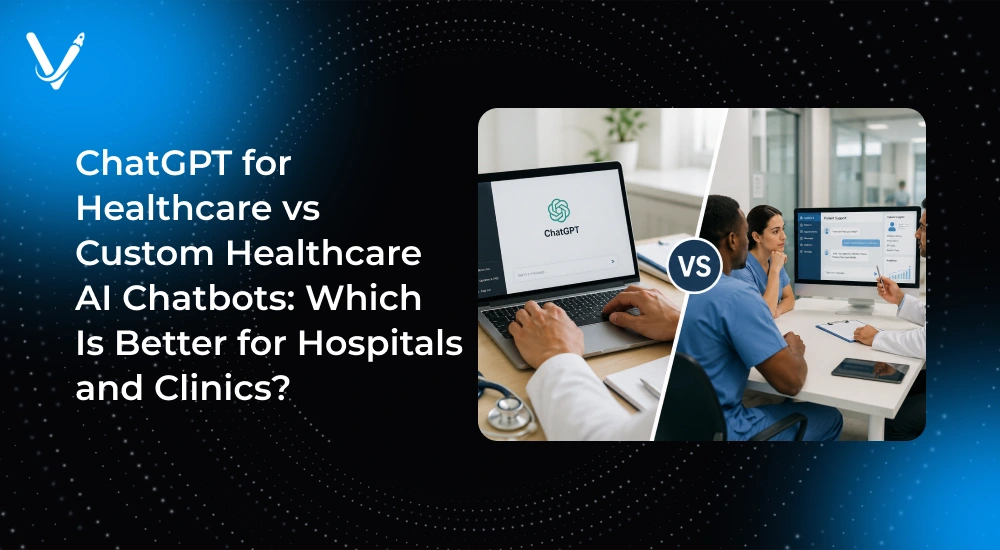
ChatGPT for Healthcare vs Custom Healthcare AI Chatbots: Which Is Better for Hospitals and Clinics?

 Jul 13, 2026







In Article:
Patients moved even faster. OpenAI says more than 230 million people ask health questions on ChatGPT every week, and most of those chats happen outside clinic hours.
So the question for hospital leaders is no longer whether AI belongs in patient communication. It is which kind of AI to buy. Some teams sign up for a subscription tool. Others invest in AI development services and build a chatbot around their own workflows.
Both paths are valid. They solve different problems, at different prices, with different risks.
Meanwhile the pressure keeps building. Phone lines stay busy. Front desk staff repeat the same answers all day. Patients wait for callbacks that never come. No-show rates eat into revenue. Care teams spend hours on tasks a machine could handle in seconds.
Pick the wrong tool and you add cost without fixing any of that. Pick the right one and you free up staff time, cut wait times, and give patients answers at 2 a.m.
This guide compares ChatGPT for Healthcare with custom healthcare AI chatbots. It is written for the people who sign the cheque: CIOs, clinic owners, operations leads, and product heads at healthcare SaaS companies.
ChatGPT for Healthcare is the enterprise version of ChatGPT built for medical organizations. OpenAI launched it in January 2026 alongside ChatGPT Health for patients and, later, a free tier for verified clinicians.
It runs on models tuned for healthcare work. It cites medical sources. It offers role-based access, audit logs, single sign-on, and a Business Associate Agreement to support HIPAA requirements. Large systems such as Cedars-Sinai, HCA Healthcare, and Boston Children's Hospital are early adopters.
• Patient education: turning lab reports and care plans into plain language.
• Administrative support: drafting discharge notes, letters, and internal documents.
• Clinical information access: pulling together research and treatment guidance with citations.
• Internal knowledge help: answering staff questions about policies and protocols.
It is fast to roll out. Staff already know the interface. It handles almost any question you throw at it, because it was trained on a huge body of general and medical knowledge.
For internal productivity, that breadth is the whole point. A general tool serves 40 departments without 40 separate builds.
The limits show up when you want it to act on your systems. Out of the box, it does not know your schedule, your insurance rules, or the patient who called yesterday.
A custom healthcare AI chatbot is an assistant built for one organization. It sits inside your website, app, or patient portal. It follows your rules, speaks in your brand voice, and connects to your systems.
Teams that offer healthcare chatbot development services usually build it on top of a foundation model, then wrap it in your data, your guardrails, and your workflows.
The chatbot talks to your EHR, your practice management system, your billing tool, and your CRM. It reads and writes real records through secure APIs, often over FHIR.
That connection is what turns a chat window into an operations tool.
• Appointment scheduling, rescheduling, and cancellations in real time.
• Patient onboarding, including forms, consent, and history collection.
• Insurance verification and eligibility checks before the visit.
• Follow-up reminders for visits, medication, and lab work.
• Symptom intake and triage routing, with clear escalation rules.
• Care coordination and handoffs between departments.
Medical chatbot development services also cover the boring parts that decide success: prompt guardrails, fallback rules, human handoff, logging, and testing against real patient questions.
Here is the short version, side by side.
| Feature | ChatGPT for Healthcare | Custom Healthcare AI Chatbot |
| Personalization | Prompt and workspace level | Built around your patients and rules |
| HIPAA Readiness | BAA available, supports compliance | Compliance designed into the build |
| EHR Integration | Through the API, not out of the box | Native, two-way, via FHIR or HL7 |
| Patient Workflows | Assists staff, does not run workflows | Owns booking, intake, and follow-up |
| Compliance Controls | Vendor controls and audit logs | Your controls, your audit trail |
| Branding | OpenAI interface | Your brand, your app, your portal |
| Scalability | Scales per seat | Scales per patient volume |
| Cost | Predictable subscription | Higher upfront, lower cost per patient |
Read the table one more time and a pattern shows up. ChatGPT for Healthcare is a tool for your staff. A custom chatbot is a tool for your patients.
Most hospitals end up needing both. They simply need them for different jobs.
Patients do not want to sit in a phone queue to move an appointment. A custom AI chatbot for clinics answers in seconds, in the patient's language, at any hour. Wait times drop because the routine work never reaches a human.
Healthcare AI automation services target the tasks that repeat all day: booking, reminders, form filling, insurance checks, and prescription refill requests. Automating those tasks gives staff hours back each week.
Healthcare virtual assistant development connects the bot to the systems where the truth lives. If the bot cannot see the schedule, it cannot book. If it cannot see the chart, it cannot answer a real question about care.
You choose where the data sits, who can read it, and how long you keep it. Protected health information never leaves systems you control.
AI patient engagement solutions push reminders that cut no-shows. AI-powered patient support solutions catch questions before they become callbacks. Both show up as real numbers in your monthly report.
This is the core trade. A subscription tool makes your staff faster. A custom build changes how the work flows.
Compliance is where most healthcare AI projects stall. Start here, not at the end. The HIPAA rules published by HHS set the baseline for how protected health information can be used, stored, and shared in the United States.
Any vendor that touches PHI needs a signed Business Associate Agreement. Consumer AI apps are not covered by HIPAA, so staff should never paste patient data into a personal account.
Collect the minimum data needed. Mask identifiers where you can. Set clear retention rules and delete what you no longer need.
Log every message, every data lookup, and every action the bot takes. If a regulator asks what the bot told a patient in March, you need an answer in minutes.
Tell patients they are talking to an AI assistant. Record consent. Give them a simple way to reach a human instead.
Encrypt data in transit and at rest. Use role-based access. Run penetration tests before launch and after every major change.
Keep a clinician in the loop for anything close to clinical advice. Global guidance from the World Health Organization stresses human accountability for health AI, and national rules keep tightening. Governance is not paperwork here. It is the thing that keeps a chatbot from giving unsafe advice at 3 a.m.
In the AMA survey, 86% of physicians called data privacy critical to wider AI adoption, and 85% wanted a say in what gets deployed. Bring clinicians into the room early.
Route calls, book slots across departments, answer visitor and billing questions, and cut front desk load.
An AI chatbot for clinics handles booking, intake forms, and reminders for a small team that has no room for extra admin staff.
Pre-visit intake, symptom collection, and post-visit follow-up, so the consult starts with the doctor already informed.
Claim status, coverage questions, network checks, and document uploads without a call centre queue.
An AI chatbot for healthcare providers deflects repeat questions and hands the hard ones to a human with the full chat history attached.
Product teams embed healthcare chatbot integration inside their own software, often built with generative AI development services, and sell it as a feature to every clinic they serve.
Cost is where the two options look furthest apart, and where the comparison is most often done wrong.
| Cost Factor | ChatGPT for Healthcare | Custom Healthcare AI Chatbot |
| Upfront cost | Low. Per-seat subscription. | Higher. Discovery, build, and testing. |
| Integration cost | Extra work through the API. | Included in the build scope. |
| Maintenance | Handled by the vendor. | Ongoing support and model updates. |
| Cost driver | Number of staff seats. | Patient volume and workflow count. |
| Long-term ROI | Staff time saved. | Staff time plus fewer no-shows and calls. |
A subscription is cheap to start and stays flat. That is a real advantage when the goal is staff productivity.
A custom build costs more on day one. The payback comes from volume. If a clinic handles 4,000 calls a month and the bot deflects a third of them, the maths turns quickly.
Do not compare licence fees to project fees. Compare the total cost of serving one patient interaction, over three years, in both models.
There is no single winner. There is a right fit per organization size and goal.
Start with a subscription tool for staff work. Add a lightweight custom bot for booking and reminders once call volume becomes painful.
Custom wins. Booking rules, doctor availability, and insurance vary by location. A general tool cannot hold that logic.
Run both. ChatGPT for Healthcare for clinical and research teams. A custom chatbot for patients, tied into the EHR and the contact centre.
Custom, always. The chatbot is part of your product, so it has to carry your brand and your data model.
Custom, with strict governance. At this size, audit trails, data residency, and human oversight are not optional.
A simple rule: if the AI only needs to know things, a subscription tool works. If it needs to do things inside your systems, build custom.
Chatbots stop answering and start acting. They book the slot, check the coverage, and send the reminder without a human touching the task.
Messages tuned to the patient's condition, language, and history, instead of the same reminder sent to everyone.
Phone lines answered by an assistant that books appointments and escalates to staff when a call sounds urgent.
Assistants that read the chart, prepare the visit summary, and hand the doctor a clean brief before the patient walks in.
None of this is far off. The building blocks are shipping now. The organizations that already have clean data and clear governance will move first.
ChatGPT for Healthcare is a strong general assistant. It is quick to deploy, easy to use, and useful for research, documentation, and internal knowledge work. It supports HIPAA requirements through a BAA, and it will make your staff faster.
A custom healthcare AI chatbot is a different animal. It plugs into your EHR, runs patient workflows end to end, carries your brand, and gives you full control over data and audit trails. It costs more upfront and pays back through volume.
Compliance decides more than most buyers expect. Consent, logging, encryption, and human oversight belong in the plan from week one, not the week before launch.
Organizations evaluating healthcare chatbot development services should focus on patient experience, compliance, integration capabilities, and long-term scalability rather than selecting solutions based solely on initial cost.
If you are weighing both options for your hospital, clinic, or health platform, talk to our team about what a custom healthcare AI chatbot would look like on top of the systems you already run.
Copyright © 2026 Vasundhara Infotech LLP. All Rights Reserved.