


AI/ML
India's $40 Billion BPO Industry Is Quietly Being Rebuilt Around Voice AI: What Businesses Need to Know

 Jun 26, 2026





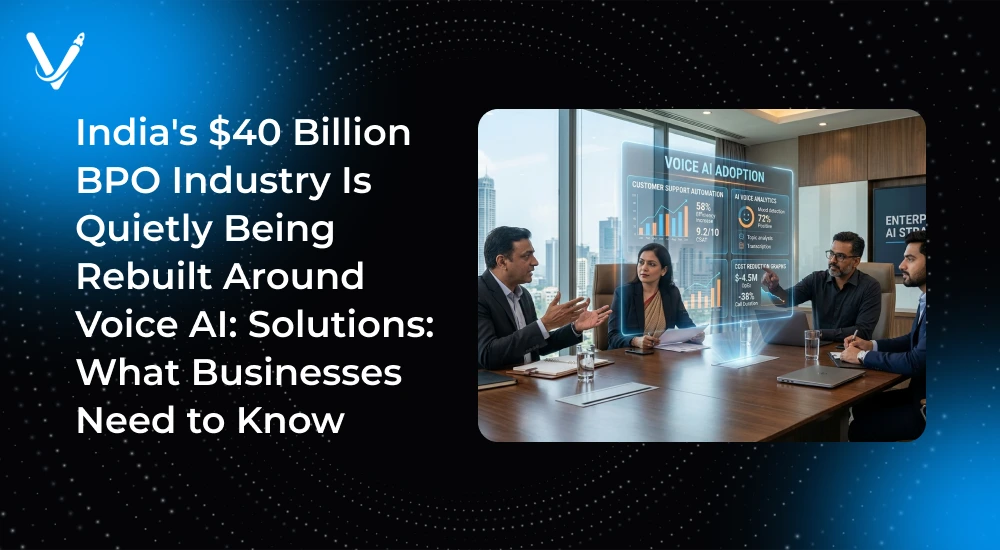
India’s business process management industry brings in around 40 billion dollars a year, per NASSCOM. For decades, it ran on people. Rows of agents answering calls around the clock. Now that model is changing fast. Voice AI is quietly rebuilding the whole industry.
Voice AI Solutions can now answer calls, understand speech, and hold real conversations. They work 24 hours a day, in many languages, at a fraction of the cost. This is a big shift for one of India’s largest sectors, and for any business that uses outsourcing.
In this guide, we break down what is happening, what voice AI can do, and what it means for your business. We also cover the compliance side, which matters a lot here. If you want to build your own voice tools, our AI development services team can help.
India’s IT and BPM sector employs more than 5 million people, per NASSCOM. A large share of them work in voice and support roles.
For years, India’s BPO sector grew on one thing: people. Millions of agents handle calls for firms around the world. It is a huge employer and a major export earner for the country.
But voice AI is changing the game. Tasks that once needed a human can now be done by software. Simple calls, FAQs, and routine support are moving to AI. The industry is being rebuilt around it, quietly but fast.
Here is what is shifting:
• Routine calls handled by AI, not agents
• Round-the-clock service without night shifts
• Many languages served from one system
• Lower cost per call
This does not mean people vanish. It means the work changes. Agents move to complex, high-value calls. AI takes the rest. The smart firms are planning for this now.
The conversational AI market is growing more than 20 percent a year, per Grand View Research. Voice is one of its fastest-growing parts.
Voice AI Solutions are tools that understand and speak human language over a call. They use AI to listen, work out what the caller needs, and reply in a natural voice.
AI Voice Agent Solutions go beyond a phone menu. An AI voice agent can answer a call, understand the need, and help, all on its own. It holds a real back-and-forth, not just a set script.
A modern ai voice agent platform can:
• Understand natural speech, not just key presses
• Answer questions and solve simple issues
• Route hard calls to the right human
• Work in many languages
• Run 24 hours a day without breaks
These run on conversational ai platforms. The best enterprise conversational ai platforms also connect to your CRM and tools, so the AI has full context on each caller.
Gartner has predicted that conversational AI will cut contact center labor costs by 80 billion dollars by 2026. That kind of saving is hard to ignore.
Voice AI is not new. But it has reached a tipping point. A few things came together at once to drive this shift.
Here is why it is happening now:
• AI voices now sound natural, not robotic
• The cost of the tech has dropped fast
• Customers expect instant, round-the-clock help
• Labor costs and agent turnover keep rising
• Rivals already use AI to cut costs
For support outsourcing companies, this is both a threat and a chance. Those that adopt Voice AI Development Services can offer more for less. Those that wait may fall behind their faster rivals.
Voice AI is not just for simple calls anymore. It now supports many parts of a modern contact center.

Here is where ai call center solutions for business help most.
The AI answers FAQs, checks order status, and books appointments. It handles the high volume of simple calls so agents do not have to.
It can make reminder calls, follow-ups, and short surveys. This keeps customers informed without tying up your team.
The AI understands what the caller needs and sends them to the right agent or team. This cuts transfers and wait times.
It helps live agents during a call. It suggests answers and pulls up records in real time. This makes each agent faster and more accurate.
It writes call summaries and updates records on its own. This is Call Center Automation Software at work, and it saves agents hours each week. See how we build AI chatbots for support teams.
McKinsey names customer operations as one of the top areas where generative AI adds value. Voice AI is a big part of that gain.
For businesses that use support or outsourcing, the upside is real. Here is what Enterprise Voice AI can bring.
• Lower support costs
• Faster answers for customers
• Round-the-clock service in many languages
• Service that scales with demand
• Agents freed for the hard cases
But it is not magic. Voice AI can get things wrong. It can frustrate callers if it is set up badly. The key is a smart rollout, clear limits, and a human backup. This is where Enterprise Voice AI done right truly pays off.
Voice AI handles real customer data and real conversations. That brings real duties. AI compliance is not a step you can skip.
Why compliance matters so much here:
• Calls may include private or financial data
• Many regions require consent before you record
• Privacy laws like India’s DPDP Act and the GDPR apply
• Wrong answers can harm customers and trust
Simple steps to stay safe:
1. Get clear consent before you record a call
2. Keep customer data secure and encrypted
3. Follow the data privacy laws in each region
4. Review AI calls for accuracy and tone
5. Keep a human in the loop for hard cases
Two laws matter most for many teams. India’s DPDP Act sets rules for how you handle personal data. For customers in Europe, the GDPR applies. Know both before you record or store any call.
One last point. Do not take a vendor’s word on safety. Test it. Check the logs and call records. AI compliance is an ongoing duty, not a one-time tick box. Human oversight stays key, even as AI takes on more calls.
You do not need to switch everything at once. A small, smart start beats a big risky leap.

ere is a simple path to bring voice AI into your support:
6. Pick one clear use case to start, like FAQs
7. Choose a strong voice AI partner or platform
8. Connect it to your CRM and tools
9. Set clear rules and a human backup
10. Test with real calls before full launch
11. Measure results, then improve
12. Scale what works across more calls
This path keeps risk low while you learn. For a custom build that fits your exact flow, see our guide to custom AI development. Start small, prove value, then grow.
India’s BPO industry is not dying. It is being rebuilt. Voice AI is taking over routine calls, while people move to the work that needs a human touch.
Rather than fearing this shift, smart businesses are using it. They cut costs, speed up service, and serve customers around the clock.
For businesses, the main benefits include:
• Lower support and outsourcing costs
• Faster, round-the-clock service
• Support in many languages
• Service that scales with demand
• Agents freed for high-value calls
At the same time, voice AI must be used with care. Consent, data security, accuracy, and clear compliance rules stay essential parts of any rollout.
Voice AI is quickly becoming a core part of modern customer service. Firms that adopt it well may gain a strong edge in the years ahead.
Businesses exploring voice AI can benefit from custom enterprise solutions. At Vasundhara Infotech, we help organizations build scalable voice AI solutions, conversational AI platforms, and call center automation software designed for real business needs.