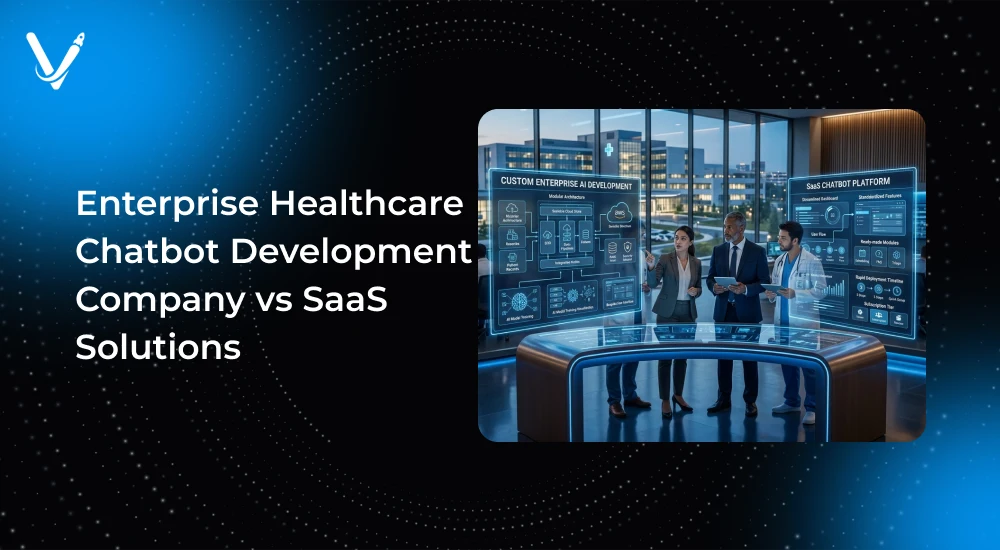
The global healthcare chatbot market was worth about 787 million dollars in 2023 and is growing more than 20 percent a year, according toGrand View Research. Hospitals, clinics, and health startups all want in. But they face one big choice first. Should you build a custom enterprise chatbot, or buy a ready-made SaaS one?
This choice shapes your cost, your control, and your risk. The wrong pick can waste months and blow your budget. The right one fits your needs and keeps patient data safe.
In this guide, we compare an Enterprise Healthcare Chatbot Development Company against SaaS solutions. We cover cost, control, compliance, and how to choose. If you want expert help, ourAI chatbot development team builds secure bots for healthcare.
What Is an Enterprise Healthcare Chatbot?
Accenture has estimated that AI tools could save the US healthcare economy up to 150 billion dollars a year by 2026. Custom-built bots are a big part of that shift.
An enterprise healthcare chatbot is a custom tool built for one organization. A Healthcare Chatbot Development Company builds it around your systems, your rules, and your patients. You own it, and you control it.
Here is what it offers:
•Built for your exact needs
•Connects deeply to your EHR and tools
•Full control over data and security
•Tuned to your real workflows
This is Enterprise AI Chatbot Development. It costs more up front, but it fits your work like a glove.
What Are SaaS Healthcare Chatbots?
SaaS tools now power a large share of new software rollouts. In healthcare, they offer a fast, low-cost way to start.
A SaaS chatbot is a ready-made product you rent. You sign up, set it up, and pay a monthly fee. The vendor builds it, hosts it, and runs it for you.
Here is what it offers:
•Fast to set up
•Lower upfront cost
•The vendor handles updates
•Less control and customization
SaaS works well for simple needs. But it may not fit complex health workflows or strict data rules. The fit depends on your size and your goals.
Enterprise vs SaaS: The Core Difference
HIPAA fines can reach about 1.9 million dollars per violation type, per year, per US rules. So the control you have over data is not a small detail. Here is a clear side-by-side.
When a SaaS Chatbot Makes Sense
For many small teams, speed and low cost win. That is where SaaS shines.
A SaaS healthcare chatbot is the right call when:
•You need a bot up and running fast
•Your needs are simple, like basic FAQs and booking
•Your upfront budget is tight
•You handle little sensitive patient data
For a small clinic with basic needs, a HIPAA-ready SaaS bot can work well. Just check the vendor’s compliance closely before you sign. Ask for proof, not promises.
When You Need an Enterprise Development Company
For larger or complex needs, custom usually wins. The fit and control are worth the higher cost.
You likely need an enterprise ai chatbot development company when:
•You handle large volumes of patient data
•You need deep EHR and system integration
•You have strict security and privacy rules
•You want full control and ownership
•You plan to scale across many sites
A hospital or health network usually needs a full enterprise ai chatbot solution. The fit, control, and security pay off over time. See how we approachcustom AI development for complex needs.
HIPAA and Compliance: Where They Differ Most
In healthcare, compliance is not optional. HIPAA controls how you store and share patient data. Both options can be HIPAA-ready, but the path differs.
With SaaS
You rely on the vendor. You must check their compliance, sign a Business Associate Agreement, and trust their setup. If something goes wrong, you have less control over the fix.
With an enterprise build
You set the rules. HIPAA-Compliant Chatbot Development is built into the design. You control encryption, access, and logs. But the duty to get it right sits with you and your partner.
Either way, your bot needs these basics:
•Encryption in storage and in transit
•Strict access controls
•Full audit logs
•A signed BAA
•Minimal data collection
Global bodies push for safe AI in health too. The World Health Organization has publishedguidance on the ethics and governance of AI for health. Whichever path you pick, test the controls and keep a human in the loop. AI compliance is a duty you cannot skip, and you can confirm the HIPAA rules atHHS.gov.
Cost: What Each Option Really Costs
Cost is more than the sticker price. Look at the total cost over a few years, not just month one.
SaaS cost
SaaS has a low upfront cost. You pay a monthly fee instead. But that fee rises with more users and more features. It is cheap to start, yet it can get pricey at scale.
Enterprise cost
A custom build costs more up front. But you own it after that. Your ongoing cost stays lower, even as use grows. This makes it a better deal for high-volume teams.
Healthcare Automation Solutions pay off most when volume is high. Run the math for your real usage before you choose. The cheaper option today may cost more over five years.
How to Choose: A Simple Decision Guide
The right choice comes from a clear, honest look at your needs. Follow these steps.
1. List your needs and must-haves
2. Check how much sensitive data you handle
3. Map your integration needs, like EHR and tools
4. Set your budget, both upfront and ongoing
5. Compare SaaS vendors and custom partners side by side
6. Ask each one for clear compliance proof
7. Pick the option that fits your needs and your rules
If you are not sure, a trusted Healthcare AI Development Company can guide you through the choice. OurAI development services team helps health teams pick the right path and build it the right way.
Conclusion
The choice between an enterprise build and a SaaS chatbot is not about which is better. It is about which is better for you.
Rather than chasing the cheapest or fastest option, match the tool to your real needs, your data, and your rules.
For healthcare teams, the key things to weigh include:
•Setup speed and upfront cost
•Control and ownership
•Data privacy and HIPAA fit
•EHR and system integration
•Total cost over time
At the same time, both paths demand care. Human oversight, strong security, and clear compliance rules stay essential, no matter which you pick.
Healthcare chatbots are quickly becoming a core part of patient care. Teams that choose well, and build with care, will serve patients better and stay safe.
Businesses exploring healthcare chatbots can benefit from custom enterprise solutions. AtVasundhara Infotech, we help hospitals and clinics build secure, HIPAA-aware AI chatbots and healthcare automation solutions designed for real patient care.
Frequently asked questions
It is a custom chatbot built for one organization by a Healthcare Chatbot Development Company. It connects to your EHR, fits your workflows, and gives you full control over data and security. You own it.
It is a ready-made chatbot you rent for a monthly fee. The vendor builds, hosts, and runs it. It is fast to set up and cheaper upfront, but you have less control and customization.
It depends on your needs. SaaS suits small teams with simple needs and tight budgets. An enterprise build suits larger teams with complex workflows, strict rules, and high data volumes.
They can be, but you must verify it. Check the vendor’s compliance, make sure they sign a BAA, and review their security setup. The duty to confirm this sits with you.
It costs more upfront than SaaS, but you own it and ongoing costs stay lower at scale. The final price depends on features, integrations, and security needs. Ask for a clear quote.
Choose custom when you handle lots of patient data, need deep EHR integration, have strict rules, or plan to scale across sites. The control and fit are worth the higher cost.





 Jun 26, 2026