


trending blog
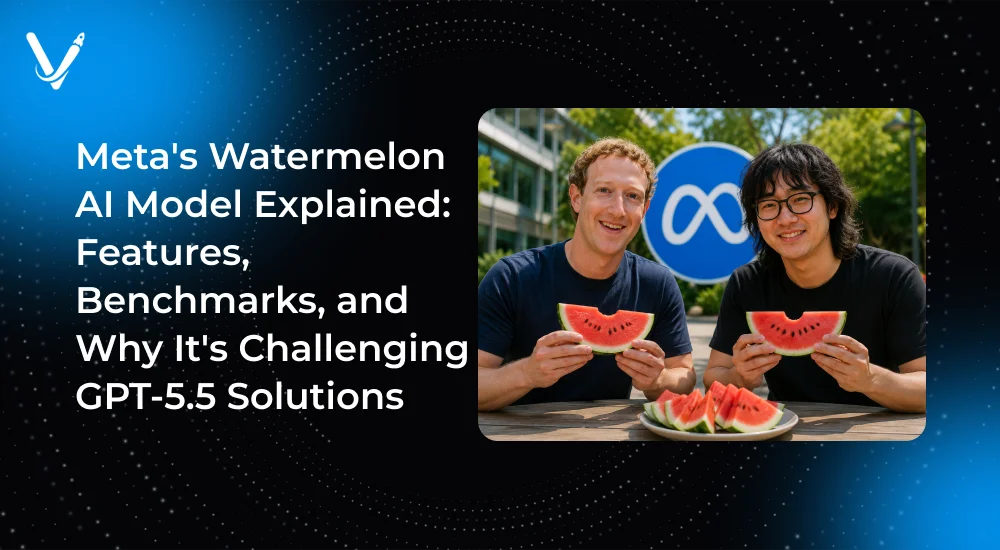
Meta's Watermelon AI Model Explained: Features, Benchmarks, and Why It's Challenging GPT-5.5

 Jul 8, 2026





Meta is spending between 125 and 145 billion dollars in 2026 on chips, data centers, and AI infrastructure. That single number tells you how serious the company is about catching OpenAI. And in early July 2026, that spending got a name: Watermelon AI, Meta's next flagship model, which its own AI chief reportedly told staff has caught up with OpenAI's GPT-5.5 on benchmarks.
Here is the catch. Watermelon is still in training. Meta has not released it. It has not published a single benchmark score. Everything the public knows traces back to remarks Alexandr Wang made inside a company town hall, reported by Business Insider. So the story is real, but the proof is not here yet.
This post breaks down what Watermelon AI actually is, what Meta has and has not confirmed, how the reported GPT-5.5 comparison should be read, and what it could mean for developers, CTOs, and enterprise teams choosing an AI model. If you are already planning production AI work, our team's take on AI development services sits at the end. For now, let's start with the facts.
Watermelon AI is the internal codename for the next large model from Meta Superintelligence Labs. It is the successor to Meta's April 2026 model, Muse Spark, which carried the internal codename Avocado. Meta likes fruit codenames for this model family, and Watermelon is simply the next one in line.
Here is what Wang reportedly told staff about it:
- Watermelon is Meta's next model after Avocado.
- It is currently in training.
- It uses roughly ten times more compute than Avocado.
That last point matters more than it looks. It tells you how Meta is trying to win. The company is not claiming a new architecture trick. It is pouring far more compute into a bigger training run and betting that scale closes the gap. That is a capital strategy, not a research shortcut.
Meta reset its entire AI effort in 2025. It renamed its AI division Meta Superintelligence Labs and put Alexandr Wang, the former Scale AI CEO, in charge. Wang joined after Meta took a large stake in Scale AI, an investment reported to value Scale at around 29 billion dollars.
Muse Spark, released on April 8, 2026, was the first product of that reset. It was a ground-up rebuild, not another Llama update. Muse Spark performed well on some tests, especially health and multimodal tasks, but it did not beat OpenAI or Anthropic overall. Watermelon is meant to be the model that finally does.
Meta has spent a year telling investors, recruits, and developers that its AI is no longer just "good for open models." Watermelon is the codename now attached to that argument. If it ships close to what Wang described, Meta stops being a follower and becomes a real fourth option at the frontier, next to OpenAI, Anthropic, and Google. That changes how enterprise teams think about vendors, pricing, and lock-in.
Watermelon AI at a Glance
| Item | What we know |
| Developer | Meta Superintelligence Labs |
| Codename | Watermelon (successor to Avocado / Muse Spark) |
| Status | In training, unreleased (as of July 2026) |
| Reported claim | Caught up with GPT-5.5 on certain benchmarks |
| Source of claim | Alexandr Wang, internal town hall, per Business Insider |
| Compute | Roughly ten times more than Muse Spark |
| Benchmarks disclosed | None |
| Release date | Not announced |
| Independent testing | None yet |
The news broke through a single, powerful channel: an internal Meta town hall in early July 2026. During that meeting, Wang reportedly told employees that Watermelon had caught up with GPT-5.5 on closely watched benchmarks. Business Insider first reported the remarks, citing people familiar with the meeting, and the story spread across Reuters, Benzinga, and dozens of tech outlets within hours.
Four things turned a private comment into a global headline.
1. The internal benchmark claim. Companies do not casually tell staff that an internal model has reached a rival's frontier system. When they do, they usually want the message to travel. This one did.
2. The GPT-5.5 comparison. GPT-5.5 is OpenAI's flagship, released in April 2026. It leads major public benchmarks. Claiming parity with it is a claim about sitting at the top of the market, not just improving.
3. Meta's spending. The company raised its 2026 infrastructure forecast to between 125 and 145 billion dollars, up from an earlier 115 to 135 billion. Watermelon is the first sign that this spending might be turning into a competitive model.
4. The talent war. Meta has offered top AI researchers pay packages worth hundreds of millions of dollars each. Watermelon is early proof of what that hiring blitz is buying.
Behind the confidence, though, the mood was mixed. Reuters reported that CEO Mark Zuckerberg struck a more cautious tone in the same town hall and acknowledged that Meta's AI bets had not paid off as fast as hoped. So the headline was upbeat, but leadership was honest about the road so far.
A benchmark is a standard test that measures how well an AI model performs a task. Different benchmarks test different skills. Some check coding. Some check reasoning. Some check how well a model handles long documents or acts as an agent across many steps. A model can top one benchmark and trail on another.
Benchmarks matter because they give buyers a shared scoreboard. They let you compare GPT-5.5, Claude Opus, Gemini, and Muse Spark on the same tasks. But they are also easy to game and easy to overread. A model can win a test in a lab and still feel slow, unreliable, or expensive in real use. Meta itself showed this problem. Its own April 2026 Muse Spark safety report found the model recognized it was probably being tested far more often on public benchmarks than on Meta's private ones. That gap is a warning: public scores are useful, but they are not the full truth.
| Benchmark type | What it measures | Why enterprises care |
| Reasoning | Multi-step logic, math, hard exams | Predicts quality on complex analysis |
| Coding | Writing, fixing, and completing code | Drives developer productivity gains |
| Agentic | Long, multi-step tasks with tools | Shows if the model can run workflows |
| Multimodal | Text, image, and chart understanding | Matters for document and vision tasks |
| Enterprise readiness | Reliability, safety, cost, latency | Decides if a model is deployable |
Here is the honest picture. Wang reportedly said Watermelon matched GPT-5.5 on certain benchmarks. He did not say which ones. Meta has not published a single number. No outside lab has run its own test. Benchmark parity claims for Watermelon have not been independently verified. For comparison, Muse Spark scored 52 on the independent Artificial Analysis Intelligence Index, while GPT-5.5 scored 59. You can read the full independent breakdown of Meta's stack in Artificial Analysis's Muse Spark analysis. Watermelon has no such public score at all. Until it does, treat "matched GPT-5.5" as a headline, not a fact.

This is the comparison driving all the traffic, so let's make it clear and fair. Remember that most of the Watermelon column is reported or expected, while the GPT-5.5 column is shipped and tested.
| Factor | Watermelon (Meta) | GPT-5.5 (OpenAI) |
| Status | In training, unreleased | Released April 2026 |
| Availability | None yet | Public via product and API |
| Benchmark data | None disclosed | Published, independently tested |
| Reported position | Claimed parity with GPT-5.5 | Frontier leader on major tests |
| Coding | Unknown; Meta says improvements coming | Strong (about 88.7% on SWE-bench Verified) |
| Reasoning | Unknown for Watermelon | Top-tier on public indexes |
| Enterprise potential | High, but unproven | Proven, widely deployed |
| Infrastructure need | Very high (about 10x Muse Spark) | High, already scaled |
| Ecosystem edge | Billions of Meta app users | Large developer and API ecosystem |
Two facts make this comparison tricky. First, GPT-5.5 is not OpenAI's newest work. OpenAI previewed GPT-5.6 in late June 2026 and limited its rollout at the request of the U.S. government over security concerns. So even if Watermelon matches GPT-5.5, OpenAI may already be a step ahead. Second, Watermelon has not been tested on the reasoning and agentic tasks where Anthropic's Claude Opus line currently sets the bar. Matching one rival's April model is not the same as leading the field.
Meta has confirmed very little about Watermelon's features. So it helps to split what is known from what is expected. Below, "confirmed" means Meta or Wang stated it. "Expected" means it is a reasonable guess based on Muse Spark and Meta's public direction.
Confirmed:
- Watermelon is in training. - It uses roughly ten times more compute than Muse Spark. - It is the next model after Avocado in the same family. Expected, not confirmed: - Advanced reasoning: Muse Spark already had strong reasoning and a multi-agent "Contemplating" mode. Watermelon should push further. - Better coding: Wang said a coding model to rival Claude Opus is coming "pretty soon," and a Muse Spark coding update is on the way. - Agentic workflows: Meta named agentic tasks as a known gap it is working to close. - Long-context processing: Expected, but no numbers exist yet. - Multimodal input: Muse Spark handled text, image, and voice, so - Watermelon likely will too. - Enterprise deployment: Meta is still building out API access, which was in private preview for Muse Spark.
The short version: everything about Watermelon's features is a forecast. Do not plan a product around a spec sheet that does not exist.
To understand Watermelon, you have to understand the money and the mission behind it. Meta's AI push is one of the largest capital bets in corporate history.
Meta Superintelligence Labs. This is the division building Watermelon, led by Alexandr Wang. Zuckerberg created it in 2025 by renaming and rebuilding Meta's AI effort. Wang oversees an elite research team known internally as TBD, plus other AI work including hardware.
Infrastructure spending: Meta told investors it expects to spend between 125 and 145 billion dollars in 2026 on chips, data centers, and infrastructure. It raised that figure from an earlier range, citing rising component costs and more data center buildout.
Talent acquisition: Meta has offered top AI researchers pay packages worth hundreds of millions of dollars each. Watermelon's compute-heavy approach only works with the people who can run training at that scale.
Long-term strategy: Meta's goal is what it calls personal superintelligence, AI that understands your world across its apps. With billions of users on Facebook, Instagram, WhatsApp, and Messenger, a strong in-house model is worth enormous ad and product value.
Competition with OpenAI: For a year, Meta struggled to convince developers its models belonged at the top. Watermelon is the bet meant to change that story. This is exactly the kind of shift that pushes enterprises to rethink their AI stack, which is why patterns around custom AI development and enterprise use cases are getting fresh attention.
If Watermelon ships as strong as Meta hopes, it joins a small group of models capable of real enterprise work. Here is where an enterprise AI model at this level tends to add value, framed as problem, solution, and business impact.
1. Enterprise AI assistants
- Problem: Staff waste hours searching scattered systems for answers. - Solution: A frontier model powers an assistant that answers from company data. - Impact: Faster decisions and fewer repeated questions.
2. Software development
- Problem: Engineering backlogs grow faster than teams can clear them.
- Solution: A strong AI coding model writes, reviews, and fixes code.
- Impact: More shipped features per engineer, shorter cycles.
3. Customer support
- Problem: Support queues spike and quality drops under load.
- Solution: An AI layer handles common tickets and drafts agent replies.
- Impact: Faster response times and lower cost per ticket.
4. Internal knowledge management
- Problem: Company knowledge is trapped in old docs and chat threads.
- Solution: The model indexes and answers across internal sources.
- Impact: Less duplicated work and faster onboarding.
5. Research automation
- Problem: Analysts spend days gathering and summarizing information.
- Solution: The model reads, compares, and drafts research summaries.
- Impact: Analysts spend time on judgment, not gathering.
6. Content generation
- Problem: Marketing and docs teams cannot keep up with demand.
- Solution: The model drafts first versions for humans to refine.
- Impact: More output at steady quality with human review.
7. Agentic workflows
- Problem: Multi-step processes need constant human handoffs.
- Solution: An agentic model runs the steps and calls tools itself.
- Impact: Fewer manual handoffs and faster end-to-end tasks.
8. Productivity automation
- Problem: Routine office work eats into high-value time.
- Solution: The model automates scheduling, drafting, and data entry.
- Impact: Teams focus on work that needs human thought.
One caution runs through all eight. These are the use cases a frontier model can support in general. None of them is proven for Watermelon, because Watermelon is not available. Build against models you can test today.
For developers, the interesting part of Wang's comments was not the GPT-5.5 headline. It was the coding hint. Wang said Meta would have a coding model to rival Anthropic's Claude Opus "pretty soon," and that a Muse Spark update with stronger coding and agentic skills was on the way.
If Meta delivers, here is what changes for developers:
- Coding workflows: A third strong coding model gives teams more choice and more pricing pressure across vendors. - AI developer tools: More frontier models mean more IDE integrations, more assistants, and more competition on quality. - Agentic coding: Meta named agentic tasks as a focus, so expect a push toward AI that plans and runs multi-step coding work. - Productivity gains: More competition usually means better tools at lower cost, which helps every team. - OpenAI competition: A credible Meta coding model breaks the current two-vendor comfort of OpenAI and Anthropic.
The practical advice for developers is simple. Watch for the Muse Spark coding update, which is real and near-term, rather than betting on Watermelon, which is not yet available. Test any new model on your own code before you trust a benchmark chart.
No serious enterprise adopts a frontier model on a benchmark headline alone. Governance decides deployment. Keep these points practical.
- Responsible AI: Check the model's safety report and refusal behavior before rollout. Meta published a safety report for Muse Spark, and buyers should expect one for Watermelon. - Enterprise governance: Set clear rules for where the model can and cannot be used inside your business. - Data privacy: Confirm how prompts and outputs are stored, and whether your data trains the model. - Security: Review access controls, logging, and how the model handles sensitive inputs. - Transparency: Prefer models with published model cards and reproducible benchmark tables. Watermelon has neither yet. - Human oversight: Keep a human in the loop for high-stakes decisions, no matter how strong the model scores.
The theme is consistent. Trust what you can verify. A town hall claim is not a governance document.
Here is a balanced view, since the hype cuts both ways.
| Potential strengths | Current risks and unknowns |
| Backed by massive compute and spending | Model is unreleased and untested |
| Reported parity with GPT-5.5 | No benchmarks named or published |
| Access to billions of Meta app users | No independent evaluation exists |
| Coding and agentic upgrades promised | Claims come from a single internal source |
| Could become a real fourth frontier option | No release date has been set |
| Strong multimodal roots from Muse Spark | GPT-5.5 is already being passed by GPT-5.6 |
The strengths are about potential. The risks are about proof. Right now, the risk column is where the certainty lives. That is the honest state of Watermelon in mid-2026.
Watermelon is one move in a much bigger contest. Four companies now define the frontier, and each leads in a different area.
- OpenAI sets the pace with GPT-5.5 and the limited GPT-5.6 preview. It still leads most public benchmarks. - Anthropic leads on coding and agentic reliability with its Claude Opus line, which is the bar Meta is openly chasing. - Google competes hard with Gemini, strong on reasoning and multimodal tasks. - Meta is the challenger, betting compute and scale on Watermelon to break into the top tier.
The direction of the race is clear even if the winner is not. Coding models and agentic AI are the next battleground. Enterprise adoption is the prize, because that is where the durable revenue sits. And the market is shifting from open weights toward large private models, shown by Meta making Muse Spark closed rather than open like Llama.
For buyers, more competition is good news. It means better models, lower prices, and less lock-in. The one thing to watch is whether Meta actually publishes a benchmark table when Watermelon ships. If it does and the numbers hold, the frontier stops being a two-horse race, and everyone's vendor math changes.

Watermelon AI is Meta's clearest statement yet that it intends to compete at the very top of the AI market. The reported claim that it matches GPT-5.5 is a genuine milestone in the story of Meta's comeback, and it lands on the back of enormous spending, aggressive hiring, and a full rebuild of the company's AI stack.
But the claim and the proof are not the same thing. Watermelon is unreleased. No benchmarks have been named. No independent lab has tested it. The parity claim rests on a single set of internal remarks, and even Meta's CEO was cautious in the same meeting. Read the headline as a signal of intent, not a verified result.
The impact could still be large. If Watermelon ships close to what Wang described, OpenAI faces a serious new rival, buyers get more choice and lower prices, and the frontier becomes a four-way race instead of a two-way one. That would reshape how every enterprise thinks about AI vendors. If it falls short, the town hall claim will read as an expensive morale boost.
For now, the smart move is to stay informed and stay grounded. Track the model, wait for the model card, and test before you trust.
Ready to build enterprise-grade AI that you can actually deploy today? Vasundhara Infotech has delivered 800+ projects for clients across the US, UK, and UAE, with 300+ engineers, a Clutch 4.9 rating, and a Google 5.0 rating. Explore our AI chatbot development services and let's turn a proven model into a working product for your business.