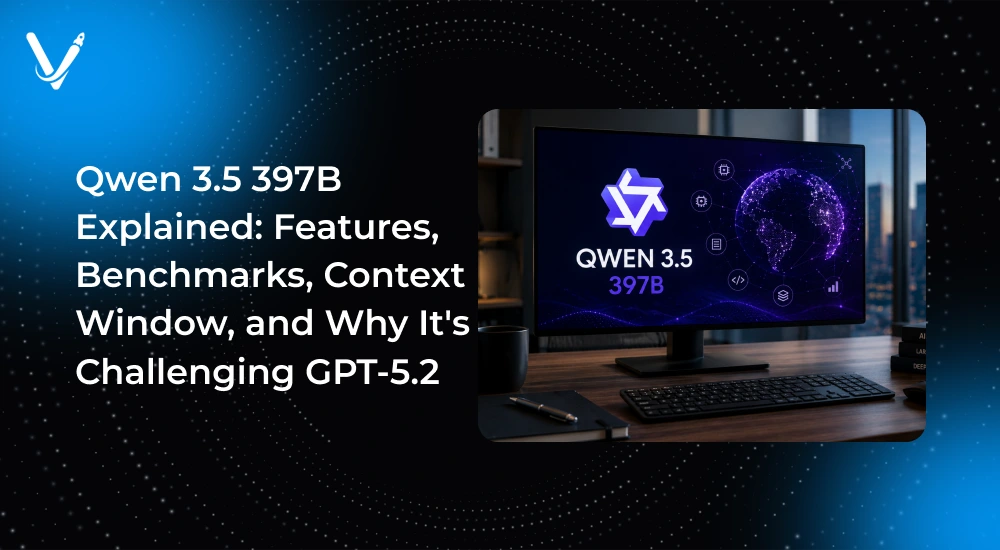
Qwen 3.5 397B is one of the most talked-about open-weight AI models of the year. It comes from Alibaba, and it aims to match top closed models like GPT-5.2, but with open weights you can run yourself.
Alibaba built the Qwen family to compete at the frontier while staying open. Developers like Qwen because they can download it, host it, and tune it. Enterprises like it because open weights mean more control over cost, data, and privacy.
That is the big shift. Open-weight models have closed much of the gap with closed ones. If you want help putting one to work, our AI development services team builds with open models often.
What is Qwen 3.5 397B?
Qwen 3.5 397B is a large open-weight language model from Alibaba’s Qwen family. You can download it, run it on your own hardware, and tune it for your needs.
Qwen is one of the most active open-model lines in AI. The models are shared openly, often under the Apache 2.0 license, and hosted on Hugging Face and Alibaba Cloud. Apache 2.0 is a permissive license, which means you can use the model in commercial products.
The "397B" points to the model’s size. It is reported to use a Mixture-of-Experts, or MoE, design. That means it has a very large total parameter count, but only activates a small part for each token. This gives big-model quality at lower running cost.
Recent Qwen models also handle more than text. Many support vision and language together, so they can read images as well as words. This makes Qwen 3.5 397B a strong base for many kinds of AI apps.
Key features of Qwen 3.5 397B
The key features include a large MoE design, few active parameters, vision-language support, long context, agentic skills, coding strength, and many languages. Here is what each one means.
| Feature | What it means (reported) |
| 397B parameters | A very large total model size |
| MoE architecture | Only part of the model runs per token |
| ~17B active params | Big-model quality at lower compute |
| Vision-language | Reads images and text together |
| Long context | Handles long documents and code |
| Agentic workflows | Runs multi-step tasks as an agent |
| Coding | Strong at writing and fixing code |
| Multilingual | Works across many languages |
The MoE design is the headline. A dense model runs all its parameters every time, which is slow and costly. An MoE model runs only the experts it needs. So you get the power of a huge model without the full cost on every call. Confirm the exact numbers with official sources.
Qwen 3.5 397B benchmarks explained
Benchmarks test how well a model codes, reasons, and acts as an agent. The exact Qwen 3.5 397B scores are reported, so confirm them before you rely on them.
For live, third-party numbers, check independent trackers like Artificial Analysis, which compare models on speed, cost, and quality. Here is what the main tests measure.
| Benchmark | What it measures | Reported result |
| SWE-Bench | Fixing real software bugs | Strong: to confirm |
| IFBench | Following instructions well | Strong: to confirm |
| Coding | Writing correct code | Strong: to confirm |
| Reasoning | Step-by-step problem solving | Strong: to confirm |
| Agentic | Completing multi-step tasks | Strong: to confirm |
Here is the honest read. Qwen models have earned a strong name for coding and reasoning, and each new release tends to push scores higher. But scores shift with every version, and vendors test in their own way. Always run your own test on your own tasks before you trust a number.
Qwen 3.5 397B vs GPT-5.2
The core difference is simple: Qwen 3.5 397B is open-weight, while GPT-5.2 is closed. That one fact shapes cost, control, and deployment. The table shows how they compare by type, not by fixed scores.
| Factor | Qwen 3.5 397B | GPT-5.2 |
| Model type | Open-weight (MoE) | Closed |
| Access | Download and self-host | API only |
| Coding | Strong: to confirm | Strong: to confirm |
| Reasoning | Strong: to confirm | Strong: to confirm |
| Context window | Long: to confirm | Long: to confirm |
| Deployment | Self-host or cloud | Vendor cloud only |
| Cost model | Pay for compute | Pay per token |
| Data control | High, stays in-house | Vendor-controlled |
Expert take: The choice is less about raw scores and more about control. If you need to self-host, tune on private data, or cap cost at scale, an open model like Qwen fits well. If you want a managed service with no infrastructure to run, a closed model may be simpler. Many teams use both, one for control and one for convenience.
Understanding the context window
A context window is how much text a model can read at once. A long window lets it handle big documents and whole codebases in one go.
Think of the context window as the model’s short-term memory. If the window is small, the model forgets earlier parts of a long input. If it is large, it can keep the whole thing in view.
Qwen 3.5 397B is reported to offer a long context window, around 256K tokens. Confirm the exact figure with official sources. A window that size unlocks real use cases:
• Long-document processing. Read a full contract or report at once.
• Codebase analysis. Feed in a whole repo and ask questions.
• Research workflows. Summarize many papers in one pass.
• Enterprise search. Answer from long internal manuals.
For example, a developer could paste a large module and ask the model to find a bug, without splitting the code into chunks. That saves time and keeps context intact.
Top Qwen 3.5 397B use cases
Qwen 3.5 397B fits many jobs, from coding assistants to AI agents and document analysis. Here are ten, each with the problem, the solution, and the business value.
1. AI coding assistants
Problem: Developers lose time on routine code.
Solution: The model writes, fixes, and reviews code.
Business value: Faster shipping and fewer bugs.
2. Enterprise knowledge management
Problem: Staff cannot find internal answers fast.
Solution: The model answers from company docs.
Business value: Quicker answers and less lost time.
3. SaaS applications
Problem: Apps want smart AI features built in.
Solution: Add the model via API or self-host.
Business value: A stronger, stickier product.
4. Research workflows
Problem: Reading long papers is slow.
Solution: The model summarizes and compares them.
Business value: Faster research and better insight.
5. Customer support
Problem: Support teams face repeat questions.
Solution: The model handles common queries.
Business value: Lower cost and faster replies.
6. AI agents
Problem: Manual multi-step tasks do not scale.
Solution: The model runs tasks as an agent.
Business value: More work done with less effort.
7. Document analysis
Problem: Long documents are hard to review.
Solution: The model reads and extracts key points.
Business value: Faster, cleaner document review.
8. Financial services
Problem: Reports and checks take staff time.
Solution: The model drafts and reviews them.
Business value: Lower cost and fewer errors.
9. Healthcare applications
Problem: Admin work pulls staff from care.
Solution: The model handles routine text tasks.
Business value: More time for patients (with oversight).
10. Internal copilots
Problem: Teams need help across many tools.
Solution: A custom copilot built on the model.
Business value: Higher output across the company.
How to use Qwen 3.5 397B
You can use Qwen 3.5 397B through an API, or self-host it, or fine-tune and deploy it yourself. Here is a simple overview.
1. API access. Call the model through a cloud API for the fastest start.
2. Self-hosting. Download the weights and run them on your own servers.
3. Fine-tuning. Train it on your own data for a better fit.
4. Enterprise deployment. Run it in your secure environment with controls.
5. Cloud deployment. Deploy on a cloud that supports the model at scale.
Self-hosting a 397B MoE model needs serious hardware, so plan your infrastructure early. For a look at how we build custom AI on open models, see our guide to custom AI development. Start small, test, then scale.
Benefits of open-weight AI models
Open-weight models give you transparency, customization, data privacy, cost control, and freedom from one vendor. That is why so many teams now choose them.
| Benefit | Open-weight models | Closed models |
| Transparency | You can inspect the model | Hidden from you |
| Customization | Full, fine-tune freely | Limited |
| Data privacy | Data can stay in-house | Data goes to vendor |
| Cost control | Pay for compute | Pay per token |
| Vendor independence | No lock-in | Tied to one vendor |
Open models are not right for every team. They need skill and hardware to run well. But for teams that value control, privacy, and cost, they are a strong choice.
AI compliance and enterprise considerations
Running your own model means you own the duty to use it safely. Plan for data privacy, security, governance, responsible AI, and monitoring.
• Data privacy. Keep private and customer data secure at every step.
• Security. Protect the model, its data, and its access points.
• Governance. Set clear rules for how the model is used.
• Responsible AI. Check output for bias, safety, and accuracy.
• Model monitoring. Track performance and issues over time.
• Compliance. Follow the laws and rules for your industry.
One rule holds across all of these. Keep a human in the loop for important calls. AI compliance is an ongoing duty, not a one-time task.
Strengths and limitations
Qwen 3.5 397B trades some ease of use for control, openness, and strong performance. Here is the honest balance.
| Strengths | Limitations |
| Open weights and Apache 2.0 license | Needs serious hardware to self-host |
| Strong coding and reasoning | Setup takes real skill |
| Long context window | Exact specs here are unconfirmed |
| Data privacy and control | You own security and compliance |
| Freedom from vendor lock-in | Less hand-holding than a managed API |
Ideal users: teams that want control, privacy, and low cost at scale, and that have the skill to run and tune an open model. Teams that want a simple, managed service may prefer a closed API.
The future of open-weight AI models
The future is bright for open-weight models. They are closing the gap with closed ones and winning enterprise trust.
• Enterprise adoption. More firms will run open models in-house.
• AI agents. Open models will power more agentic workflows.
• Multimodal AI. Text, image, and more will blend in one model.
• Real competition. Open models will keep pressing GPT and Claude.
• Lower costs. MoE designs will cut the cost of frontier AI.
The takeaway is clear. Open-weight models like Qwen are no longer the underdog. They are a real choice for serious work, and the gap keeps shrinking.
Conclusion
Qwen 3.5 397B matters because it shows how far open-weight AI has come. A large, open model that targets top closed rivals like GPT-5.2 is a real shift in the market.
Developers are interested because they can download, host, and tune it. Enterprises should pay attention because open weights bring control over cost, data, and privacy. Against GPT-5.2, the trade is open control versus managed ease, and many teams will use both.
Looking ahead, open-weight models will keep closing the gap and winning enterprise trust. The teams that learn to run and tune them well may gain a real edge.
Want to build on an open model like Qwen? At Vasundhara Infotech, we help teams pick, deploy, and tune open-weight AI for real business needs. And remember to confirm all specs and benchmarks with official sources before you commit.





 Jul 3, 2026