trending blog
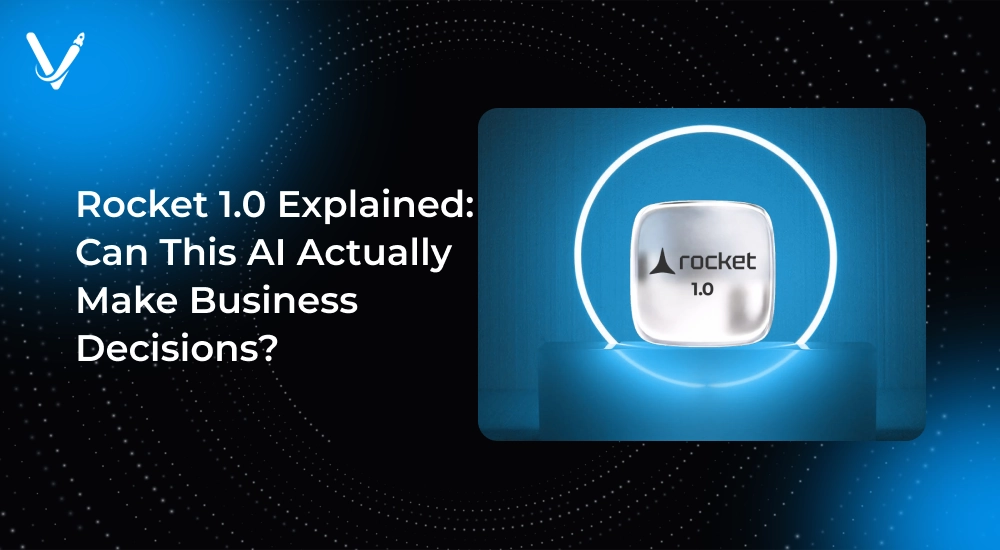
Rocket 1.0 Explained: Can This AI Actually Make Business Decisions?

 Apr 9, 2026


The Growing Problem with Business Decision-Making
What Is Rocket 1.0 AI?
How Rocket 1.0 AI Works
Rocket 1.0 AI vs Traditional AI Tools
Data-Driven Trends Behind Decision AI
Benefits for Businesses and Startups
Limitations and Challenges
The Bigger Picture: Where Rocket 1.0 Fits
Final Verdict
Take the Next Step with AI-Driven Business Solutions
Most businesses today are not struggling with a lack of data. They are struggling with what to do with it. Teams jump between dashboards, reports, and AI tools, yet decisions still take time. Even after analysis, uncertainty remains, and execution often gets delayed.
This gap between insight and action is where many companies lose momentum. Founders, marketers, and product teams spend hours gathering information, but translating that into clear decisions is still a manual process. This is exactly the problem that new AI decision making tools are trying to solve.
Rocket 1.0 AI enters this space with a bold claim. Instead of just answering questions, it aims to help users make decisions and act on them. But how realistic is that promise?
Rocket 1.0 AI is positioned as a business decision AI platform that goes beyond traditional chat-based tools. Unlike standard AI assistants that provide suggestions or explanations, it focuses on delivering structured decisions backed by context and data.
At its core, Rocket 1.0 AI tries to combine three layers into one system. It analyzes inputs, generates strategic recommendations, and helps execute tasks. This creates the impression of a unified workspace rather than a standalone tool.
The idea is simple but ambitious. Instead of using multiple AI productivity tools for research, planning, and execution, users can rely on a single system that handles the entire workflow. This shift reflects a broader trend in the future of AI in business, where tools are expected to move from support roles to decision roles.
The most important feature of Rocket 1.0 AI is its decision engine. Users provide a business scenario, such as launching a product or improving conversions, and the system analyzes the situation.
Instead of returning generic advice, it attempts to deliver structured outputs. These may include recommendations, reasoning, and possible alternatives. The goal is to reduce ambiguity and give users something they can act on quickly.
This approach aligns with the rise of AI tools for startups, where speed and clarity are often more valuable than deep technical analysis. Startups need direction, not just data, and Rocket 1.0 AI tries to fill that gap.
One of the biggest limitations of traditional AI tools is the lack of memory. Each session starts fresh, and users need to repeat context repeatedly. Rocket 1.0 AI attempts to solve this by maintaining ongoing context.
It stores information about projects, decisions, and workflows. Over time, this allows the system to provide more relevant outputs. Instead of isolated responses, users get continuity across tasks.
This feature is particularly useful for businesses working on long-term strategies. It reduces the need for repeated inputs and allows decisions to evolve based on past actions.
Beyond recommendations, Rocket 1.0 AI also focuses on execution. It can generate structured outputs such as workflows, content drafts, and basic product frameworks. This reduces the gap between planning and doing.
For example, if a user decides to launch a campaign, the system may assist with outlining the steps, generating content, and organizing tasks. While it does not replace full development or operations teams, it speeds up early-stage execution.
This combination of decision and execution is what differentiates it from many existing AI productivity tools.
To understand its practical value, it helps to look at how businesses might actually use Rocket 1.0 AI.
A startup founder can input a problem such as entering a competitive market. The system may provide positioning ideas, target audience insights, and suggested next steps. This reduces the time spent on early-stage planning.
Marketing teams can use Rocket 1.0 AI to evaluate campaign strategies. Instead of testing multiple ideas manually, they can get structured recommendations on messaging, channels, and execution plans.
Product managers often deal with unclear priorities. Rocket 1.0 AI can help analyze user feedback, market trends, and internal data to suggest feature priorities. This makes decision-making faster and more aligned.
Businesses can use the platform to streamline internal processes. By analyzing workflows, the system may suggest improvements that reduce time and cost. This aligns with the broader adoption of business decision AI across operations.
To evaluate its impact, it is important to compare Rocket 1.0 AI with commonly used tools.
This comparison highlights a shift in how AI is being designed. The focus is moving from information delivery to outcome generation. That shift is central to the evolution of AI decision making tools.
The rise of tools like Rocket 1.0 AI is not random. It is supported by broader industry trends.
According to recent reports, over 70% of businesses are already using some form of AI in their operations. However, a significant portion of these companies report that AI is mainly used for automation and insights, not decision-making.
At the same time, studies suggest that companies that use data-driven decision processes are significantly more productive than those that rely on intuition alone. This creates a demand for tools that can bridge the gap between data and decisions.
Another key trend is the consolidation of tools. Businesses are increasingly looking for platforms that reduce complexity rather than add to it. Managing multiple tools creates inefficiencies, which is why unified systems like Rocket 1.0 AI are gaining attention.
These trends indicate that the future of AI in business is not just about smarter tools, but more integrated systems.
Rocket 1.0 AI offers several potential advantages, especially for growing businesses.
By providing structured recommendations, the platform reduces the time required to analyze options. This is critical for startups that need to move quickly.
Instead of using multiple tools for different tasks, businesses can rely on a single system. This simplifies workflows and reduces operational overhead.
With context memory, decisions are more consistent over time. This helps teams maintain alignment across projects.
By combining decision-making and execution, Rocket 1.0 AI increases overall efficiency. Teams can focus more on strategy and less on repetitive tasks.
These benefits make it an attractive option among AI tools for startups that need both speed and structure.
Despite its potential, Rocket 1.0 AI is not without limitations. Understanding these is important for realistic expectations.
The platform still requires human input and validation. It can suggest decisions, but it cannot fully replace human judgment. Businesses must review outputs before acting on them.
The accuracy of recommendations depends on the quality of input data. Poor or incomplete data can lead to misleading results.
As a relatively new concept, decision-focused AI systems are still evolving. Features may not be as refined as established tools.
There is a risk of relying too heavily on AI-generated decisions. Businesses must balance automation with critical thinking.
These challenges highlight that while business decision AI is promising, it is not a complete solution yet.
Rocket 1.0 AI represents a broader shift in how AI is used in business. The focus is moving from assistance to action. This shift is driven by the need for faster decisions and more efficient workflows.
However, the transition is gradual. Current tools, including Rocket 1.0 AI, are stepping stones rather than final solutions. They provide value, but they still require human oversight.
This balanced view is important. It prevents unrealistic expectations while still recognizing the potential of the technology.
Rocket 1.0 AI introduces an interesting approach to decision-making. By combining analysis, context, and execution, it attempts to solve a real business problem. The idea of moving from insights to actions is both relevant and timely.
At the same time, it is important to view it as an evolving tool rather than a complete solution. It can support decisions, but it cannot replace human expertise. Businesses that use it effectively will treat it as a partner, not a replacement.
For companies exploring the future of AI in business, Rocket 1.0 AI is worth paying attention to. It reflects where the industry is heading, even if it is not fully there yet.
A strategic approach is key. Instead of relying entirely on AI, businesses should integrate it into their decision-making process carefully. This ensures better outcomes and reduces risks.
Understanding tools like Rocket 1.0 AI is just the beginning. The real advantage comes from applying AI strategically to your business processes.
At Vasundhara Infotech, we help businesses move beyond experimentation and build practical AI solutions that deliver results. Whether you want to automate workflows, improve decision-making, or develop custom AI-powered applications, our team can guide you at every step.
If you are exploring how AI can create real business impact, now is the right time to act. Connect with our experts to discuss your goals and discover how tailored AI solutions can support your growth.
Copyright © 2026 Vasundhara Infotech. All Rights Reserved.