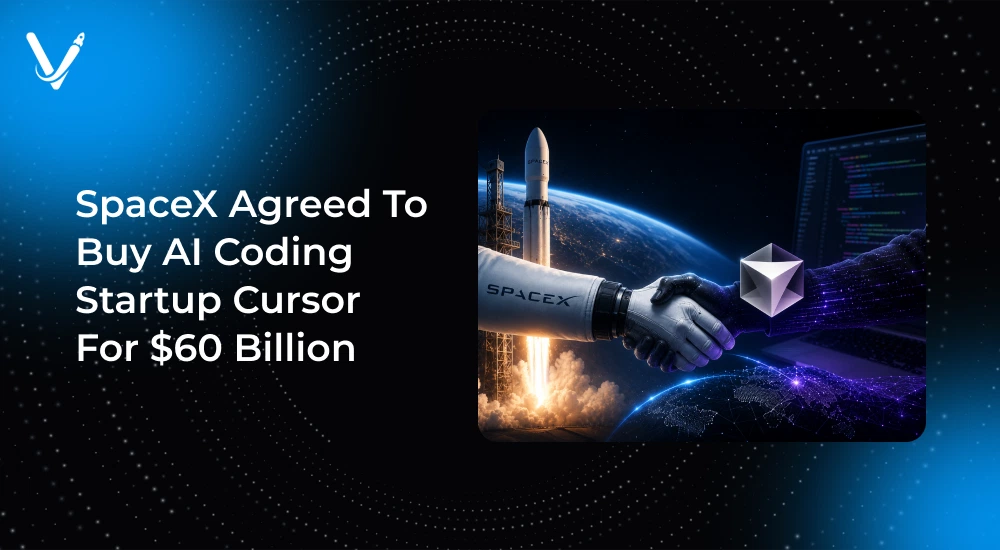
SpaceX just agreed to buy the AI coding startup Cursor for $60 billion in stock. It is one of the biggest AI acquisition deals ever, and it landed just days after SpaceX's record-breaking stock market debut. The size of the number alone tells you how valuable AI coding has become.
For anyone who builds software, this is big news. It signals where AI software development is heading, and who will control the tools developers use every day. This post breaks down the deal in plain words: the data behind it, why it happened, and what it means for the future of AI coding assistants. Every fact here comes from a primary news source.
If your team is thinking about how to use AI in your own work, our AI development services page is a good place to start. First, the facts.
The Deal in Brief
Here is what happened, based on reporting from CNBC and a SpaceX regulatory filing. SpaceX, the rocket and AI company led by Elon Musk, agreed to buy Cursor in an all-stock deal worth $60 billion. Cursor is made by a San Francisco startup called Anysphere. It will become a fully owned part of SpaceX once the deal closes.
The deal is expected to close in the third quarter of 2026, pending regulatory approval. Because SpaceX paid in stock, not cash, the deal cost it only about 3.4% in dilution at its new market value. As Reuters reported, SpaceX shares jumped after the news, briefly making it one of the most valuable companies in the United States.
Why $60 Billion? Cursor's Fast Rise
So why is an AI coding startup Cursor worth $60 billion? The answer is speed of growth. Cursor was only founded in 2022, but it grew faster than almost any software tool in memory.
Cursor built a popular tool that helps developers write, edit, and review code with AI. It became so easy to use that it helped spark a new trend people call vibe coding, where you describe what you want and the AI writes it. By late 2025, the company crossed $1 billion in annualized revenue. Reuters later put its business revenue even higher, near $2.6 billion.
That growth set its price. Before the SpaceX deal, Cursor was raising money at a valuation north of $50 billion. The $60 billion buyout topped that. This is the Cursor AI valuation that turned heads across the tech world.
Why SpaceX Wants an AI Coding Company
At first glance, a rocket company buying a coding tool sounds odd. But it makes sense once you look closer. Earlier in 2026, SpaceX merged with Musk's AI lab, xAI, the maker of the Grok chatbot. So SpaceX is now an AI company too.
Buying Cursor gives that AI arm a strong foothold in AI coding, one of the first places where AI is making real money from businesses. It also puts SpaceX in direct competition with the leaders in AI coding tools, such as Anthropic and OpenAI, who make their own coding products.
There is a technical reason too. Cursor and xAI have been building a shared AI model together. Cursor gets to train future tools on xAI's huge data center in Memphis. In return, SpaceX gets Cursor's large base of expert developers. For a company that pitched investors a massive AI market, owning a top AI coding assistant is a clear play for that prize.
What It Means for the AI Coding Market
This deal is a sign of a bigger shift. The AI coding tools market is consolidating fast. The biggest tech companies now own or back nearly every major coding assistant. Independent tools are getting bought or boxed in.
This matters for a few reasons. First, it means more money and computing power will flow into these tools, so they should get better faster. Second, it raises the stakes on lock-in. When your coding tool is owned by a giant AI lab, switching later can get harder. Third, it shows that AI coding is now core strategy for the largest firms in tech, not a side project.
For developers, more competition usually means better tools and features. But fewer independent players can also mean less choice over time. The smart move is to watch the market closely and avoid betting everything on a single tool.
The AI Compliance Angle
Here is the part many headlines skip. A deal like this raises real compliance and governance questions, and businesses should pay attention. When a coding tool joins a giant AI company, your code and data may flow through new systems with new rules.
First, there is the regulatory side. A $60 billion AI acquisition needs approval from regulators before it can close. Antitrust bodies are watching big tech AI deals closely, so the timeline is not certain.
Second, there is governance. SpaceX's AI arm, xAI, has faced public controversies over its Grok chatbot's outputs, and all of its co-founders left the company. Musk himself said the AI division needed to be rebuilt. That history is a reminder that strong AI governance is not a given, even at the biggest firms.
For your own business, the lesson is to do your homework before you trust any AI coding tool with your code.
Ask these questions:
• Data privacy: Where does your code go, and is it used to train the vendor's models?
• Code ownership: Who owns the code the AI writes, and are there license risks?
• Security: Are there clear controls, audit logs, and a breach response plan?
• Stability: Will the tool and its terms stay the same after an ownership change?
Rules like the EU AI Act, which adds major duties in 2026, push for exactly this kind of care. Whoever owns the tool, the duty to use it safely and keep clean records stays with you. Good governance is now part of AI software development, not an afterthought.
What It Means for Developers and Businesses
So what should you actually do? For most teams, the answer is not to panic, but to plan. The future of AI coding assistants looks powerful, well-funded, and fast-moving. That is mostly good news for the people who build software.
Here are a few practical takeaways:
• Expect rapid change: These tools will gain features fast, so keep learning and testing them.
• Avoid heavy lock-in: Keep your skills and workflows flexible across more than one tool.
• Put governance first: Set clear rules for how your team uses AI on real code.
• Focus on judgment: AI writes code, but people still design systems and make the calls.
The teams that win will treat AI coding assistants as powerful helpers, not as a full replacement for skilled engineers. The tools are getting stronger. Knowing how to use them well is the real edge.
Final Thoughts
The SpaceX and Cursor deal is more than a big number. It is a clear signal that AI coding has moved to the center of the tech world. A startup founded in 2022 is now worth $60 billion. The biggest companies are racing to own this space. And the tools your team uses every day are changing hands and getting more powerful.
For businesses, the message is simple. AI coding is here, it is serious, and it is worth real strategy. Use these tools, but use them with care, good governance, and a clear plan.
Want help putting AI to work in your software, the right way? Vasundhara Infotech helps teams build and adopt AI safely. Explore our AI development services, see how our AI development team works, and learn about our custom software development. Get in touch for a free consultation built around your goals.





 Jun 17, 2026