AI/ML
Should You Upgrade to an Advanced AI Platform for App Development? Key Signs and Benefits

 May 29, 2026







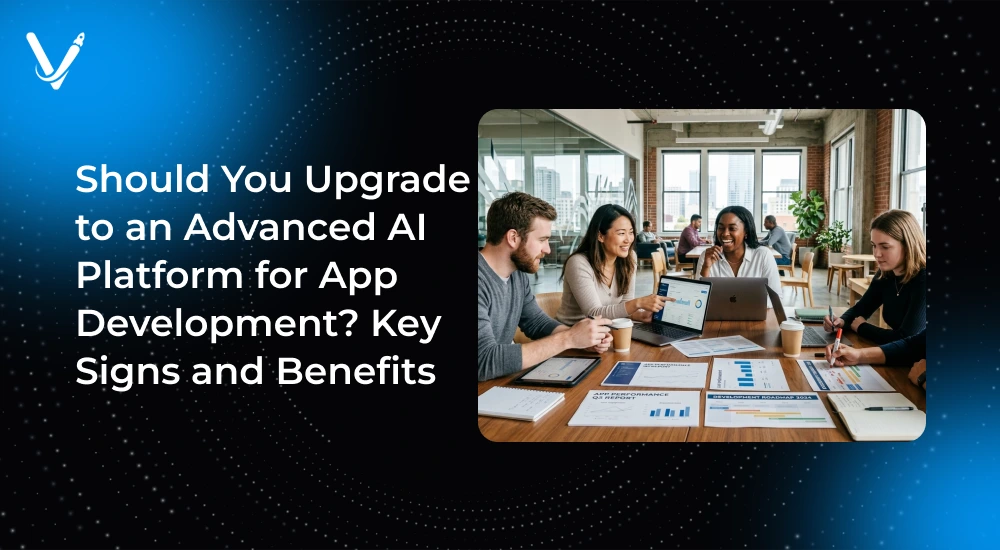
Should you upgrade to an advanced AI platform for app development? The short answer: upgrade when your current tools start holding you back. If your builds stall, your costs keep climbing, or you can't scale without things breaking, it's time. An advanced AI platform for app development pays off for teams shipping real products, not for one-off tests.
Most teams start small. You try a few AI tools. You wire up an API. You ship a feature. That works for a while. But growth changes the math. What felt fast at the start can feel slow at scale.
The question is no longer whether to use AI. It's which platform to build on. In Stack Overflow's 2025 Developer Survey, 84% of developers said they use or plan to use AI tools, up from 76% the year before. AI is now part of how software gets made. If you're weighing a move, our AI development services team maps this decision with clients every week.
This guide helps you choose. We'll walk through the signs you've outgrown your setup. We'll cover the real benefits of upgrading. And we'll be honest about when an upgrade isn't worth the money or effort yet.
Not all AI platforms are the same. The gap between basic and advanced ones is wide.
A basic platform is what most teams start with. Think general tools and prebuilt APIs. You send a request, you get a response. It's quick to start and cheap at low volume. But you don't control much. You share infrastructure with everyone else. You can't fine-tune the model. And you're stuck with whatever the vendor offers.
An advanced or enterprise AI platform is built for scale. It gives you more control over models, data, and infrastructure. You can train or fine-tune models on your own data. You get stronger security and built-in compliance. You can plug AI into your existing systems. And you can grow without rebuilding from scratch.
That's the core of the basic vs advanced AI platforms debate. One is fine for testing. The other is built for products that need to last.

This jump matters because AI is now central to many products, not a side feature. The global AI code tools market was worth $4.86 billion in 2023. It's projected to reach $26.03 billion by 2030, according to Grand View Research. More teams are building serious AI features, and they need platforms that can keep up.
How do you know it's time? Watch for these signs. If three or more sound familiar, you've likely outgrown your setup.

These signs add up. Stack Overflow's 2025 Developer Survey found that 45% of developers say debugging AI-generated code takes longer than writing it themselves. A better platform reduces that drag and gives your team time back.
So what do you actually get when you upgrade? Here are the benefits of advanced AI platforms that matter most.
The payoff is real, but it's not automatic. McKinsey's 2025 State of AI report found that 78% of organizations now use AI in at least one business function. Yet only 39% report real impact at the enterprise level. The teams that win don't just buy better tools. They rebuild how they work around them.
That's where strong AI development solutions and the right partner help. If you want models tuned to your business, an experienced custom AI development team can build them.
An upgrade isn't always the right call. Here's when to wait.
Be honest about where you are. Upgrading too early wastes money. Upgrading too late costs you speed and trust. The goal is to match the platform to your stage.
If your app touches personal or regulated data, compliance isn't optional. This is one of the strongest reasons to move to an enterprise AI platform.
Beyond rules, you need governance. That means model governance, so you know which model made which decision and on what data. It means audit trails you can show to auditors and customers. And it means AI disclosure, so users know when they're talking to AI, not a person. This is now expected, and in some places it's required.
These aren't just legal checkboxes. They build trust. And trust is in short supply. Stack Overflow's 2025 survey found that 46% of developers actively distrust AI output. Good governance is how you earn that confidence back.
Ready to compare options? Use this checklist. Score each platform on these points.
Don't pick on price alone. The cheapest option often costs more later in lost time and risk. Match the platform to your roadmap, not just your current sprint.
If you're not sure where to start, a short AI software development audit can save months. Our innovation consulting team reviews your stack and maps the smartest path forward.
Upgrading to an advanced AI platform for app development is a big decision, not a default. The right time is when your current tools cost you more in speed, money, or risk than a better platform would. Watch the signs. Weigh the benefits. And be honest about your stage.
If the signs point to yes, you don't have to figure it out alone. Vasundhara Infotech builds scalable, secure, AI-powered apps for companies that are ready to grow. From custom AI app development to full AI development solutions, our team helps you pick the right platform and build on it the right way.