For years, your AI assistant could tell you what to do. It could not actually do it. You asked a question, got an answer, and then went off to handle the real work yourself.
Gemini Spark wants to flip that.
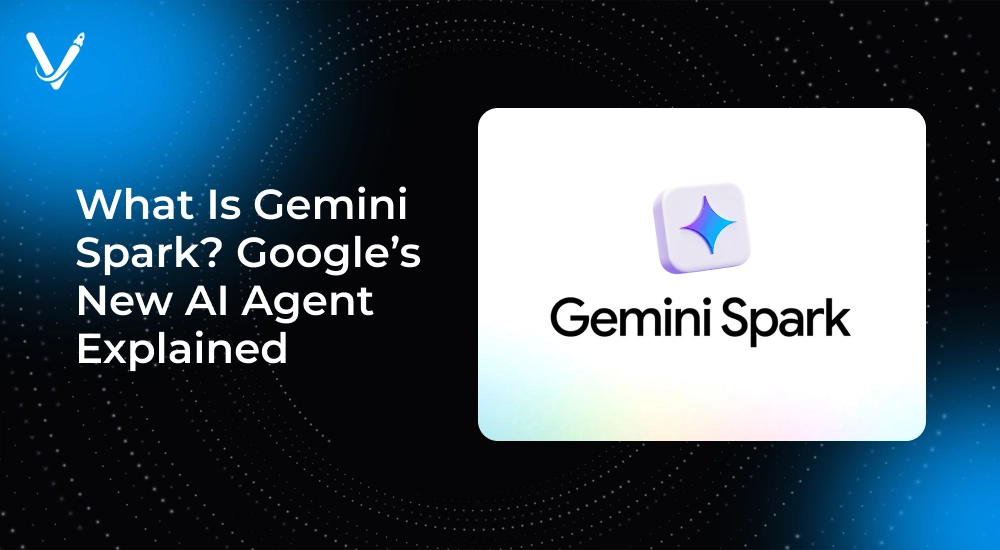
At Google I/O 2026, Google introduced Gemini Spark, a new Google AI agent built to take action on your behalf. It does not just chat. It reads, plans, and finishes tasks across the apps you already use. And it does this around the clock, even when your laptop is closed.
This is a big shift. So let's break down what Gemini Spark is, why Google built it, and what it means for how we work and search.
What Is Gemini Spark, Exactly?
In plain terms, Gemini Spark is a personal AI agent that lives inside the Gemini app. Google describes it as a "24/7 personal AI agent" that acts on your behalf and under your direction.
Think of the difference this way. A normal chatbot waits for you to ask something. An AI agent goes and does the job for you, step by step, across different tools.
Spark runs on Gemini 3.5 Flash, Google's faster new model, and a system called Antigravity that lets it behave like an agent. It does not run on your phone or computer alone. Instead, it works on dedicated cloud machines through Google Cloud. That is why it can keep working in the background while you do other things.
The setup is built around three simple ideas:
- Tasks: one-off jobs you hand to the agent, like summarizing a long email thread.
- Skills: things you teach it to do well, so it gets better over time.
- Schedules: recurring jobs that run on their own, like a weekly report.
It is also opt-in by design. Spark only connects to the apps you allow. By default, those connections stay off until you switch them on.
Why Google Launched Gemini Spark
Google did not build Spark on a whim. A few real pressures pushed it forward.
The first is changing user behavior. More people now start their questions in a chatbot instead of a search box. That trend worries any company that built its business on search. Spark is part of Google's answer. It shows that Google can help you finish tasks, not just find links.
The second is competition. OpenAI and Anthropic have both shipped strong agent products, and both are reportedly heading toward public offerings. Google needed a clear move of its own in the agentic AI race.
The third is scale. The Gemini app now serves more than 900 million people each month across 230 countries. That is up from 400 million a year earlier. Google has a huge user base and a deep set of products. Spark ties them together.
And here is Google's quiet advantage: it already holds your email, your calendar, your docs, and your files. That context is hard for rivals to match.
Key Features and Capabilities
So what can this AI productivity assistant actually do? Quite a lot, and the list keeps growing.
Deep Google Workspace Integration
Spark connects natively to the Google tools most of us live in: Gmail, Calendar, Drive, Docs, Sheets, Slides, YouTube, and Google Maps. Because these links are built in, you do not have to wire up messy third-party connectors. The agent just reads the context it needs and gets to work.
An Agent That Never Sleeps
Since Spark runs on Google Cloud, it does not need your device to stay on. You can hand it a long job and walk away. On Android, a new system called Halo lets you track its progress while it runs.
You can even email Spark directly through its own Gmail address, almost like messaging a coworker. Ask it for a status update, and it can pull the facts from your emails, docs, sheets, and slides, then write the draft for you.
Real Multi-Step Workflows
This is where Spark moves past simple chat. It can chain several actions into one connected job. Here are a few examples Google has shown:
- Pull every important deadline from your inbox and send you a clean list.
- Summarize long email threads so you skip the scrolling.
- Turn meeting notes into a polished report in Google Docs, then draft an email to share it.
- Check your credit card bill each month and flag hidden fees.
- Declutter your inbox by sorting newsletters and unsubscribing from junk.
Reach Beyond Google
Spark is not locked inside Google. At launch it can connect to Canva, OpenTable, and Instacart, with more partner apps coming. Google also plans to let it send texts and emails and operate a web browser through Chrome.
One honest note: Google calls Spark "experimental." It can take sensitive actions, and the company warns users to supervise it and not rely on it for legal, medical, or financial advice. AI-powered workflows are powerful, but they still need a human watching the wheel.
Gemini Spark vs ChatGPT and Microsoft Copilot
You cannot judge a Google AI agent in a vacuum. So how does Spark stack up against the two biggest names in AI productivity?
Each tool plays to a different strength.
- Gemini Spark wins on native Google integration. If your life runs through Gmail and Workspace, Spark reads your context with no setup. Its always-on cloud agent model is its other edge.
- ChatGPT is the flexibility leader. With Agent Mode, GPT-5.4, and Deep Research, it works well no matter which apps you use. It runs on its own cloud computer and is the most widely adopted standalone assistant, holding most of the consumer chatbot market.
- Microsoft Copilot is the workplace insider. It is woven into Microsoft 365, so it pulls context from your Outlook, Word, Excel, and Teams. Its Wave 3 update in early 2026 added agent features and even let it tap models from other labs.
Here is the simple way to read it. Copilot fits Microsoft shops. ChatGPT fits people who want one tool that goes anywhere. Spark fits the huge crowd that lives inside Google.
And many teams do not pick just one. A Forrester survey in early 2026 found that about a third of enterprise AI deployments now run more than one platform. Spark gives Google's billion users a strong reason to keep their agent inside the Google family.
How Gemini Spark Fits Google's Larger AI Strategy
Spark is one piece of a much bigger plan. Gemini is now the center of everything Google builds in AI.
That includes new models like Gemini 3.5 Flash for fast, smart action, plus tools for multimodal AI that handle text, images, and video together. Google also showed agents like Daily Brief, which gives you a personalized morning summary.
The thread tying it all together is a move from answers to action. Google does not just want to win AI search. It wants to own the workflow that starts after the search. When you ask a question, the next step used to be a list of blue links. Now Google wants the next step to be a finished task.
That is a defensive play and an offensive one at the same time. It protects search while opening a new front in enterprise AI tools and personal productivity.
What AI Agents Mean for Business
Step back from the product, and you see a market shifting fast. AI agents are no longer a science project. They are becoming core software.
The numbers tell the story. The agentic AI market grew from about $7.6 billion in 2025 to a projected $10.8 billion in 2026. Gartner expects 40% of enterprise applications to include task-specific AI agents by the end of 2026, up from less than 5% a year earlier.
But there is a catch worth respecting. While most enterprises say they have adopted agents, far fewer run them in production. Reports put real production use somewhere between 11% and 31%. Gartner even warns that more than 40% of agentic AI projects could be scrapped by 2027 due to unclear value and weak governance.
The lesson is clear. Buying an agent is easy. Making it deliver real value is the hard part. Tools like Spark lower the setup cost, which could help close that gap, but only for teams that pair them with good process and oversight.
From Search Boxes to AI-Powered Workflows
Here is the deeper change underneath all of this.
For two decades, the web ran on a simple loop: type a query, scan results, click, repeat. That loop trained how we think and how businesses earn attention.
Agentic AI breaks the loop. Instead of searching for information and acting on it yourself, you describe an outcome and let a contextual AI assistant handle the steps. The search happens inside the workflow, not before it.
For businesses, this raises a hard question. If an agent books the table, compares the prices, and drafts the email, who is the customer the agent talks to? Gartner predicts that by 2028, AI agents will handle a fifth of interactions on digital storefronts built for humans. Marketing, sales, and product teams will all need to plan for an audience that is part human, part machine.
This is why AI workflow automation matters far beyond convenience. It changes how people find things, decide things, and buy things.
Real-World Use Cases for Businesses and Professionals
Theory is nice, but where does Spark actually help? Here are practical examples.
For individual professionals:
- Inbox triage: sort, summarize, and clear email so you start the day in control.
- Meeting prep: get a short brief with the right context before each call.
- Report drafting: turn raw notes into a clean document and a ready-to-send email.
For small businesses and teams:
- Recurring admin: schedule weekly summaries, expense checks, and reminders.
- Customer follow-ups: draft replies and pull order details on demand.
- Cross-app errands: book a table, order supplies, or build a design through partner apps.
These are not flashy demos. They are the small, repeated chores that eat hours every week. That is exactly where AI agents pay off first.
The Future of AI Agents and Enterprise AI Systems
Look ahead, and the direction is steep. IDC projects global AI spending to grow about 32% per year through 2029, reaching $1.3 trillion. Gartner's best case sees agentic AI driving close to 30% of enterprise application software revenue by 2035.
The next stage is not single agents but teams of them. Analysts expect multi-agent systems, where several specialized agents coordinate on one workflow, to roughly double in share over the next year. Gartner even predicts that by 2028, most B2B buying could be handled with agents in the loop.
Spark sits early on this curve. Today it is a personal assistant. Tomorrow's version may manage a small fleet of agents that talk to other companies' agents on your behalf.
Two things will decide who wins. The first is trust. People will only hand over real authority once agents prove safe and reliable. The second is governance. Enterprises need clear rules, audit trails, and limits before they let agents act at scale.
Google's opt-in design and human-in-the-loop warnings show it knows this. The companies that treat safety as a feature, not an afterthought, will lead this market.
Final Thoughts
Gemini Spark marks a real turning point for Google and for the wider shift toward agentic AI. It takes the assistant you already t alk to and gives it hands.
The bigger picture is the move from search to action. We are leaving the era of typing queries and clicking links. We are entering one where you state a goal and an AI agent carries it out across your apps.
That change will reshape productivity software, search behavior, and how businesses reach customers. The early movers, in tooling and in good governance, will set the pace. Whether Spark becomes the default Google AI agent or just the opening act, one thing is clear: the agent era has started, and it is moving fast.
At Vasundhara Infotech, we help startups, SaaS companies, and enterprises build AI-driven applications, workflow automation systems, and intelligent digital products designed for the next generation of AI-native business operations. If your business is exploring AI agents, enterprise automation, or custom AI software development, now is the time to start preparing for what comes next.



 May 20, 2026