Artificial intelligence has changed rapidly over the last two years. When ChatGPT entered the mainstream, prompt engineering became one of the most talked-about skills in AI. Businesses discovered that small changes in prompts could dramatically improve outputs from large language models.
Soon, companies started using prompts for:
- content generation
- coding
- workflow automation
- customer support
- research assistance
- AI copilots
For a while, it looked like better prompts were the key to building better AI systems.
But as enterprise AI applications became more advanced, a larger challenge emerged. AI systems needed memory, retrieval, external tools, workflow awareness, user history, and access to real-time business data. A good prompt alone could not solve those problems.
That shift introduced a new concept into modern AI architecture: context engineering.
Today, the discussion around context engineering vs prompt engineering is becoming increasingly important for founders, CTOs, AI engineers, SaaS companies, and enterprise product teams building scalable AI systems.
Prompt engineering still plays an important role. However, context engineering is quickly becoming the infrastructure layer that powers intelligent AI applications at scale.
This article explores the real difference between prompt engineering and context engineering, how modern AI systems use both approaches, and why context-aware architectures are shaping the future of enterprise AI.
What Is Prompt Engineering?
Prompt engineering is the process of designing instructions that guide AI models toward better outputs.
A prompt acts as the communication layer between humans and large language models. It tells the model:
- what task to perform
- how to behave
- what format to follow
- which constraints to consider
The rise of generative AI made prompt engineering popular because models often respond differently depending on wording, examples, structure, and context provided in the input.
Common Prompt Engineering Techniques
Role Prompting
Role prompting assigns a professional identity or behavior pattern to the AI model.
Example:
“Act as a senior financial analyst.”
This influences:
- tone
- reasoning style
- vocabulary
- output structure
Few-Shot Prompting
Few-shot prompting provides examples before asking the model to complete a task.
For example, businesses may show:
- customer support replies
- product descriptions
- sentiment classifications
before requesting new outputs.
This helps models recognize response patterns.
Chain-of-Thought Prompting
Chain-of-thought prompting encourages step-by-step reasoning.
This technique improves:
- logical analysis
- mathematical reasoning
- planning tasks
- multi-step workflows
Instruction-Based Prompting
This is the most common form of prompting.
Examples include:
- summarize this document
- generate a product description
- classify customer feedback
- write SQL queries
Where Prompt Engineering Works Best
Prompt engineering works well for lightweight AI tasks that do not require persistent memory or deep system integrations.
Common use cases include:
- AI writing tools
- coding assistants
- summarization
- chatbot interactions
- language translation
- research assistance
- simple workflow automation
For standalone AI interactions, prompts are often enough.
However, enterprise AI systems rarely operate inside isolated prompt-response environments anymore.
What Is Context Engineering?
Context engineering refers to the systems and infrastructure that determine what information an AI model receives before generating a response.
Unlike prompt engineering, which focuses mainly on instructions, context engineering manages the broader information ecosystem surrounding the model.
This includes:
- memory systems
- retrieval pipelines
- external tools
- APIs
- databases
- workflow state
- user history
- enterprise knowledge
- business logic
In modern AI systems, the model itself is only one part of the architecture. The real intelligence often comes from how context is collected, filtered, prioritized, and delivered to the model at runtime.
When discussing what is context engineering vs prompt engineering, the simplest explanation is this:
- Prompt engineering shapes instructions.
- Context engineering shapes intelligence environments.
How Context Engineering Works in Modern AI Systems
Modern AI applications dynamically build context before every interaction.
Instead of sending only a prompt, enterprise AI systems often retrieve:
- internal documents
- CRM records
- workflow history
- knowledge base articles
- customer preferences
- real-time operational data
This information is assembled and injected into the model’s context window.
That process dramatically improves:
- relevance
- personalization
- accuracy
- workflow continuity
This is why advanced AI copilots feel significantly smarter than basic chatbots.
In many cases, the difference comes from better context orchestration rather than a more powerful model.
Examples of Context Engineering
AI Copilots
AI copilots integrated into SaaS platforms often retrieve:
- project history
- customer accounts
- analytics data
- workflow activity
before generating recommendations.
Enterprise Chatbots
Enterprise chatbots access:
- company documentation
- HR policies
- support databases
- product catalogs
to provide more accurate responses.
Retrieval-Augmented Generation (RAG)
RAG systems retrieve external knowledge from vector databases before generating outputs.
This reduces hallucinations and improves factual accuracy.
Autonomous AI Agents
Modern AI agents maintain:
- goals
- workflow memory
- task state
- tool access
- reasoning chains
These systems rely heavily on context engineering.
Context Engineering vs Prompt Engineering
The discussion around context vs prompt engineering has become more important as businesses move from simple AI experiments to production-grade enterprise systems.
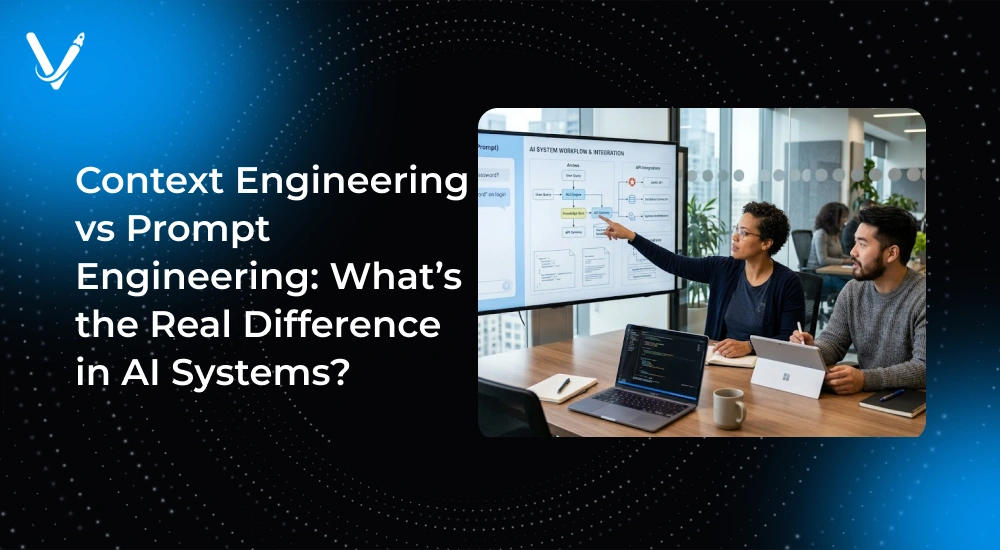
While both approaches influence AI behavior, they operate at different layers of the architecture.
| Factor | | Context Engineering |
| Primary Focus | Writing instructions | Managing contextual intelligence |
| Goal | Improve responses | Improve system behavior |
| Scope | Interaction-level | System-level |
| Memory Handling | Minimal | Persistent memory |
| Personalization | Limited | Advanced |
| Scalability | Moderate | High |
| Workflow Complexity | Simple tasks | Multi-step orchestration |
| Enterprise Readiness | Basic | Enterprise-grade |
| Tool Usage | Rare | Core capability |
The biggest difference in prompt engineering vs context engineering differences is that prompt engineering focuses on outputs, while context engineering focuses on environments.
Why Prompt Engineering Alone Is No Longer Enough
Prompt engineering remains valuable, but modern AI systems face challenges that prompts alone cannot solve.
Static Prompts Break at Scale
Enterprise environments constantly change.
Business systems evolve, workflows expand, and operational data updates continuously. Static prompts cannot adapt efficiently to dynamic environments.
Hallucinations Increase Without Retrieval
AI models without retrieval systems often generate inaccurate information.
This becomes dangerous in industries like:
- healthcare
- finance
- legal services
- enterprise operations
Context Loss Hurts User Experience
Traditional chat systems struggle to maintain long-term memory across sessions.
Users frequently need to repeat:
- preferences
- tasks
- workflows
- previous conversations
Token Limits Create Constraints
Even with larger context windows, models still face practical limitations.
AI systems must intelligently prioritize:
- documents
- memories
- workflow state
- business data
This is fundamentally a context engineering problem.
Enterprise AI Requires Orchestration
Modern AI workflow automation depends on:
- APIs
- databases
- external tools
- multi-step reasoning
- approval systems
- operational workflows
Prompting alone cannot coordinate complex enterprise environments.
The Rise of Context-Aware AI Systems
The shift toward context engineering is accelerating rapidly across generative AI systems.
Several technologies are driving this transition.
Retrieval-Augmented Generation (RAG)
RAG architecture allows AI systems to retrieve external information before generating responses.
Instead of relying only on training data, models can access:
- enterprise documents
- PDFs
- customer records
- support history
- operational databases
This improves accuracy significantly.
Vector Databases
Vector databases help AI systems retrieve semantically relevant information.
Popular platforms include:
- Pinecone
- Weaviate
- Chroma
- Milvus
These systems are foundational to modern context-aware AI infrastructure.
Memory Systems in AI
Persistent memory systems help AI applications remember:
- user behavior
- workflow history
- preferences
- prior interactions
This creates more adaptive AI experiences.
AI Orchestration Frameworks
Frameworks like:
- LangChain
- LangGraph
- LlamaIndex
- Semantic Kernel
coordinate:
- retrieval
- memory
- workflows
- tool usage
- reasoning pipelines
AI Agents and Tool Calling
Autonomous AI agents can:
- browse systems
- call APIs
- execute workflows
- generate reports
- coordinate tasks
These systems depend heavily on context engineering rather than prompting alone.
In-Context Learning vs Prompt Engineering
The discussion around in context learning vs prompt engineering often creates confusion because both approaches influence model behavior without changing model weights.
However, they work differently.
Prompt Engineering
Prompt engineering focuses on designing instructions that guide outputs.
Example:
“Write a professional email summarizing this report.”
The model follows the instruction directly.
In-Context Learning
In-context learning happens when models learn patterns from examples included inside the context window.
For example:
- showing several labeled examples
- asking the model to continue the pattern
The model temporarily adapts without retraining.
Context Learning vs Prompt Engineering
The debate around context learning vs prompt engineering becomes important in enterprise AI because modern systems increasingly combine:
- prompting
- retrieval
- memory
- contextual examples
- dynamic workflows
This creates more adaptive AI behavior.
Prompt Engineering vs In Context Learning
The difference between prompt engineering vs in context learning is that prompting focuses on instructions, while in-context learning focuses on pattern recognition from examples placed inside the context window.
Real-World Enterprise Use Cases
Healthcare
Healthcare AI systems retrieve:
- patient records
- medical guidelines
- compliance protocols
before generating recommendations.
This improves reliability and reduces operational risk.
Fintech
Financial AI systems rely on:
- transaction history
- fraud models
- compliance systems
- market data
to support intelligent decision-making.
Ecommerce
AI recommendation engines use:
- browsing history
- inventory systems
- pricing data
- customer behavior
to personalize shopping experiences.
SaaS Platforms
Modern SaaS AI copilots analyze:
- user activity
- tickets
- analytics
- workflow history
to automate operations and improve productivity.
Enterprise Search
AI-powered enterprise search systems combine:
- vector retrieval
- semantic search
- memory systems
- organizational knowledge
to improve information discovery.
Future of AI System Design
The future of AI infrastructure is moving toward intelligent orchestration rather than isolated prompting.
Long-Context AI Systems
Newer models support larger context windows, allowing:
- larger document analysis
- workflow continuity
- extended reasoning
However, larger context alone does not solve retrieval efficiency problems.
Persistent AI Memory
Future AI systems will maintain continuous memory across:
- applications
- workflows
- organizations
- user interactions
Multi-Agent AI Systems
Many enterprise AI ecosystems now involve multiple AI agents collaborating together.
This creates new orchestration challenges involving:
- memory synchronization
- context sharing
- workflow coordination
Adaptive AI Infrastructure
Enterprise AI systems increasingly depend on:
- dynamic context routing
- retrieval optimization
- orchestration layers
- workflow-aware reasoning
Context engineering is becoming central to scalable AI architecture.
Which Matters More: Prompt Engineering or Context Engineering?
The answer is not either-or.
Prompt engineering still matters because prompts shape:
- behavior
- reasoning
- formatting
- instructions
- communication style
But context engineering determines whether AI systems can scale effectively in real-world environments.
A strong prompt cannot compensate for:
- missing business data
- weak retrieval pipelines
- lack of memory
- disconnected workflows
- poor orchestration
In modern AI systems, prompts are increasingly becoming one layer inside larger context-aware architectures.
The companies building the most successful AI products today are not simply writing better prompts. They are building smarter AI environments.
Conclusion
The debate around context engineering vs prompt engineering reflects a larger shift happening across the AI industry.
Prompt engineering helped businesses unlock the first wave of generative AI adoption. It improved model usability, output quality, and interaction design.
But modern enterprise AI systems require much more than prompts.
Today’s AI applications increasingly depend on:
- retrieval systems
- vector databases
- workflow orchestration
- memory systems
- external tools
- dynamic context injection
This is why context engineering is becoming foundational to scalable AI architecture.
Understanding the prompt engineering vs context engineering differences is now critical for businesses building:
- AI agents
- enterprise copilots
- workflow automation systems
- AI-native software platforms
The future of AI will belong to systems that combine strong prompting with intelligent context orchestration.
Whether you are developing AI agents, enterprise copilots, workflow automation platforms, or context-aware AI applications, Vasundhara Infotech helps businesses design intelligent AI systems built for real-world scalability.





 May 19, 2026