


AI/ML
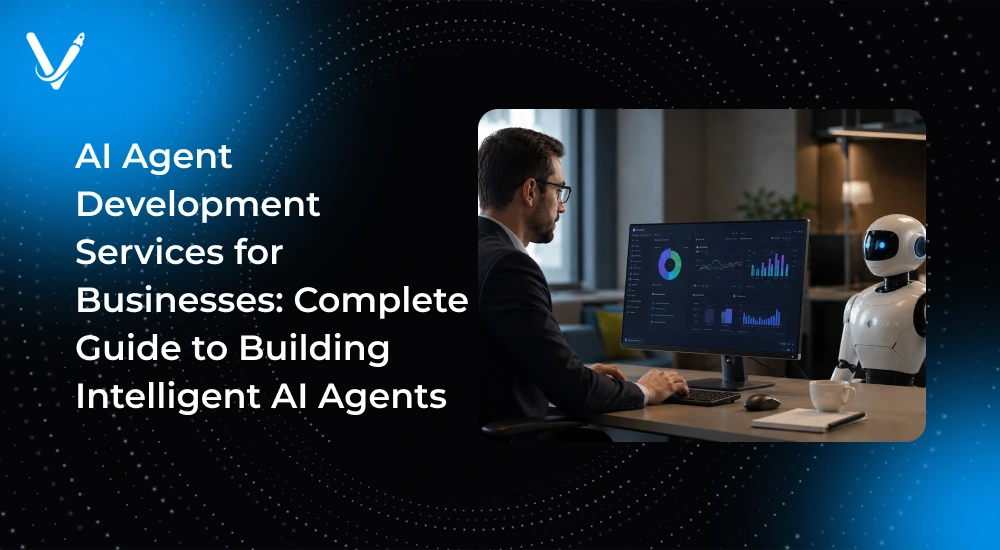
AI Agent Development Services for Businesses: Complete Guide to Building Intelligent AI Agents

 Jul 17, 2026





A chatbot answers a question. An AI agent gets the job done.
Ask a chatbot to book a meeting and it tells you how. Ask an agent, and it checks your calendar, finds a slot, sends the invite, and confirms. That is the shift happening in business software right now.
Modern AI agents can reason, plan, use tools, pull from data sources, and run multi-step tasks on their own. They are no longer stuck answering questions. Companies now use them for workflow automation, customer service, software development, and daily operations, and many start by scoping the work with an AI development services partner.
Adoption is moving fast. Big vendors are shipping agent platforms, and enterprises are running agents in real production work, not just demos.
This guide explains what AI agents are, how they are built, what they cost, and how to keep them safe. It is written for founders, CTOs, product leaders, operations teams, and enterprise buyers who have to make the call.
An AI agent is software that pursues a goal and completes tasks for you, not just a bot that replies. Google Cloud describes agents as systems that use AI to pursue goals and complete tasks on behalf of users. That word 'complete' is the whole difference.
A chatbot follows a script and answers within it. An agent breaks a goal into steps, picks tools, takes actions, and checks its own work. One talks. The other does.
An agent combines a language model with memory, reasoning, planning, and tool calling. IBM frames the agent as the model plus the tools and memory that let it act. The model thinks; the tools let it reach the real world.
• Planning and reasoning: it breaks a goal into an ordered set of steps.
• Tool usage: it calls APIs, databases, and apps to get things done.
• Memory systems: it remembers context within a task and across tasks.
• Autonomous task execution: it runs the steps and adjusts if one fails.
Put together, these turn intelligent AI agents for business into something closer to a digital worker than a search box. This is what agentic AI development services actually build.
Agents take on repetitive, multi-step work so staff spend their time on judgment calls, not busywork.
An agent can run a whole process end to end, across several systems, without a human clicking through each screen.
Business process automation with AI cuts the hours spent on routine tasks. The savings show up in the monthly report, not just the pitch deck.
Agents gather data, summarize it, and flag what matters, so people decide faster with better inputs.
Agents do not sleep. Support, monitoring, and processing run around the clock without overtime.
Customers get answers and actions in seconds, at any hour, in their own language.
The use cases span industries. Finance uses agents for fraud checks and reporting. Healthcare uses them for intake and scheduling. SaaS teams embed them as product features. Ecommerce uses them for support and order handling. Customer support teams use AI automation services to deflect routine tickets and route the hard ones to people.

Most companies start with one narrow agent that solves a painful, high-volume task. Multi-agent systems come later, once the first one earns trust.
A real agent needs more than a language model. Here are the layers that make it work.
• User interface layer: chat, voice, app, or an API another system calls.
• LLM layer: the model that reasons and decides what to do next.
• Memory layer: short-term context and long-term recall across tasks.
• Planning layer: breaks the goal into steps and orders them.
• Tool calling layer: connects to APIs, databases, and apps.
• Workflow orchestration layer: runs the steps and handles failures.
• Monitoring layer: logs every action so you can see what happened.
• Security layer: access control, data protection, and guardrails.
Skip a layer and the agent gets unreliable fast. Microsoft's guidance on AI agent design patterns covers how these pieces fit together for production systems, which is worth reading before you commit to a design.
Start with the outcome, not the tech. What task, done how many times, at what cost today? That number is your baseline.
Pick one high-volume, rule-heavy task. Avoid anything high-risk for the first build. Prove value before you expand.
Choose a model that fits your task and budget. You rarely need the biggest one. Match the tool to the job.
Give the agent the documents and data it needs, cleaned and current. A grounded agent is far more reliable than one working from memory.
Connect the APIs, databases, and apps the agent must use. This is where custom AI agent development gets real, and where most of the effort goes.
Decide what the agent should remember and for how long. Too little memory makes it forgetful; too much raises privacy questions.
Set approval steps, access limits, and logging before launch. This is the part good AI agent consulting services insist on early, not late.
Test against real tasks with known correct outcomes. Launch to a small internal group first, then widen once it holds up.
An agent resolves common tickets end to end, checks order status, issues refunds, and hands hard cases to a human with full context.
A sales agent scores inbound leads, asks follow-up questions, and books meetings for the ones worth a rep's time.
Staff ask a question and the agent answers from company policy, with a link to the source. This is a common, low-risk first build.
Agents read invoices, contracts, and forms, pull the key fields, and push them into the right system. This replaces hours of manual entry.
An agent runs a full process, such as onboarding a new client, across CRM, email, and billing, without a person driving each step.
HR and IT agents handle routine requests, from leave balances to password resets, so staff get instant answers.
Coding agents write, review, and test code. This is one of the fastest-growing agent use cases in real production teams.
An agent pulls data, runs the query, and returns a plain-language summary, so non-technical staff get answers without SQL.
The real payoff is AI workflow automation: agents that run whole processes, not single replies.
The agent carries out a sequence of steps in order, adjusting when something fails, instead of stopping at the first hurdle.
It moves work across CRM, email, ERP, and support tools, so data does not get re-typed between systems.
It gathers the facts, weighs them against your rules, and recommends an action for a person to approve.
It fetches the right record from the right system on demand, so staff stop hunting through tabs.
Over time, the logs show where a process is slow, giving you a clear target to fix.
For anything sensitive, the agent pauses for a human to approve. AI automation services should build this checkpoint in by default, not as an option.
An agent that can act is more useful and more risky than a chatbot. Governance is what keeps that power safe.
Limit what data the agent can see. Collect the minimum, know where it sits, and mask sensitive fields.
Give each agent only the permissions it needs. An agent should never have more access than the person it works for.
Keep a person in the loop for high-stakes actions. Approval steps are not friction; they are the safety net.
Log every action the agent takes and every tool it calls. When something goes wrong, the log is your first answer.
Guard against prompt injection and tool misuse. An agent with real access is a real attack surface.
Tell users when an agent acts on their behalf. Be clear about what it can and cannot do.
As agents get more autonomous, monitoring, approval workflows, and role-based access controls matter more, not less. Set them up before you scale, not after an incident.
An agent can be confidently wrong. Grounding it in real data and adding checks reduces this, but never assume zero risk.
If a tool the agent depends on fails, the whole task can stall. Build in retries and clear fallback rules.
Connecting the agent to your systems is usually the hardest and most expensive part, not the AI itself.
An agent with access to real systems is a target. Treat it like any privileged account and lock it down.
Model calls add up with volume. Watch the per-task cost, or a useful agent can quietly get expensive.
An agent that works for ten users may struggle at ten thousand. Plan the infrastructure early.
Staff resist tools they do not trust. Start with a helpful, low-risk agent and let results build confidence.
Several specialized agents that split a big job and hand work to each other, like a small team.
Whole processes that run with little human input, pausing only for approvals that matter.
Agents that sit alongside staff, take on a slice of the work, and learn the team's way of doing things.
Agents from different tools and teams talking to each other through shared standards, so work flows across boundaries.
A managed set of agents across the business, sharing data and rules on one backend. Building that reliably takes real engineering, so most teams pair it with custom software development rather than a stack of disconnected tools.
Agents tuned for one field, with the rules and data that field needs, often built on generative AI development services so the guardrails fit the domain. None of this is far off; the pieces ship today.
Ask to see real agents they have shipped, not slides. Tool calling, memory, and orchestration are hard to fake.
A good partner talks about layers, guardrails, and failure handling, not just the model.
They should raise access control, audit logs, and prompt injection before you do.
A partner who knows your field already understands your rules, your data, and your risks.
Agents need upkeep as models and tools change. You want a partner who stays past launch.
Ask how they take an agent from a pilot to production volume. Start with a small paid pilot before the full build.
AI agents are the step beyond chatbots. They reason, plan, use tools, and complete multi-step tasks instead of just answering questions.
The business case is strong: less manual work, faster processes, lower costs, and round-the-clock operations across finance, healthcare, SaaS, ecommerce, and support.
Building one takes more than a model. It takes memory, planning, tool calling, orchestration, monitoring, and security, built as proper layers.
Governance is what makes it safe. As agents act more on their own, access controls, approval steps, and audit trails become the difference between an asset and a liability.
Businesses evaluating AI agent development services should focus on solving high-value business problems, establishing strong governance controls, and building scalable agent architectures that can evolve over time.
If you are planning your first agent or scaling to many, our team can help you scope the use case, the architecture, and the governance before a line of code is written.