


AI/ML
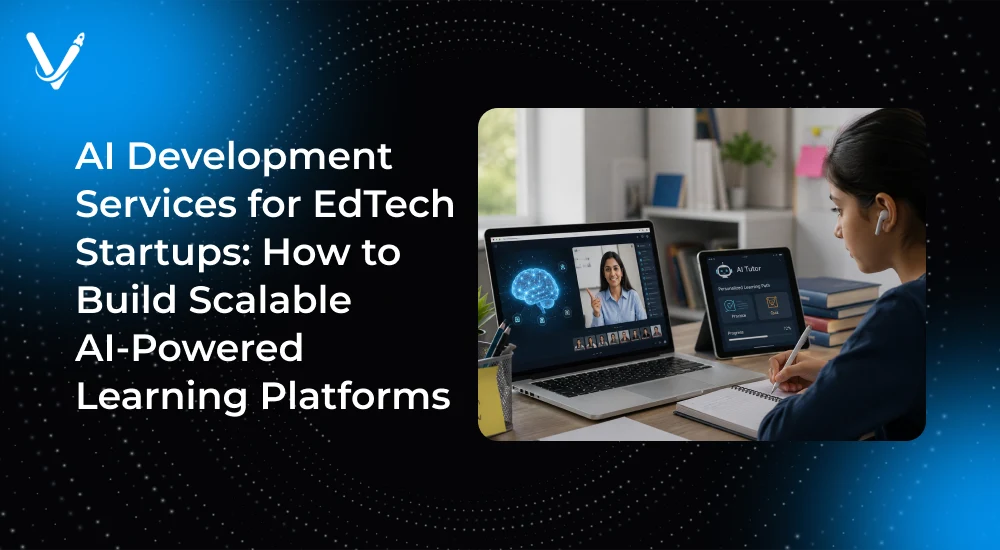
AI Development Services for EdTech Startups: How to Build Scalable AI-Powered Learning Platforms

 Jul 17, 2026





In one year, university student use of AI tools jumped from 66% to 92%. The HEPI student survey recorded that leap in a single academic year. Learners did not wait for permission. They just started.
That is the wave EdTech startups are riding. Personalized learning, AI tutors, and smart assistants are no longer nice extras. They are what users now expect.
Startups are investing because the demand is real. Platforms like Khan Academy's Khanmigo and Duolingo have shown that AI tutoring and adaptive learning work at scale. To build the same, most teams partner with an AI development services provider rather than hire a full AI team on day one.
AI-powered learning platforms are now a major trend across schools, universities, and corporate training. The startups that move first, and build carefully, win the market.
This guide walks through how to build one: the features, the LMS underneath, the steps, the costs, the compliance rules, and how to pick the right build partner.
The platform adjusts to each learner. Weak areas get more practice. Strong students skip ahead. This is the feature users ask for first.
An AI tutor gives one-to-one help at a cost no startup could match with human staff. It explains a concept as many times as a student needs.
Reminders, nudges, and instant answers keep learners moving. Dropout is often a timing problem, and AI can catch a stalled learner early.
Every click becomes a signal. Founders can see which lessons confuse people and which features actually drive completion.
Quizzes grade themselves. Written work gets a first-pass score in seconds. This frees your small team to focus on product, not marking.
The platform suggests the next best lesson. In learning products, this is one of the biggest drivers of retention.
Together, these educational technology solutions raise outcomes on one side and cut manual work on the other. That mix is why AI has moved from optional to essential in EdTech.
An AI-powered learning platform uses AI to personalize teaching, assess learners, and analyze progress. It responds to the individual, not the syllabus.
Old eLearning systems were digital filing cabinets. Everyone saw the same screens in the same order. AI changes the logic, so the system reacts to what each learner does.
• AI tutors that explain and guide on demand.
• Recommendation engines that pick the next lesson.
• Adaptive learning that shifts difficulty with performance.
• Learning analytics that flag risk early.
• Conversational learning assistants that answer in plain language.
Students get help that fits them and feedback that arrives at once. Educators get time back and a clear view of who needs support. Both sides win.
You cannot build everything at once. Here is what matters, and why each one helps you scale.

Start with one or two that solve your users' biggest pain. Add the rest once the core proves itself.
Behind every AI learning product sits an LMS. If the base is weak, no amount of AI on top will save it.
• User management: roles, permissions, and single sign-on.
• Course management: authoring, versioning, and scheduling.
• Assessment systems: quizzes, assignments, and auto-grading.
• Mobile learning: responsive or native, with offline support.
• Analytics: learner, cohort, and org-level views.
• Integrations: student records, video, and payment tools.
• AI layer: recommendations, tutoring, and automation on top.
Learning management system development today starts with the data model. Modern LMS platforms increasingly build in AI-driven recommendations and automation, so plan for that layer from the first sprint, not as an afterthought.
K-12, university, or corporate learners each need a different product. Pick one to start. Trying to serve all three at once slows you down.
List every feature, then cut it in half. Keep the one or two that solve your users' worst problem.
Ship a working version in eight to twelve weeks. Get it in front of real learners before spending the rest of the budget.
Almost nobody needs to train a model from scratch. Existing models plus your own content cover most cases, which is why teams often use generative AI development services instead of hiring a research team.
Clean, tag, and store your content and learner data. Most of the work in an AI project is data plumbing, not model tuning.
The best AI is invisible. Learners should feel helped, not managed. Keep the interface simple.
Build a test set of real questions with correct answers. Have educators grade the output. Fix the weak spots before launch.
Plan for traffic spikes at exam time and enrolment. Cloud auto-scaling handles this, but budget for the bill.
Cost depends on scope, features, and how clean your data is. These are working ranges, not fixed quotes.

Development complexity, the AI features you pick, integrations, security, infrastructure, and ongoing maintenance all shift the cost. Two factors move it most: how many systems you connect, and how clean your data is.
Pricing from an education software development services team also depends on scope and region. A good EdTech software development company will break the estimate down feature by feature, and budget for the monthly run cost, not just the build.
Khan Academy's Khanmigo guides a student toward the answer instead of handing it over. That is a design choice worth copying.
Duolingo adjusts difficulty from every answer. The AI is invisible, which is exactly the point.
QANDA, used by millions of students across Asia, lets a learner photograph a maths problem and get a step-by-step solution. It shows how large-scale adoption follows when the tool solves a real, daily pain.
Canvas, Moodle, and their peers keep adding recommendations and analytics. Startups with an unusual angle still build their own.
Universities use chatbots for admissions, fees, and timetables. The wins came from timely nudges, not from clever AI.
Education handles data about minors, so the bar is high. UNESCO published the first global guidance on generative AI in education, and its message is blunt: protect student data, keep humans in control, and make sure AI narrows gaps rather than widening them.
Collect the minimum. Know where the data sits. Ask whether a vendor trains models on your learners' work, and get it in writing.
In Europe, consent, data residency, and the right to deletion all apply. Design for deletion early; retrofitting it is painful.
In the US, FERPA protects student records. Any vendor touching them needs the right agreements and controls.
No grade or admission should rest on a model alone. A person signs off on anything that affects a learner.
A model trained on one group can misjudge another. Test grading and recommendations across different learners before launch, then keep testing.
Every AI-generated lesson needs a human reviewer and a review date. Major AI labs, including Google AI, publish responsible AI principles that are a useful reference when you set your own rules. Address compliance early; it is far cheaper than fixing it later.
Messy content and thin learner data produce weak AI. Cleaning data is most of the work, and it is not glamorous.
Teachers and learners resist tools that feel forced. Make the AI helpful and optional, not another hoop to jump through.
AI-generated content can be wrong and sound confident. Every item needs a human review before it reaches a learner.
Model calls and storage cost money every month. Budget for run cost, not just build cost, or the unit economics break.
Traffic spikes at exam time. Plan for it, or the platform falls over when it matters most.
Privacy law is moving. Build the audit trail now so you can prove compliance later.
Course drafts, quiz banks, and translation in hours instead of months. The review step stays human.
Assistants that follow a learner across a whole program, not just one lesson.
Tutors that adapt to a learner's exact level and explain in the way that works for them.
Curricula assembled per learner from a bank of modules, based on goals and current skills.
Systems that plan a study path, act on it, and check their own work. Building that reliably takes real engineering, so most teams pair it with custom software development rather than a stock tool. The same technology is now reshaping workforce training too.
This shift is widely tracked. OECD research on skills keeps making the same point: learning is continuous now, which turns education software into permanent infrastructure.
Conclusion
Ask to see real AI work: models, recommendation engines, analytics. A landing page that says 'AI' is not proof.
A partner who has shipped a learning product already knows the traps around grading, rosters, and parent access.
Ask how they handle traffic spikes and growing content. A pilot and a platform are different builds.
Encryption, access control, and audit logs should be standard, not add-ons you request.
AI systems are not projects that end at launch. Models drift and content ages. You want a partner who stays.
Start with a small paid pilot before committing to a full build. It tells you more than any sales call.
AI has moved from optional to essential in EdTech. Learners expect personalization, instant help, and tools that adapt to them.
The features that matter most are AI tutors, personalized paths, adaptive assessments, and analytics, all sitting on a solid LMS. Build the base well, then layer AI on top.
Costs are real and so are the challenges: data quality, content accuracy, run cost, and scale. Plan for them from the start.
Compliance is not a line item to cut. With student data, it is what keeps the product alive.
EdTech startups investing in AI-powered learning platforms should focus on personalization, scalability, learner outcomes, and long-term platform growth rather than simply adding AI features.
If you are planning an AI learning platform or an upgrade to an existing one, our team can help you scope it around those four things.