


AI/ML
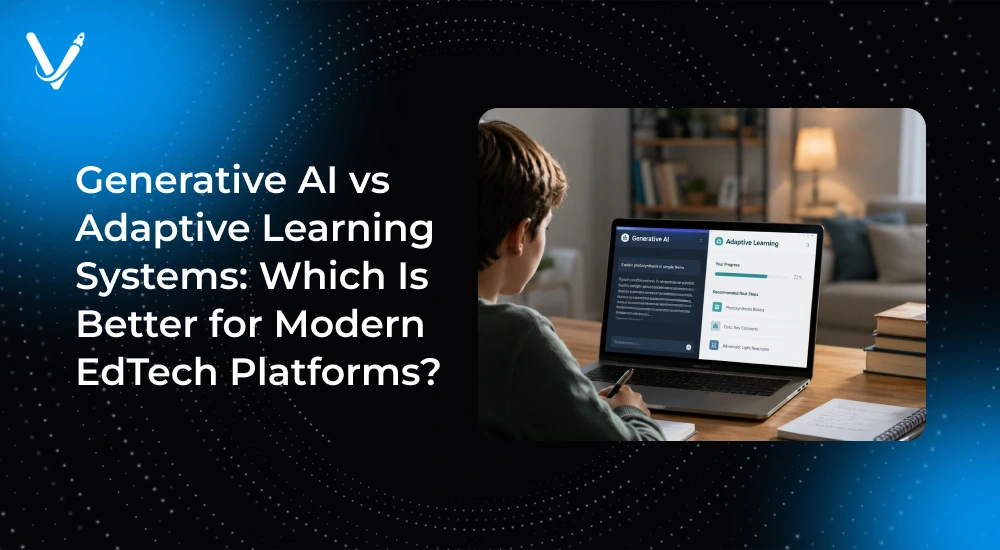
Generative AI vs Adaptive Learning Systems: Which Is Better for Modern EdTech Platforms?

 Jul 20, 2026





University student use of AI tools jumped from 66% to 92% in a single academic year, according to the HEPI student survey. Teachers followed close behind, with roughly 60% of US K-12 teachers using an AI tool during the 2024 to 2025 school year.
That has left EdTech companies with a hard question. Two technologies promise personalized learning, and they work in completely different ways.
Generative AI creates content and holds conversations. Adaptive learning tracks a learner and decides what to serve next. Both claim to personalize, and teams evaluating AI development services usually have to pick one to build first.
Here is the short answer: most serious platforms end up running both. But the order you build them in, and the budget each takes, matters a great deal.
This guide explains what each technology does, how they compare on cost and complexity, where each wins, and how they fit together in one architecture.
Generative AI creates new content in response to a request. In education, that means lessons, quizzes, explanations, and conversation.
It runs on large language models trained on huge amounts of text. Given a prompt, the model predicts and produces an answer rather than picking from a fixed list.
This is why it can explain the same concept five different ways for five different students. Nothing was scripted in advance.
• AI tutors that answer questions and guide a student through a problem.
• Lesson planning and draft course material in minutes rather than weeks.
• Quiz and question bank generation at scale.
• Personalized explanations tuned to a learner's level and language.
• Student support that answers routine questions any hour.
The catch is that a model can be confidently wrong. Any serious build pairs it with trusted source material and human review, which is standard practice in generative AI development services. Without that, AI-powered learning platforms ship errors at scale.
An adaptive learning system watches how a learner performs and adjusts the content, pace, and difficulty to match.
Adaptive algorithms score each interaction. A student model tracks what the learner knows and where the gaps are. A recommendation engine picks the next item.
Learning analytics sit underneath, turning clicks and answers into a picture of progress.
• Student modeling that maps knowledge and skill level.
• Personalized learning paths built per learner from a shared library.
• Dynamic assessments where the next question depends on the last answer.
• Recommendation engines that choose the next lesson or practice set.
• Learning analytics that flag risk and measure progress.
Adaptive learning platform development is really data engineering with teaching logic on top. Personalized learning platform development lives or dies on how well that data model is designed.

The pattern is worth reading twice. Generative AI personalizes how something is explained. Adaptive learning personalizes what comes next.
Course drafts, worked examples, and question banks in hours instead of months. For a startup with a small content team, this is often the single biggest unlock.
Khan Academy's Khanmigo is the clearest example. It guides a student toward the answer rather than handing it over, which is a design choice, not a technical one.
Quizzes generate and grade themselves. Written answers get a first-pass score and specific feedback in seconds.
The same idea, explained at a new level or in another language. Or with a fresh analogy. All on demand.
In the Gallup survey, teachers using AI weekly reported saving close to six weeks of work across a school year. That time goes back into teaching.
Learners get an answer at 11 p.m. instead of waiting until Monday. Fewer of them stall and drop out.
Each learner moves through the same library on a different route. Strong students skip ahead; weaker ones get more practice.
Assessment stops being an event and becomes a constant signal. Every answer updates the learner model.
Founders and educators see which modules confuse people and which cohorts fall behind, with numbers rather than guesses.
The system pinpoints exactly which sub-skill is missing, not just that a student failed a test.
Duolingo is the everyday example. Difficulty shifts from every answer, and the AI stays invisible. That is the point.
Studies across many school and training settings point the same way. Learners do better with adaptive delivery than with one-size-fits-all courses. Results shift by subject and by how well it is built. Treat the numbers as a direction, not a promise.
Yes, and this is where the interesting products are being built.
Researchers have made this argument directly. A position paper on combining generative AI with adaptive learning argues that the union of the two will shape the next stage of learning formats, rather than one replacing the other.
The adaptive engine decides what a learner needs. The generative layer produces it. That is the whole idea in one sentence.
• AI-generated lessons, created on demand for a detected gap.
• Adaptive delivery that decides when and at what level to serve them.
• Personalized tutoring that already knows the learner's history.
• AI recommendations informed by real analytics, not guesses.
• Intelligent feedback that explains why an answer was wrong.
• An AI-powered LMS that holds both layers on one data model.
Alone, each has a clear weakness. Generative AI without analytics does not know what a learner needs. Adaptive learning without generation can only serve what someone already wrote. Together, they cover each other's gaps.
Business challenge: Teachers spend hours on lesson prep and marking, with little time for struggling students.
AI solution: Generative AI drafts lessons and grades work. Adaptive delivery assigns practice by skill gap.
Measurable outcome: Teachers win back hours each week. Struggling pupils get help sooner.
Business challenge: Large cohorts make individual support impossible, and dropout shows up too late to fix.
AI solution: Adaptive analytics flag students at risk. AI tutors help them at any hour.
Measurable outcome: Higher retention and better course completion rates.
Business challenge: Generic compliance training that staff click through without learning anything.
AI solution: Adaptive paths built by role and skill. Generative AI writes the scenario content.
Measurable outcome: Shorter training time and better assessment scores per employee.
Business challenge: Candidates need endless practice questions, and writing them is slow and costly.
AI solution: Generative AI writes the question banks. Adaptive testing then targets weak spots.
Measurable outcome: Higher pass rates and far lower content production cost.
Business challenge: Learners need to practise real conversation. A fixed course cannot give them that.
AI solution: Generative AI runs the open conversation. Adaptive logic sets the words and the difficulty.
Measurable outcome: Longer daily engagement and faster progress through levels.
Business challenge: A small team must ship a differentiated product before funding runs out.
AI solution: Start with generative AI for speed, then add adaptive logic as usage data accumulates.
Measurable outcome: The product ships sooner. Over time, the data becomes a moat.
The two technologies have very different cost curves. This surprises most first-time buyers.

Working Cost Ranges

Generative AI is cheaper to start. It also bills you every month. Adaptive learning costs more upfront, then runs cheaply. Education software development services should price both curves for you. AI application development services often suggest starting generative, then adding adaptive once you have real usage data. For the rest of the build, custom AI development services and custom software development cover the LMS and integrations that hold it together.
Education handles data about children. That sets the bar higher than in most fields. UNESCO has published global guidance on AI in education, and the message is direct: protect student data, keep humans in control, and make sure AI narrows gaps rather than widening them.
Collect the minimum. Know where data sits. Ask whether a vendor trains models on your learners' work, and get the answer in writing.
In Europe, consent, data residency, and the right to deletion all apply. Adaptive systems store detailed learner profiles, so design for deletion from the start.
In the US, FERPA protects student education records. Any vendor touching them needs the right agreements and access controls.
Tell learners when AI generated content or influenced a grade. Hidden AI destroys trust quickly.
No grade or admission decision should rest on a model alone. A person signs off on anything affecting a learner's record.
Test grading and recommendations across different learner groups before launch, then keep testing. The OECD Digital Education Outlook makes a related point worth remembering: AI works best when it sits on clean data and clear rules.
Start with generative AI. It ships faster and shows value sooner. Add adaptive logic once you have real usage data to feed it.
Generative AI first, for lesson prep and grading. Most schools lack the content tagging that adaptive systems need.
Adaptive learning matters more here. Large cohorts and retention analytics are where the value sits. Add AI tutoring on top.
Hybrid, without question. At this scale both layers pay for themselves, and the data advantage compounds.
Adaptive paths by role, with generative AI producing scenario content. Skills tracking is usually the real requirement.
Hybrid. Your customers will ask for both, and building them on one data model is far cheaper than bolting on a second system later.
A simple rule: if you need content and conversation, go generative. If you need sequencing and analytics, go adaptive. If you need learners to actually finish, you need both.
Systems that plan a study path, act on it, and check their own work, rather than waiting for each instruction.
Tutors that stay with a learner across a whole program and remember what happened last month.
The line between the two technologies is already blurring. Adaptive engines increasingly use models to decide, not just rules.
The LMS becomes the brain rather than the shelf, holding analytics, generation, and delivery in one place.
Curricula assembled per learner from a module bank, based on goals and current skills.
Assistants for teachers and trainers, not just students. This is where much of the near-term productivity gain sits.
Generative AI and adaptive learning solve different problems. One creates content and conversation. The other tracks learners and decides what comes next.
Generative AI is faster and cheaper to launch, with an ongoing usage bill. Adaptive learning costs more upfront, then scales cheaply and compounds as data accumulates.
Three things decide which to build first. How big your content library is. How clean your data is. How much learner history you already hold.
Compliance is not optional. Student privacy, FERPA, GDPR, transparency, human oversight, and bias testing belong in the plan from week one.
If you are building the next wave of EdTech, look at both. Weigh generative AI and adaptive learning together. The goal is learning that scales, fits each student, and can be measured.
If you are weighing the two for your platform, our team can help you map the sequence, the cost curve, and the data model before development starts.