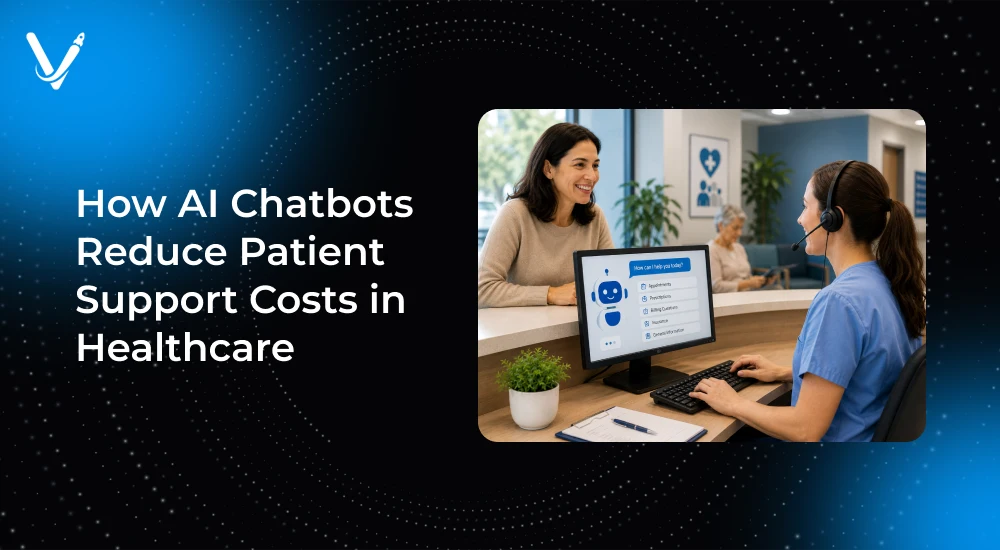
AI chatbots in healthcare are changing how hospitals and clinics support patients, and how much that support costs. Costs are rising, staff are stretched thin, and patients want fast answers. Chatbots help with all three.
The market shows the shift. The healthcare chatbot market was worth about 787 million dollars in 2023 and is growing more than 20 percent a year, per Grand View Research. McKinsey has also noted the strong role AI can play in cutting healthcare admin costs.
Patient support automation is now a priority, not a nice to have. If you want help building it, our AI chatbot development team builds secure healthcare bots. This guide shows how chatbots cut costs, where they help most, and how to choose one.
What are AI chatbots in healthcare?
AI chatbots in healthcare are software tools that talk with patients in plain language to answer questions, book visits, and guide next steps. They use AI to understand requests and reply in a helpful way.
These bots run on two key ideas. The first is natural language processing, or NLP, which lets the bot understand what a patient means. The second is conversational AI, which lets it hold a real back-and-forth, not just fixed scripts.
People also call them AI healthcare virtual assistants. They live on a website, an app, or a phone line. Their job is patient support automation: taking routine work off staff so care teams can focus on patients.
Here is how they compare to old-style support:
| Factor | Traditional Patient Support | AI Chatbots |
| Hours | Office hours only | 24/7, any time |
| Wait times | Long phone queues | Instant answers |
| Cost | Rises with staff | Lower at scale |
| Volume | Limited by staff | Handles high volume |
| Consistency | Varies by person | Same every time |
Why patient support costs are rising
Patient support costs are rising because of high call volume, staff shortages, and heavy admin work. The pressure is real and growing.
The World Health Organization points to a large, growing shortage of health workers worldwide. When staff are scarce, every routine task costs more. Here is where the money goes.
• Call center costs. Phone support needs staff, space, and tools.
• Administrative burden. Booking, forms, and follow-ups eat staff time.
• Staff shortages. Fewer workers means higher cost per task.
• Appointment scheduling. Booking by phone is slow and repetitive.
• High inquiry volume. Simple questions flood the front desk.
• Engagement gaps. Missed follow-ups lead to no-shows and readmissions.
Each of these adds cost. Together, they strain budgets and burn out staff. This is the problem AI chatbots are built to ease.
How AI chatbots reduce patient support costs in healthcare
AI chatbots reduce patient support costs by automating the routine tasks that eat the most staff time. Here is how, task by task.
| Task | How the chatbot cuts cost |
| Appointment scheduling | Books, moves, and cancels without a call |
| FAQ automation | Answers common questions instantly |
| Patient triage | Guides patients to the right next step |
| Medication reminders | Sends nudges to cut missed doses |
| Insurance verification | Gathers and checks details up front |
| Patient follow-up | Checks in after visits at scale |
| Call center automation | Deflects routine calls, cuts hold times |
| Admin tasks | Collects forms and updates records |
The pattern is simple. Every task the bot handles is a task staff no longer do by hand. That cuts call volume, shortens wait times, and lowers cost per interaction. Staff then focus on the calls that truly need a human.
Top use cases of AI chatbots in healthcare
The top use cases run from scheduling and intake to voice AI support. Here are ten, each with the problem, the solution, and the business impact.
1. Appointment scheduling
Problem: Phone lines clog with booking requests.
Solution: A bot books, moves, and cancels visits.
Business impact: Fewer calls and fewer no-shows.
2. Patient intake
Problem: Paper intake is slow and error-prone.
Solution: A bot collects intake before the visit.
Business impact: Faster visits and cleaner data.
3. Insurance verification
Problem: Checking coverage takes staff time.
Solution: A bot gathers and checks details.
Business impact: Less admin work and fewer delays.
4. Billing support
Problem: Billing questions overwhelm staff.
Solution: A bot answers common billing queries.
Business impact: Lower call volume and faster answers.
5. Telehealth assistance
Problem: Patients need help before virtual visits.
Solution: A bot guides setup and prep.
Business impact: Smoother telehealth and fewer no-shows.
6. Medication reminders
Problem: Patients forget doses and refills.
Solution: A bot sends timely reminders.
Business impact: Better adherence and outcomes.
7. Post-discharge follow-up
Problem: Follow-up calls are hard to scale.
Solution: A bot checks in after discharge.
Business impact: Fewer readmissions and better care.
8. Patient education
Problem: Staff repeat the same guidance often.
Solution: A bot shares clear, approved info.
Business impact: More informed, confident patients.
9. Symptom assessment
Problem: Patients are unsure where to go.
Solution: A bot guides next steps, not a diagnosis.
Business impact: Right care, at the right time.
10. Voice AI support
Problem: Call centers are costly and slow.
Solution: Voice AI handles routine calls 24/7.
Business impact: Lower cost and shorter wait times.
Solutions for hospitals and clinics
Healthcare AI chatbot solutions fit both large hospitals and small clinics, with the right build for each.
Hospital chatbot software handles high volume across many departments. It routes patients, books visits, and answers questions at scale. Healthcare chatbots for clinics are lighter and focused, often built for booking, FAQs, and reminders. For a look at custom builds, see our guide to custom AI development.
Medical AI chatbot services also cover patient engagement chatbot healthcare needs, like reminders, education, and follow-up. And AI customer support in healthcare ties it all together, giving patients quick, clear help any hour of the day.
The right solution depends on your size and goals. A big health system needs scale and deep integration. A small clinic needs a simple, affordable bot that just works.
The best AI chatbot platforms for automating appointment scheduling in healthcare share four traits: strong scheduling, easy integration, and solid compliance. Use these traits to compare your options.
| What to compare | What to look for |
| Platform capabilities | Natural chat, voice, and 24/7 booking |
| Scheduling automation | Books, moves, and cancels in real time |
| Integration support | Connects to your EHR and calendar |
| Compliance features | HIPAA support and a signed BAA |
Rather than chase a brand name, score platforms on these four traits for your setup. Ask for a demo on your real booking flow, and confirm the compliance details before you commit.
Key features to look for
The key features of a healthcare AI chatbot are HIPAA compliance, EHR integration, multilingual support, voice AI, analytics, human escalation, omnichannel support, and strong security.
• HIPAA compliance: built in from day one
• EHR integration: connects to Epic, Cerner, and more
• Multilingual support: serves diverse patients
• Voice AI: handles calls, not just chat
• Analytics: tracks usage and outcomes
• Human escalation: hands hard cases to staff
• Omnichannel support: web, app, SMS, and phone
• Security and encryption: protects patient data
AI compliance and security
Any healthcare chatbot must protect patient data under HIPAA, with strong security and human oversight. Compliance is not optional in healthcare.
• HIPAA. Follow US rules for handling patient data.
• Data privacy. Collect only what you need, and keep it safe.
• Security controls. Use encryption, access controls, and audit logs.
• Human oversight. Keep staff in the loop for hard cases.
• Responsible AI. Check output for accuracy and safety.
One rule holds throughout. Do not take a vendor’s word on safety. Ask for proof, confirm the BAA, and test the controls before you go live.
Healthcare AI chatbot ROI and cost savings
The ROI of a healthcare chatbot comes from lower staffing and call-center costs, faster responses, and happier patients. Here is where the savings show up.
| Area | How it saves or earns |
| Staffing costs | Fewer routine tasks for staff |
| Response times | Instant answers, day or night |
| Call-center costs | Fewer calls and shorter hold times |
| Patient satisfaction | Quick, clear help builds loyalty |
To measure ROI, track a few numbers before and after launch: call volume, wait times, no-show rates, and cost per interaction. Compare the bot’s cost to the staff time it saves. Most healthcare bots pay off through fewer routine calls and freed staff time.
The future of AI chatbots in healthcare
The future is generative, voice-first, and agentic, with bots moving from answering questions to running whole care workflows.
• Generative AI. Bots hold natural, flexible conversations.
• Voice AI. Phone support gets automated at scale.
• AI agents. Bots complete multi-step tasks on their own.
• Engagement automation. Reminders and follow-ups run without staff.
• Personalized care. Each patient gets tailored guidance.
The takeaway is clear. Healthcare chatbots are moving from simple helpers to smart, always-on support. Teams that adopt them well will cut costs and serve patients better.
Conclusion
Healthcare providers are adopting AI chatbots for a simple reason. They cut costs while making patient support faster and easier. As budgets tighten and staff stay scarce, that combination is hard to beat.
The savings are real: fewer routine calls, less admin work, and lower call-center costs. The patient experience improves too, with instant answers, easy booking, and timely follow-ups. Staff get to focus on care, not repeat questions.
Looking ahead, chatbots are getting more generative, voice-first, and agentic. The teams that adopt them well, with strong compliance and clear goals, will lead on both cost and care.
Ready to cut patient support costs with a secure chatbot? At Vasundhara Infotech, we help hospitals and clinics build custom, HIPAA-aware AI chatbots and healthcare automation. Start with one use case, prove the value, then scale.





 Jul 6, 2026