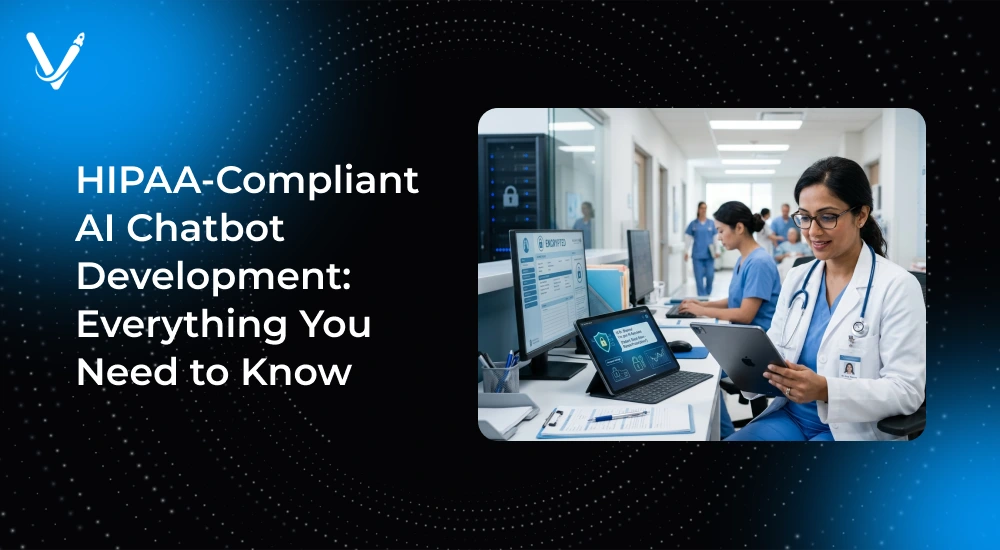
HIPAA-compliant AI is now a must-have for any healthcare organization using chatbots. AI chatbots can book visits, answer questions, and ease staff load. But in healthcare, they must protect patient data at every step.
The market is growing fast. The healthcare chatbot market was worth about 787 million dollars in 2023 and is growing more than 20 percent a year, per Grand View Research. As use rises, so does the risk of a data breach or a rule broken.
A non-compliant bot can lead to heavy fines and lost trust. That is why HIPAA-compliant AI chatbot development matters so much. If you want expert help, our AI chatbot development team builds secure healthcare bots. This guide covers what it is, the rules, the process, and how to choose a partner.
What is HIPAA-compliant AI?
HIPAA-compliant AI is any AI system that meets US rules for protecting patient health data. In healthcare, that is not optional.
HIPAA is the US law that protects patient data. You can read the official rules at HHS.gov. The data it protects is called Protected Health Information, or PHI. This includes names, records, and anything that links health data to a person.
When an AI system touches PHI, it must follow HIPAA. That means the bot, the servers, and the vendor all have to meet the rules. A standard chatbot does not do this by default.
Why HIPAA compliance matters for healthcare AI
HIPAA compliance matters because it protects patient privacy, meets the law, and keeps patient trust. The cost of getting it wrong is high.
Healthcare data breaches are the costliest of any industry, with an average cost near 10 million dollars, per IBM’s Cost of a Data Breach report. One weak chatbot can open the door to that kind of loss. Here is what is at stake.
• Patient privacy. Health data is deeply personal and must stay safe.
• Regulatory rules. HIPAA fines can reach millions per violation type per year.
• Data security. A breach can expose thousands of patient records.
• Legal liability. Non-compliance can bring lawsuits and penalties.
• Trust. Patients must feel sure their data is safe with you.
In short, compliance is not just a legal box. It protects your patients, your budget, and your name. That is why HIPAA-compliant conversational AI is worth the extra care.
Key requirements for HIPAA-compliant AI chatbot development
A HIPAA-compliant chatbot needs a signed BAA, encryption, access controls, audit logs, data policies, authentication, monitoring, and risk assessments. Here is the checklist.
These are not optional add-ons. They are the base of any safe build. A real HIPAA-compliant chatbot solution has all of them from day one. For plain-language explainers on these rules, the HIPAA Journal is a helpful resource.
How HIPAA-compliant conversational AI works
A HIPAA-compliant chatbot moves a patient request through secure steps, from chat to a safe reply. Here is the flow, stage by stage.
The key is that PHI stays protected at every stage. Data is encrypted, access is limited, and every step is logged. When the bot is unsure, or the case is sensitive, it hands off to staff.
Features of HIPAA-compliant chatbot solutions
HIPAA-compliant chatbot solutions support scheduling, patient support, intake, insurance, billing, reminders, telehealth, many languages, and voice AI. Each feature is built to protect PHI.
Enterprise healthcare AI chatbot solutions
Enterprise healthcare AI chatbot solutions serve hospitals, health systems, clinics, telehealth providers, and insurers, each with its own needs.
A hospital or health system needs scale, deep EHR links, and strong governance. A clinic needs a simpler, affordable bot. Telehealth providers need smooth support before and after virtual visits. Insurers need secure help with claims and coverage. For custom builds across these settings, see our guide to custom AI development.
Enterprise deployment adds more needs. You must handle high volume, connect to many systems, and pass strict security reviews. You also need clear admin controls, audit trails, and a plan for scale. A good partner builds all of this in from the start.
Healthcare chatbot software development process
Healthcare chatbot software development follows eight clear steps, from gathering needs to ongoing monitoring.
Compliance runs through every step, not just one. That is what sets healthcare builds apart. Skipping the security and HIPAA steps is the fastest way to a costly mistake.
Benefits of HIPAA-compliant AI chatbots
The benefits include lower admin work, a better patient experience, 24/7 support, faster replies, lower costs, higher productivity, and stronger compliance.
The payoff is both financial and human. You cut costs and free staff, while patients get faster, safer support. And because the bot is compliant, you gain those wins without adding risk.
Common challenges and how to solve them
The main challenges are data privacy, EHR integration, security risks, AI errors, monitoring, and vendor choice. Here is how to handle each.
AI errors deserve extra care. A bot can sound sure but be wrong. In healthcare, that is a real risk. The fix is simple: the bot should not diagnose, should admit doubt, and should pass hard cases to staff.
How to choose a HIPAA-compliant AI partner
Choose a partner with real healthcare experience, deep HIPAA expertise, strong security, AI skill, EHR integration, and long-term support. Use this checklist.
• Healthcare experience: real health projects and case studies
• HIPAA expertise: a clear, documented process and a BAA
• Security capabilities: encryption, access controls, and audits
• AI expertise: modern NLP, gen AI, and voice AI
• EHR integrations: proven links to Epic, Cerner, and more
• Long-term support: updates and care after launch
Ask for proof, not promises. A strong partner will show you their security setup and sign a BAA without pushback. If a vendor dodges these questions, keep looking.
The future of HIPAA-compliant conversational AI
The future is generative, voice-first, and agentic, with AI moving from answering questions to running whole care workflows.
• Generative AI. Bots hold natural, flexible conversations.
• Voice AI. Phone support gets automated at scale.
• AI agents. Bots complete multi-step tasks on their own.
• Personalized care. Each patient gets tailored guidance.
• Agentic workflows. AI plans and runs care tasks end to end.
• Healthcare automation. Whole admin pipelines run with less manual work.
These shifts bring big gains, but compliance must keep pace. McKinsey has noted the strong role AI can play in healthcare. The winners will pair that power with strong, built-in safeguards.
Conclusion
HIPAA compliance matters because it protects your patients, your budget, and your name. In healthcare, an AI chatbot that is not compliant is not an option. The risk is simply too high.
A compliant chatbot brings real gains: lower admin work, faster support, 24/7 help, and happier patients. And because the safeguards are built in, you get those wins without adding risk. The keys are a signed BAA, strong security, EHR integration, and human oversight.
Looking ahead, healthcare AI is getting more generative, voice-first, and agentic. The teams that pair that power with strong compliance will lead on both cost and care.
Ready to build a secure, HIPAA-compliant chatbot? At Vasundhara Infotech, we help hospitals and clinics build custom, HIPAA-aware AI chatbots and healthcare software. Start with one use case, prove the value, then scale.





 Jul 7, 2026