


AI/ML
Best AI Chatbot Development Companies in the USA for Healthcare

 Jul 2, 2026





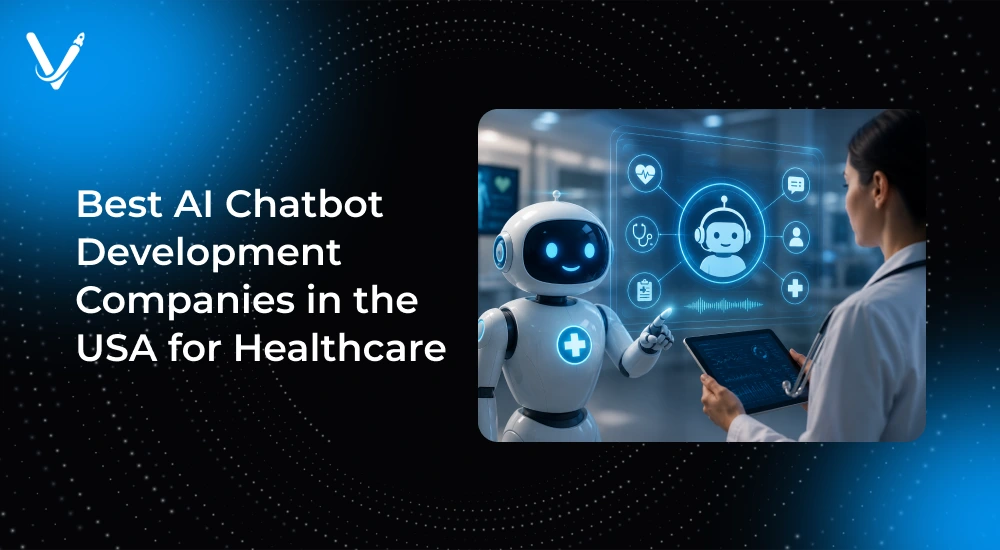
Choosing among the best AI chatbot development companies in the USA for healthcare is now a core decision for hospitals and health systems. Healthcare AI is growing fast, patients expect instant answers, and staff are stretched thin. AI chatbots help close that gap.
The numbers show why. The healthcare chatbot market was worth about 787 million dollars in 2023 and is growing more than 20 percent a year, per Grand View Research. Accenture has estimated AI could save the US healthcare economy up to 150 billion dollars a year by 2026. And the World Health Organization points to a large, growing shortage of health workers worldwide, near 10 million by 2030.
Against that backdrop, chatbots handle routine work so staff can focus on care. But healthcare is not like other fields. Any bot must protect patient data under HIPAA and connect to core systems like the EHR. That raises the bar for who you hire to build it.
This guide covers why hospitals adopt chatbots, what makes a healthcare bot different, how to judge a partner, twelve companies to know, cost ranges, use cases, and how to choose.
Healthcare organizations need AI chatbots because they ease staffing pressure, cut wait times, and meet rising patient demand for instant, round-the-clock help.
Hospitals face a hard mix: packed schedules, thin staffing, and patients who expect fast answers. Chatbots absorb the routine load. Here is where they help most.

A healthcare AI chatbot is different because it must protect patient data under HIPAA, connect to clinical systems, and follow healthcare workflows. A generic bot cannot do this safely.
The differences run deep:
• HIPAA compliance. It must follow US rules for patient data.
• PHI protection. It safeguards protected health information at every step.
• Secure infrastructure. Encryption, access controls, and audit logs are built in.
• EHR integration. It connects to systems like Epic and Cerner.
• Healthcare workflows. It fits triage, intake, and care paths.
• Voice AI. It can handle calls, not just chat.
Here is a clear side-by-side:

For the official rules, see HHS on HIPAA and the HHS Security Rule. For EHR and interoperability standards like FHIR, HealthIT.gov (ONC) is the primary source. Any partner you pick should know these well.
We assessed companies on healthcare expertise, HIPAA support, EHR integration, AI capabilities, scalability, enterprise support, reviews, and reputation. Use this same framework to score your own shortlist.
This is an evaluation framework, not a fixed ranking. Weight each factor for your needs, then score vendors yourself.

Score each vendor from 1 to 5 on every factor, multiply by your weights, and compare totals. This turns a fuzzy choice into a clear one.
Below are twelve companies known for healthcare AI and chatbot work, described by their public focus. Confirm each one’s HIPAA, BAA, and integration details directly before you engage.
Overview: A leader in healthcare voice AI and clinical documentation, known for Dragon Medical and ambient documentation tools now part of Microsoft.
Healthcare expertise: Deep, with long roots in clinical voice and documentation. AI capabilities: Voice AI, ambient clinical notes, and Microsoft cloud AI.
HIPAA compliance support: Positions strongly for healthcare-grade security; confirm terms. Integrations: Works within the Microsoft and clinical ecosystem.
Best for: Large health systems wanting clinical voice and documentation AI.
Pros: Deep healthcare focus; strong cloud backing. Cons: Enterprise scale and cost; less a custom chatbot shop.
Overview: A conversational AI platform focused on healthcare communications and call automation.
Healthcare expertise: Healthcare-specific, built for patient communications. AI capabilities: Adaptive conversational AI for chat and voice.
HIPAA compliance support: Built for healthcare use; confirm BAA and setup. Integrations: Connects to common healthcare systems.
Best for: Health systems automating calls and web queries.
Pros: Healthcare focus; call automation strength. Cons: Platform-based, so less fully custom.
Overview: A conversational AI and virtual assistant platform for healthcare and patient engagement.
Healthcare expertise: Healthcare and life sciences focus. AI capabilities: Voice and chat virtual assistants.
HIPAA compliance support: Positions for HIPAA-aware deployments; confirm. Integrations: Integrates with health and CRM tools.
Best for: Patient engagement and voice assistants.
Pros: Healthcare-specific platform. Cons: Niche platform; confirm custom flexibility.
Overview: A healthcare data and AI platform focused on data activation and patient engagement.
Healthcare expertise: Strong, data-platform depth across health systems. AI capabilities: Data-driven AI, analytics, and engagement.
HIPAA compliance support: Enterprise healthcare posture; confirm specifics. Integrations: Deep data and EHR connectivity.
Best for: Data-driven engagement across large systems.
Pros: Data platform depth. Cons: Broader than chatbots alone.
Overview: A global IT services firm with a healthcare software practice.
Healthcare expertise: Broad, with healthcare among many verticals. AI capabilities: Custom software, AI, and integration.
HIPAA compliance support: Offers HIPAA-aware builds; confirm scope. Integrations: Custom EHR and system integration.
Best for: Custom healthcare software, including chatbots.
Pros: Broad engineering capability. Cons: Generalist; confirm depth of health AI.
Overview: An AI development company building custom AI and generative AI solutions.
Healthcare expertise: Cross-industry AI, including health projects. AI capabilities: Generative AI, agents, and custom models.
HIPAA compliance support: Offers compliant builds; confirm health experience. Integrations: Custom integrations per project.
Best for: Custom gen-AI and agent builds.
Pros: Strong AI and gen-AI focus. Cons: Confirm healthcare and HIPAA depth.
Overview: A global consultancy with a large health and life sciences practice.
Healthcare expertise: Very broad, enterprise-scale. AI capabilities: Strategy, AI, and system integration at scale.
HIPAA compliance support: Enterprise compliance capability; confirm scope. Integrations: Deep enterprise and EHR integration.
Best for: Large-scale healthcare transformation.
Pros: Scale, resources, and reach. Cons: High cost; can be slower to deliver.
Overview: A global technology and consulting firm with deep enterprise AI experience.
Healthcare expertise: Broad enterprise, with healthcare work. AI capabilities: Enterprise AI, data, and integration.
HIPAA compliance support: Enterprise-grade posture; confirm scope. Integrations: Strong enterprise integration.
Best for: Complex, enterprise AI and integration.
Pros: Enterprise depth and reliability. Cons: Cost and complexity for smaller teams.
Overview: A global IT services firm with a dedicated healthcare vertical.
Healthcare expertise: Strong healthcare vertical. AI capabilities: Healthcare IT, automation, and AI.
HIPAA compliance support: Healthcare-focused posture; confirm scope. Integrations: Large-scale healthcare IT integration.
Best for: Large health payers and providers.
Pros: Healthcare vertical scale. Cons: Enterprise-oriented; less boutique.
Overview: The digital arm of a global consultancy, strong in strategy and build.
Healthcare expertise: Broad, enterprise-scale. AI capabilities: Strategy plus digital and AI build.
HIPAA compliance support: Enterprise compliance capability; confirm scope. Integrations: Enterprise integration.
Best for: Strategy-led builds for large orgs.
Pros: Strategy and delivery depth. Cons: Premium cost.
Overview: Our own company, a custom AI and software development firm founded in 2013 with a US office in New Jersey.
Healthcare expertise: Growing healthcare portfolio, including patient-facing bots. AI capabilities: Custom AI chatbots, generative AI, and voice AI.
HIPAA compliance support: Builds HIPAA-aware healthcare chatbots; BAA on request. Integrations: Custom EHR, booking, and CRM integration.
Best for: Clinics, health startups, and mid-size providers wanting custom builds.
Pros: Custom, cost-effective, and dedicated attention. Cons: Smaller than global consultancies.
Overview: Boutique specialists that build deeply tailored healthcare AI, often for a single system or use case.
Healthcare expertise: Deep, but narrow by design. AI capabilities: Highly custom AI and workflows.
HIPAA compliance support: Usually compliance-first; confirm per firm. Integrations: Tailored integrations.
Best for: Deep, single-purpose custom needs.
Pros: Focus and flexibility. Cons: Smaller scale and capacity.
This table compares each company by focus and best fit, not by fixed scores. Treat the "best for" column as your quick guide.

Healthcare AI chatbot development typically ranges from about $15,000 for a basic bot to $120,000 or more for an enterprise assistant. These are estimates that vary by scope, integrations, and compliance needs.

Cost has several parts. Development is the build itself. Integration covers EHR and system links. Compliance covers security, testing, and a BAA. Maintenance covers updates and support after launch, often 15 to 25 percent of the build cost per year. Always get itemized quotes and confirm what is included.
The key features of a healthcare AI chatbot are HIPAA compliance, EHR integration, voice AI, analytics, scheduling, omnichannel support, human escalation, multilingual support, and strong security.
• HIPAA compliance: built-in from day one
• EHR integration: connects to Epic, Cerner, and more
• Voice AI: handles calls, not just chat
• Analytics dashboard: tracks usage and outcomes
• Appointment scheduling: books and manages visits
• Omnichannel support: web, app, SMS, and phone
• Human escalation: hands hard cases to staff
• Multilingual support: serves diverse patients
• Security controls: encryption, access, and audit logs
The top use cases include scheduling, intake, insurance checks, billing, telehealth, reminders, education, follow-up, symptom checks, and voice call automation.
Problem: Phone lines clog with booking requests.
Solution: A bot books, moves, and cancels visits.
Impact: Fewer calls and fewer no-shows.
Problem: Paper intake is slow and error-prone.
Solution: A bot collects intake before the visit.
Impact: Faster visits and cleaner data.
Problem: Checking coverage takes staff time.
Solution: A bot gathers and checks details.
Impact: Less admin work and fewer delays.
Problem: Billing questions overwhelm staff.
Solution: A bot answers common billing queries.
Impact: Lower call volume and faster answers.
Problem: Patients need help before virtual visits.
Solution: A bot guides setup and prep.
Impact: Smoother telehealth and fewer no-shows.
Problem: Patients forget doses and refills.
Solution: A bot sends timely reminders.
Impact: Better adherence and outcomes.
Problem: Staff repeat the same guidance often.
Solution: A bot shares clear, approved info.
Impact: More informed, confident patients.
Problem: Follow-up calls are hard to scale.
Solution: A bot checks in after discharge.
Impact: Fewer readmissions and better care.
Problem: Patients are unsure where to go.
Solution: A bot guides next steps, not a diagnosis.
Impact: Right care, at the right time.
Problem: Call centers are costly and slow.
Solution: Voice AI handles routine calls 24/7.
Impact: Lower cost and shorter wait times.
Healthcare AI chatbots deliver 24/7 support, shorter wait times, lower costs, better patient experience, higher staff productivity, and stronger engagement.

Choose the right healthcare AI chatbot company by checking their healthcare portfolio, HIPAA expertise, security, EHR skills, AI depth, support, and case studies. Use this checklist on every vendor.
• Healthcare portfolio: real health projects and clients
• HIPAA expertise: a clear, documented process
• Security standards: encryption, access, and audits
• EHR integrations: proven links to your systems
• AI expertise: modern NLU, gen AI, and voice AI
• Long-term support: updates and care after launch
• Case studies: proof of real results
If you want a custom, HIPAA-aware build, our AI chatbot development team can help you scope and deliver it.
The future is generative, agentic, and voice-first, with AI moving from answering questions to running whole care workflows.
• Generative AI. Bots hold natural, flexible conversations.
• AI agents. Bots complete multi-step tasks on their own.
• Voice AI. Phone support gets automated at scale.
• Predictive healthcare. AI flags risks before they grow.
• Personalized engagement. Each patient gets tailored guidance.
• Agentic workflows. AI plans and runs care tasks end to end.
• Healthcare automation. Whole admin pipelines run with less manual work.
The best AI chatbot development companies in the USA for healthcare fall into three camps: healthcare AI specialists, custom developers, and global consultancies. Each suits a different need.
Best fit by use case:
• Clinical voice and documentation: healthcare AI specialists
• Flexible, cost-effective custom builds: custom developers
• Large, complex, multi-system rollouts: global consultancies
On cost, plan for about $15k to $120k or more, plus integration, compliance, and ongoing support. On implementation, start with one use case, prove value with a pilot, then scale. And whatever you do, confirm HIPAA, BAA, and EHR details directly with each vendor.
Looking ahead, healthcare chatbots are getting more generative, agentic, and voice-first. The teams that pair the right partner with strong compliance and clear goals will serve patients better and stay safe.
Ready to build a secure healthcare chatbot? At Vasundhara Infotech, we help hospitals and clinics build custom, HIPAA-aware AI chatbots and healthcare automation solutions. Explore our AI development services to get started.