


AI/ML
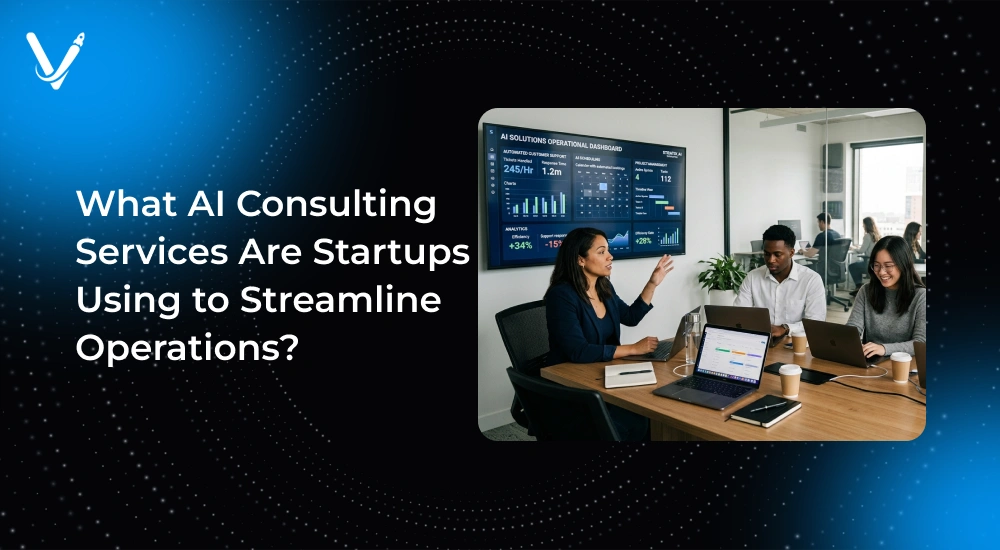
What AI Consulting Services Are Startups Using to Streamline Operations?

 May 25, 2026





Most startups run on a small team and a long to-do list. You wear many hats. You ship fast. And you feel every wasted hour. So when manual work piles up, growth slows down. That is the exact gap AI is now filling.
More founders are turning to AI consulting services to fix this. Instead of buying random tools, they bring in experts to map the right AI solutions for startups. The goal is simple. Cut busywork, speed up decisions, and free your team to do real work. In short, they want AI-driven operations that scale without bloating the payroll.
This guide breaks down what those services actually look like. You will see the data, the real gains, and how to pick a partner. Let’s dig in.
The shift is not hype. It is happening fast.
Nearly nine in ten organizations now use AI in at least one part of their business, according to McKinsey’s State of AI research. That is close to full mainstream adoption. Small firms are right there in the mix too. Use of generative AI among small businesses jumped to 58% in 2025, up from 40% a year earlier, per the U.S. Chamber of Commerce.
So why the rush? A few reasons stand out:
• Lean teams, big workloads. You cannot hire your way out of every task. AI fills the gap.
• Pressure to scale. Investors want growth. AI helps you do more with the same headcount.
• Cheaper than ever. Strong tools are now within reach of an early-stage budget.
But here is the catch. Most companies still struggle to turn AI use into real results. McKinsey found that only 39% report a clear bottom-line impact. The tools are easy to buy. Using them well is the hard part. That gap is exactly why AI consulting for startups has taken off. A good partner helps you skip the trial-and-error and aim straight at AI operational efficiency.
Not every startup needs the same thing. But a clear set of services keeps showing up. These are the building blocks of modern startup AI solutions.

This is where most startups begin. AI workflow automation takes over the repetitive steps that eat your day. Think data entry, invoice sorting, lead routing, and status updates. The work still gets done. It just gets done without a human clicking through it. For many teams, this is the fastest win in business process automation AI.
New tools only help if they talk to your old ones. AI integration services connect AI to the systems you already run, like your CRM, help desk, or billing app. Done right, data flows on its own. No copy-paste. No siloed spreadsheets. This is the quiet backbone of any AI automation services rollout.
Generative AI writes, drafts, and replies in seconds. With generative AI consulting, an expert helps you point that power at the right jobs. That might mean support replies, sales emails, or first drafts of marketing copy. Startups save real time here. AI-using small firms report saving 5 to 15 hours a week on content work, per HubSpot’s 2025 marketing research.
Your data already holds clues about what comes next. Predictive analytics turns it into clear forecasts. You can spot churn early, plan stock better, and price with more confidence. This is where AI business automation starts to shape real strategy, not just chores.
A pilot that never ships helps no one. AI implementation services cover the build, launch, and upkeep. This includes MLOps, the practice of keeping models live and reliable over time. Strong startup workflow automation depends on this step. Without it, good ideas stall in “pilot purgatory.”
Customers want answers now. A smart chatbot handles common questions around the clock. It books calls, sorts tickets, and hands hard cases to a human. You serve more people without adding seats. That is one of the clearest paths to AI-powered business operations at startup scale.
Talk is cheap. Numbers are not. So what do startups actually get back?

The wins tend to land in three places:
• Time back. Hours once lost to manual tasks go to product, sales, and customers.
• Lower costs. More than half of small business AI users expect to save up to $2,000 a month, per a Thryv survey.
• Faster decisions. Clean data and quick forecasts mean you act sooner.
The market reflects this pull. Global spending on generative AI was set to hit $644 billion in 2025, a 76% jump in one year, Gartner reports. Startups are a growing slice of that spend. They are not waiting for proof. They are building it.
Still, the gains are not automatic. The teams that win redesign how work flows. They do not just bolt AI onto a broken process. That mindset is what separates a real result from a shiny demo.
The right partner saves you months. The wrong one burns cash. So choose with care.
Here is what to look for:
• Business focus first. Good consultants ask about your goals before they pitch tech. Strategy beats tools. This is where solid innovation consulting earns its keep.
• Proven delivery. Ask for case studies and real outcomes. Pilots that shipped matter more than slides.
• Clean integration. Make sure they can plug AI into your current stack without chaos.
• Honest scope. A trustworthy team tells you what AI cannot do, not just what it can.
• Long-term support. AI implementation services should include upkeep, not just launch.
One more tip. Start small. Pick one painful process. Prove the value. Then scale. This keeps risk low and trust high.
Speed is great. But it cannot come at the cost of trust. As you adopt AI, you also take on new duties around data and risk.
Start with privacy. If you handle customer data, rules like the GDPR in Europe apply. The EU AI Act adds more. It sorts AI by risk level and sets clear duties for higher-risk uses. Many U.S. states are writing their own AI rules too. This patchwork worries owners. In fact, 65% of small businesses say they are concerned about complying with new state AI laws, per the U.S. Chamber of Commerce. Worse, only about a third feel ready.
So what should a startup do? Keep it simple but serious:
• Know your data. Track what you collect, store, and share.
• Pick business-grade tools. Avoid feeding sensitive data into consumer apps with unclear policies.
• Keep a human in the loop. For big decisions, let a person review the AI’s call.
• Be transparent. Tell users when AI is involved.
Responsible AI is not red tape. It is smart business. Build compliance in from day one, and you avoid painful rework later. It also makes your AI-driven operations easier to trust and sell.
AI is no longer a “someday” project for startups. It is a daily edge. The right mix of AI workflow automation, integration, and generative AI can hand your team hours back each week. It can cut costs and sharpen every decision. And with smart compliance, you grow without nasty surprises.
The key is focus. You do not need every tool. You need the right ones, set up well, aimed at real problems. That is what good consulting gives you.
Ready to map your first AI win? Talk to an AI consulting team and turn manual work into AI-powered business operations that scale.