


AI/ML
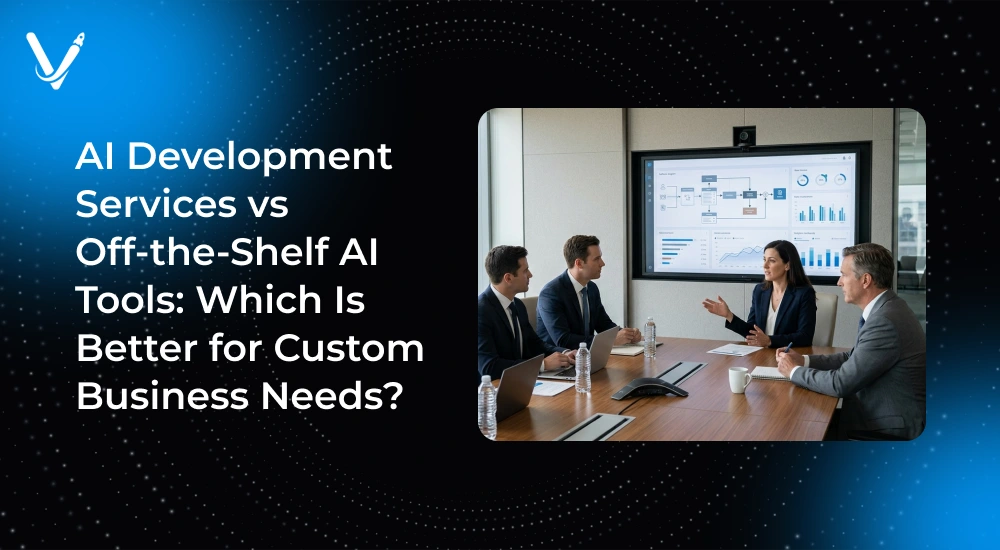
AI Development Services vs Off-the-Shelf AI Tools for Businesses

 May 18, 2026





Artificial intelligence is no longer limited to large tech companies. Startups, mid-sized businesses, and global enterprises are now investing heavily in AI-powered business solutions to improve operations, reduce costs, and deliver better customer experiences.
According to recent industry reports, the global AI market is expected to cross $1.8 trillion by 2030. Businesses are rapidly adopting AI automation solutions across customer service, analytics, logistics, sales, healthcare, and enterprise workflows.
But one question continues to slow down decision-making:
Should companies invest in custom AI development or use off-the-shelf AI tools?
The answer depends on business goals, scalability needs, technical maturity, and long-term strategy.
Some companies need fast deployment and low upfront investment. Others require highly customized enterprise AI solutions built around proprietary workflows and internal systems.
This guide breaks down the differences between AI development services and ready-made AI platforms so businesses can make smarter long-term decisions.
Off-the-shelf AI tools are prebuilt software platforms designed for mass adoption. These tools usually offer ready-made AI features that businesses can deploy quickly without building infrastructure from scratch.
Examples include:
These platforms focus on simplicity and fast implementation.
Businesses can start using these tools within days instead of spending months on development.
Subscription-based pricing reduces upfront investment, making these platforms attractive for startups and small businesses.
Most ready-made platforms require minimal technical expertise. Teams can integrate them into existing workflows without large engineering teams.
Many tools already include:
This reduces implementation time significantly.
Despite their convenience, off-the-shelf AI tools come with limitations.
These tools are designed for broad use cases, not specialized workflows.
A healthcare company, for example, may require custom compliance automation that a generic AI platform cannot provide.
Businesses often become dependent on external vendors for updates, pricing, and feature availability.
Prebuilt systems may not align with internal operations, forcing teams to change workflows around the software.
As operations grow, businesses may discover limitations in integrations, automation depth, or data processing flexibility.
AI development services involve building customized AI systems tailored to a company’s specific business processes, datasets, and operational goals.
Unlike generic software, custom AI solutions are designed around unique business needs.
This may include:
Custom AI platforms are designed specifically for company operations rather than broad market usage.
Businesses can automate highly specific processes that standard software cannot support.
Custom AI systems can connect with:
Many enterprises require scalable AI systems with advanced governance, security, and compliance support.

Several industries increasingly depend on AI software development for operational efficiency.
Factor | Off-the-Shelf AI Tools | Custom AI Development |
Initial Cost | Lower | Higher |
Deployment Speed | Fast | Slower |
Customization | Limited | Extensive |
Scalability | Moderate | High |
Integration Flexibility | Basic | Advanced |
Security Control | Vendor-managed | Business-controlled |
Compliance Support | Generalized | Industry-specific |
Ownership | Vendor-owned platform | Full ownership |
Maintenance | Included | Managed internally or by provider |
Long-Term ROI | Moderate | Potentially higher |
Competitive Advantage | Limited | Strong |
Workflow Automation | Generic | Fully tailored |
Off-the-shelf AI platforms remain valuable for many businesses.
Early-stage startups often prioritize speed over customization. Prebuilt tools allow them to validate ideas quickly.
Teams can test AI use cases without investing heavily in infrastructure or development.
Companies without dedicated AI teams can still benefit from automation and analytics.
Businesses can automate repetitive tasks like:
For companies seeking short-term productivity improvements, ready-made AI software can deliver strong value.
Custom AI development provides deeper operational flexibility and long-term strategic value.
Businesses can create proprietary systems competitors cannot easily replicate.
Companies maintain ownership over:
This becomes increasingly important in regulated industries.
Custom enterprise software can automate highly specialized business operations.
For example:
Custom-built enterprise AI solutions scale more effectively as business complexity grows.
Custom AI integration services allow businesses to connect multiple systems into a unified ecosystem.
Businesses can continuously adapt AI capabilities without waiting for vendor updates or feature releases.

Many organizations underestimate the long-term challenges of AI adoption.
Monthly subscription pricing may appear affordable initially, but costs often increase as usage grows.
Large enterprises using multiple AI tools can face substantial recurring expenses.
Many AI platforms struggle to integrate deeply with legacy enterprise systems.
This often creates workflow fragmentation.
Businesses handling sensitive customer or financial data may face governance and compliance risks when using external AI vendors.
As regulations evolve, companies need better control over:
Businesses relying heavily on third-party platforms may lose operational flexibility over time.
Generic AI tools may fail to deliver high accuracy in specialized business environments.
Many modern businesses are no longer choosing between “custom” or “prebuilt.
Instead, they are combining both approaches.
This hybrid AI model is becoming increasingly popular in enterprise automation.
Businesses often:
This approach allows companies to balance:
Hybrid systems reduce infrastructure complexity while still enabling customization.
For example:
This creates more flexible and scalable AI integration platforms.
Business Need | Best Approach |
Fast MVP launch | Off-the-shelf AI tools |
Limited budget | Off-the-shelf AI tools |
Complex workflows | Custom AI development |
Regulatory compliance | Custom AI solutions |
Enterprise-scale operations | Hybrid AI strategy |
Proprietary business logic | Custom AI development |
Rapid experimentation | Off-the-shelf AI tools |
Long-term scalability | Hybrid or custom AI |
Internal system integration | Custom AI solutions |
Competitive differentiation | Custom AI development |
The next phase of AI adoption will move beyond simple chatbots and automation tools.
Businesses are increasingly investing in:
AI agents are becoming capable of:
This will reshape enterprise operations across industries.
Businesses now want AI-driven business transformation rather than isolated automation tools.
Companies are integrating:
into unified enterprise automation environments.
Industry-specific AI systems will become more important than generalized software.
Healthcare, finance, legal, and logistics companies increasingly require specialized AI implementation services designed around operational requirements.
There is no universal answer to the custom AI vs off-the-shelf AI debate.
The right choice depends on:
Off-the-shelf AI tools work well for:
Custom AI development is often better for:
For many businesses, the future will likely involve hybrid AI ecosystems that combine external AI models with customized infrastructure and intelligent automation.
Companies that treat AI as a long-term operational capability rather than a short-term software purchase will be better positioned for sustainable growth.
Whether you need rapid AI implementation, custom AI development, enterprise automation, or scalable AI integration services, Vasundhara Infotech helps businesses design AI solutions tailored to real operational needs.
From AI consulting services and workflow automation to enterprise-grade AI software development, our team helps startups and enterprises turn AI investments into measurable business outcomes.