Introduction
Let's be honest. If you have ever run a small business, you already know the pain. The phone rings while you are with a customer, you miss the call, and twenty minutes later you find out it was someone ready to book or buy. And then there is the front desk. Hire someone good, and they are great until they call in sick, take a holiday, or quit at the worst possible time. Hire someone average, and you are losing leads quietly without even noticing.
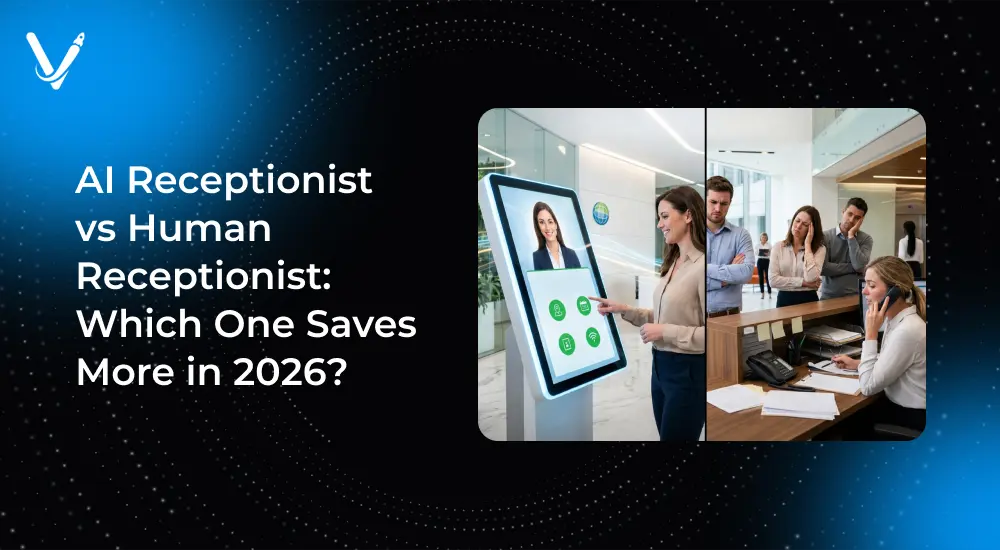
This is exactly why so many businesses in 2026 are taking a serious look at the AI receptionist option. The whole ai receptionist vs human receptionist debate used to feel like science fiction. Today, it is a real, practical question that thousands of small business owners are asking every single day. So let us actually break it down properly, no sales pitch, no fluff. Just what saves you more, what does the job better, and where the honest trade-offs sit.
What is an AI Receptionist?
An AI receptionist is a software program that answers your phone, greets your customers, books appointments, takes messages, and routes calls, all on its own. No coffee breaks, no sick days, no awkward Monday morning energy. It picks up on the first ring, every single time, and handles the basics of front-desk work without needing anyone to babysit it.
The smarter versions, often called an ai virtual receptionist or ai powered receptionist, can do a lot more than just answer "press 1 for sales." They actually understand what your caller is saying, look up information in your booking system, send confirmation texts, and handle follow-ups, the whole flow. Think of it less as a phone tree and more as a digital team member who happens to never need a lunch break.
The way it shows up in your business depends on what you need. Some businesses use it as a 24/7 backup that catches every call after hours. Some replace their front desk completely. Most land somewhere in the middle, where the AI receptionist handles the routine stuff and a human steps in only when the conversation actually needs a human.
How an AI Voice Receptionist Works
Here is the part most business owners genuinely want to understand. How does this thing actually work without sounding like a robot from 2008?
An ai voice receptionist uses three things working together. First, it listens to what the caller says and converts speech into text. Second, it figures out what the caller actually wants, whether that is booking an appointment, asking about pricing, or checking on an order. Third, it speaks back in a natural human-sounding voice. The whole thing happens in real time, in under a second, and the caller usually has no idea they are talking to software.
Where the Real Magic Happens: Call Automation and Booking
This is where it stops being a clever toy and starts being a real business tool.
When someone calls your business and says "I want to book an appointment for Thursday at 2 PM," your ai virtual receptionist does not just write that down. It actually checks your calendar, sees Thursday at 2 is taken, offers Thursday at 3 instead, books the slot the moment the caller agrees, sends them a confirmation text, and adds the appointment to your CRM. All while you are with another customer, or asleep, or on holiday in Spain.
The same flow works for taking payments, capturing leads, answering FAQs, and routing complicated calls to a real person. It is basically the boring 80% of front-desk work, automated and running on its own, 24/7.
AI Receptionist vs Human Receptionist (Detailed Comparison)
Right, this is the part you are actually here for. Let's lay out the ai receptionist vs human receptionist comparison side by side, no sugar-coating.
| Factor | AI Receptionist | Human Receptionist |
| Hours covered | 24/7, never sleeps | 40 hours a week, on a good week |
| Monthly cost | $50 to $500 typically | $2,500 to $4,500 in the US |
| Sick days, leave, no-shows | Zero | Several per year, sometimes more |
| Calls handled at once | Hundreds at the same time | One at a time |
| Languages | Often 20+ supported natively | Usually one or two |
| Learning curve | Set up once, runs forever | Weeks of training per hire |
| Empathy in difficult calls | Limited, improving | Genuinely better, especially in sensitive cases |
| Handling unusual situations | Sometimes struggles | Usually figures it out |
| Mood on a Monday morning | Always the same | Depends on the weekend |
So which one wins? Honestly, it depends on what kind of calls your business handles most. If 90% of your calls are people asking the same five questions and trying to book appointments, the AI receptionist wins on cost, consistency, and pure volume. If your business deals with emotional, complex, high-value conversations where empathy and human judgment matter, a human still has the edge. The smartest businesses in 2026 are not picking one or the other. They are using both, with the AI handling the routine flow and humans stepping in only when it actually adds value.
How Much Does an AI Receptionist Cost?
Here is where the numbers get interesting, especially if you have ever opened a payroll spreadsheet and stared at the front-desk salary line wondering if there is a better way.
An ai receptionist for small business typically costs somewhere between $50 and $500 per month, depending on how much call volume you have and how many features you need. Compare that to hiring a human receptionist in the US, where you are looking at $2,500 to $4,500 a month before benefits, taxes, and the inevitable hiring costs. That is a difference that adds up to tens of thousands of dollars every single year.
Here is the rough breakdown:
- Basic AI receptionist at $50 to $100 per month covers call answering, simple FAQs, and message taking
- Mid-range AI receptionist at $150 to $300 per month handles call routing, appointment booking, calendar integration, and SMS confirmations
- Custom AI receptionist solution at $300 to $500+ per month or built on a one-time setup fee gives you full CRM integration, multi-language support, custom voice training, and analytics
The cost positioning here is what really matters for SMEs. For most small businesses, an AI receptionist pays for itself within the first month just by capturing the after-hours calls that were previously going to voicemail. Every recovered booking is essentially free money.
Benefits of an AI Receptionist for Small Businesses
Now let's get to the real reason small business owners are switching over. The benefits of an ai receptionist for small business are not theoretical. They show up directly in your bank account, your customer reviews, and your stress levels.
- Never miss a call again. Around 60% of customers will not leave a voicemail. They just hang up and call your competitor. An AI receptionist picks up every single call, every single time
- Save serious money. The cost difference between an AI receptionist and a full-time human receptionist over a year is typically $25,000 to $40,000 for a single position
- Scale instantly. Your call volume tripled because you ran a successful ad campaign? No problem. Your AI handles 1 call or 100 calls at the same quality and the same speed
- Capture after-hours leads. Most calls outside business hours are completely lost in a traditional setup. An AI receptionist captures them all, books them when possible, and sends warm leads straight to your team for the morning
- Speak more languages without hiring. A virtual front desk AI can handle calls in 20+ languages, which is something almost no small business can afford to do with human staff
- Consistent customer experience. Every caller gets the same friendly, professional greeting and the same accurate information, regardless of the day or time
For most small businesses, this is not even a close decision once they actually look at the numbers. The ai receptionist for small business market is growing fast for exactly this reason.
Key Features of an AI Powered Receptionist
A serious ai powered receptionist in 2026 should give you all of these as standard, not as paid add-ons:
- Natural voice conversations that sound human, not robotic, with proper pauses, tone, and rhythm
- 24/7 call answering with no downtime, no holiday breaks, no sick leave
- Live calendar integration with Google Calendar, Outlook, Calendly, and major booking systems
- CRM connection so every call automatically logs to HubSpot, Salesforce, Zoho, or whatever system your team already uses
- Multi-language support covering at least the top 20 most-spoken languages
- Smart call routing that hands off complex or high-value calls to the right human team member
- SMS and email confirmations sent automatically to callers after every booking
- Detailed analytics dashboard showing call volumes, common questions, conversion rates, and missed opportunities
- Custom voice training so your ai virtual receptionist sounds on-brand for your business
If a vendor is not offering most of these features in their core package, keep looking. The technology is mature enough now that all of this should be the baseline, not the premium tier.
When Should You Choose an AI Receptionist?
Not every business needs an AI receptionist. Here is when it actually makes sense to make the switch:
- You are a small business losing calls outside of business hours. Even 5 missed calls a week could be costing you thousands in lost revenue
- You are scaling and your front desk cannot keep up. Adding more humans gets expensive fast. An automated call answering system scales without adding headcount
- You operate in multiple time zones. International customers calling at 3 AM your time will get a real conversation, not a voicemail beep
- Your call volume is unpredictable. Marketing campaigns, seasonal spikes, viral moments, all of these crush a human-only front desk. AI does not flinch
- You want consistency. Every caller gets the same experience every single time, no bad days, no off-script moments
- You are paying $40,000+ a year for front-desk work that is mostly routine. The math just does not work out anymore
If even two of those describe your business, an AI receptionist is probably going to save you serious money in 2026. If all of them apply, it is honestly hard to justify not making the switch.
Conclusion
So back to the question that started this whole thing. AI receptionist vs human receptionist, which one saves more? For most small and mid-sized businesses in 2026, the AI receptionist wins on cost, availability, and consistency by a wide margin. A human still wins on empathy, complex problem-solving, and high-touch customer relationships. The smart move for most businesses is to combine both, letting the AI receptionist handle the routine 80% of calls and freeing your human team to focus on the conversations that actually need a human.
The real question is not whether AI receptionists work. It is how much money you are willing to keep losing every month before you finally try one.
Get a Custom AI Receptionist Built for Your Business
If you are ready to stop missing calls and stop overpaying for front-desk coverage, Vasundhara Infotech builds custom ai receptionist for small business solutions that connect directly with your existing tools, your CRM, and your booking system. Every ai powered receptionist we build is shaped around your specific workflow, trained on your business data, and tuned to sound exactly the way your brand should sound on the phone.
- Built around your business, not a one-size-fits-all template
- Full integration with your CRM, calendar, payment systems, and booking tools
- Designed to capture every call, scale with your growth, and pay for itself within the first month
Explore Our AI Development Services and let's build your custom AI receptionist together.





 May 1, 2026