AI/ML
AI Voice Agent Developer for an AI Automation Agency Serving Auto Repair Shops

 May 7, 2026







In Article:
Introduction
Why Auto Repair Shops Are Adopting AI Voice Automation
What Is AI Voice Agent Development?
How AI Voice Agents Help Auto Repair Businesses
Core Features of Modern AI Voice Agents
AI Voice Agent Development Services for Automation Agencies
Best AI Voice Agent Development Tools 2026
Challenges in Developing AI Voice Agents
How to Develop AI Voice Agent Solutions for Auto Repair Shops
Choosing the Right AI Voice Agent Development Company
Future of AI Voice Automation in Service Businesses
Conclusion
Auto repair shops handle hundreds of customer interactions every week. Most of these conversations revolve around appointment scheduling, service updates, repair estimates, emergency requests, and follow-up reminders. While many shops still rely on manual phone support, rising customer expectations and staffing shortages are pushing businesses toward automation.
This shift has increased interest in AI voice agent development across local service industries. According to recent market reports, conversational AI adoption in customer service environments continues to grow as businesses look for faster response times and lower operational costs. For auto repair businesses, AI voice systems are becoming a practical solution for handling repetitive customer interactions without overwhelming internal teams.
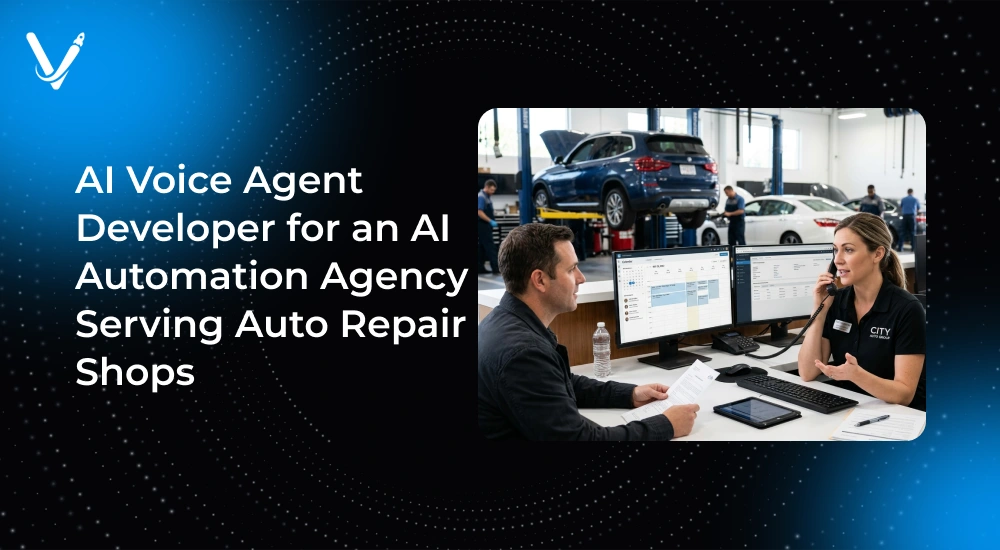
Auto repair businesses depend heavily on phone communication. Customers often call during busy working hours to ask about pricing, repair timelines, or appointment availability. Missed calls frequently lead to lost revenue, especially when competitors respond faster.
AI-powered voice systems solve this challenge by automating customer communication around the clock. Many repair shops now use conversational AI to answer service questions, confirm appointments, and route urgent repair requests automatically. These systems reduce wait times while improving the customer experience.
Automation also helps smaller businesses manage growing call volumes without increasing staffing costs. Shops using AI and voice agent development services often see improvements in operational efficiency because repetitive administrative tasks no longer require constant human involvement.
For multi-location repair businesses, centralized voice automation improves consistency across customer interactions while supporting scalable operations.
AI voice agent development refers to the process of building intelligent conversational systems that interact with users through speech. These systems use technologies such as natural language processing, speech recognition, machine learning, and voice synthesis to understand and respond to customer requests.
Modern voice AI agents can handle dynamic conversations instead of relying on rigid scripted responses. For example, a customer calling an auto repair shop may ask about oil changes, brake repair pricing, or appointment availability. The AI system interprets the request, retrieves relevant information, and provides a conversational response in real time.
Businesses investing in ai voice agent development services often integrate these systems with CRMs, appointment management platforms, and communication tools. This allows voice agents to manage workflows directly instead of simply answering questions.
As voice automation becomes more advanced, many voice ai agents for developers now support multilingual conversations, sentiment analysis, and personalized customer interactions.
Auto repair shops deal with operational bottlenecks that directly affect customer retention. AI voice agents reduce many of these challenges by automating communication and workflow management.
Voice AI systems can schedule appointments automatically by checking calendar availability and confirming bookings with customers in real time. Automated reminders also reduce no-show rates.
Repair shops often miss calls during busy periods. AI agents answer incoming calls immediately, gather customer details, and route requests based on urgency.
AI voice systems can identify high-intent customers by asking relevant service questions before forwarding calls to staff members. This improves lead management efficiency.
Many businesses use voice AI to provide repair status updates, estimated completion times, and follow-up communication after service appointments.
These capabilities make AI voice automation especially valuable for local service businesses that depend on high-volume customer communication.
Modern AI voice systems are designed to support more than simple call automation. Businesses investing in ai voice agent development expect intelligent workflows that integrate directly into daily operations.
Key features commonly included in AI voice solutions include:
Advanced ai voice agent development tools 2026 are also introducing predictive conversation capabilities. These systems analyze customer intent and conversation history to improve interaction quality over time.
Developers building enterprise voice systems increasingly focus on scalability, latency reduction, and integration flexibility to support real-world operational environments.
Automation agencies serving local businesses are rapidly expanding into voice AI implementation. Many agencies now offer ai and voice agent development services alongside chatbot automation, CRM integration, and workflow optimization.
Auto repair shops represent a strong market for voice automation because they rely heavily on phone-based customer engagement. Agencies helping these businesses automate operations often combine voice AI with appointment management systems and customer communication platforms.
An experienced ai voice agent development company typically handles infrastructure setup, API integrations, workflow design, conversational logic, and deployment optimization. Agencies also provide training and performance monitoring to improve conversation quality after implementation.
As demand grows, more ai voice agent development companies are specializing in industry-specific workflows for healthcare, automotive services, home services, and hospitality businesses.
The rapid growth of conversational AI has created a competitive ecosystem of development platforms and infrastructure tools. Businesses and developers now have access to more flexible solutions for building scalable voice systems.
Popular ai voice agent development tools 2026 include platforms that support speech recognition, real-time voice synthesis, NLP modeling, and workflow orchestration. Many developers combine multiple APIs and cloud services to create customized voice automation systems.
Cloud infrastructure providers also play an important role in AI voice deployment. Scalable infrastructure improves uptime, response speed, and integration reliability across high-volume communication environments.
For developers, choosing the right technology stack depends on factors such as latency requirements, multilingual support, integration needs, and conversation complexity.
While voice automation offers significant advantages, building reliable systems requires careful planning and technical expertise. One major challenge involves handling natural human conversation patterns accurately.
Customers may speak with different accents, interrupt conversations, or use unclear language. Voice AI systems must interpret these variations while maintaining conversational accuracy. Poor recognition quality can negatively affect customer trust.
Integration complexity is another challenge. Businesses often use different CRMs, scheduling systems, and communication tools. Developers must ensure seamless synchronization across platforms to avoid workflow disruptions.
Data privacy and security also remain important considerations. AI voice systems handling customer information must comply with industry security standards and communication regulations.
Businesses looking to develop ai voice agent solutions should begin by identifying operational bottlenecks. Most repair shops experience challenges related to missed calls, appointment management, and repetitive customer inquiries.
The development process typically starts with workflow mapping. Developers analyze customer interactions and identify automation opportunities within scheduling, support, and lead qualification processes.
Next, developers integrate speech recognition models, conversational AI engines, and backend systems such as CRMs or scheduling platforms. Voice workflows are then tested extensively to improve response accuracy and conversational flow.
Successful AI voice implementations prioritize practical usability over excessive complexity. Repair shops benefit most from systems that solve operational problems directly while remaining easy for staff members to manage.
Selecting the right ai voice agent development company requires more than reviewing technical capabilities. Businesses should evaluate industry experience, deployment expertise, and long-term support capabilities.
A reliable development partner should understand conversational AI architecture, NLP optimization, API integrations, and cloud infrastructure management. Experience with local service industries is also valuable because customer communication patterns differ significantly between industries.
Businesses should also review case studies and deployment outcomes before selecting a provider. Strong ai voice agent development companies typically demonstrate measurable improvements in call handling, appointment conversion, and customer engagement metrics.
Scalability matters as well. The ideal development partner should support future integrations and workflow expansion as business operations grow.
Voice AI adoption is expected to increase significantly across local service industries over the next few years. Improvements in speech recognition accuracy and conversational modeling are making AI interactions more natural and reliable.
Businesses are also moving toward fully integrated communication ecosystems where voice agents, chatbots, CRMs, and workflow automation systems operate together. This trend is creating new opportunities for developers and automation agencies specializing in conversational infrastructure.
For auto repair businesses, voice automation will likely become a standard operational tool rather than a competitive advantage. Shops that automate communication early may improve customer retention and operational efficiency faster than competitors relying entirely on manual workflows.
As AI systems continue evolving, voice automation will become more personalized, predictive, and context-aware across customer interactions.
AI voice automation is changing how service businesses manage customer communication, scheduling, and operational workflows. Auto repair shops, in particular, benefit from voice systems that reduce missed calls, automate repetitive tasks, and improve response times during busy periods.
Businesses investing in ai voice agent development services are not simply adopting another software tool. They are building scalable communication infrastructure that supports long-term operational growth and customer experience improvements.
For automation agencies and developers, the growing demand for conversational AI creates significant opportunities across local service industries. Companies that develop ai voice agent solutions focused on practical business outcomes will be better positioned to support the next generation of service automation.
At Vasundhara Infotech, we help businesses build intelligent AI voice agent solutions tailored for real-world operational needs. From appointment scheduling and customer call automation to conversational AI integration and workflow optimization, our team develops scalable systems designed to improve efficiency and customer experience across service-based industries.
Copyright © 2026 Vasundhara Infotech LLP. All Rights Reserved.