


AI/ML
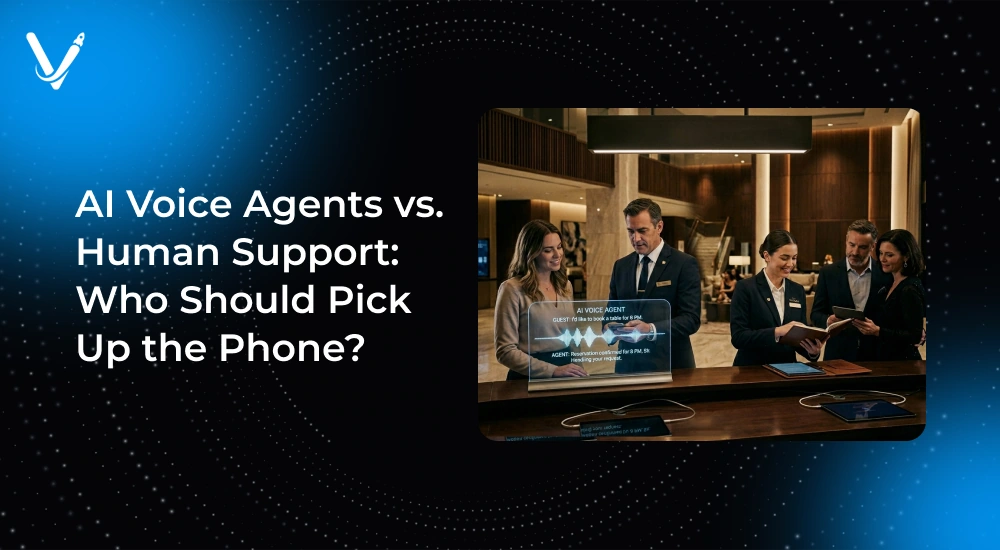
AI Voice Agents vs. Human Support: Who Should Pick Up the Phone?

 May 22, 2026





Your phone rings at 2 a.m. A customer wants to reset a password. Should a machine answer, or a person? That single question now sits on the desk of almost every support leader.
The choice between AI voice agents vs human support is no longer a thought experiment. The tools work. The savings are real. And the pressure to act is high. A Gartner survey of customer service leaders found that 91% feel pushed by executives to roll out AI this year.
But "use AI" is not a strategy. The smart move is knowing which calls a machine should handle, which calls a human should own, and how to pass a call between them without friction. This guide breaks down the trade-offs with current data, so you can decide with confidence.
An AI voice agent is software that answers a phone call, understands natural speech, and replies in a human-like voice. It can verify a customer, look up an order, process a simple request, and escalate when needed. Unlike old phone menus, it holds a real conversation instead of forcing you to press buttons.
This is a big leap from the IVR systems most of us hate. Modern voice AI for customer support runs on large language models. It understands intent, accents, and context. It can also act, not just talk. It can update an account or book an appointment in real time.
The market reflects this shift. The global AI customer service market is expected to reach about $15 billion in 2026, according to widely cited industry research. Adoption is broad too. McKinsey reports that 88% of organizations now use AI in at least one business function, up from 78% a year earlier. Customer service is one of the most common uses.
So AI customer service automation is mainstream. The harder question is where it actually wins.
AI voice agents win on speed, volume, and cost. They answer instantly, handle thousands of calls at once, and never sleep. For routine, high-volume questions, like order status, password resets, or billing lookups, they often resolve issues faster and cheaper than a human team. This makes them ideal for tier-one support.
Here is where the case for AI call center automation is strongest:
• Always on. Customers expect help at any hour. 24/7 AI customer support removes the night shift problem and cuts wait times to near zero.
• Scale without panic. A holiday rush or a product recall can flood your lines. AI absorbs spikes without new hires.
• Fast, consistent answers. AI does not have a bad day. It gives the same correct answer every time.
• Strong first-contact resolution. Well-built AI agents resolve 55% to 70% of tier-one contacts on their own, per industry benchmarks. Klarna's AI assistant cut average resolution time from about 11 minutes to roughly 2 minutes.
The cost gap is striking. Gartner data shows a self-service contact can cost under $2, while a live agent contact can run over $13. That is why Gartner projects conversational AI will cut contact center labor costs by $80 billion in 2026.
Speed also wins hearts. Zendesk research found that 51% of consumers prefer a bot over a human when they want immediate help. When AI is fast and accurate, people stop caring who answers.

Human agents win on empathy, nuance, and trust. They handle angry customers, complex problems, and high-stakes moments far better than software. When a situation needs judgment, emotion, or a creative workaround, a person should take the call. Some moments simply need a human voice.
The data backs this up. While many people accept bots for quick tasks, most still want a human for hard ones. Zendesk's research shows strong consumer preference for human agents on complex or emotional issues. Trust is the deciding factor.
Here is where a human still beats AI in the human vs AI support agent debate:
• Emotional moments. A grieving customer, a billing dispute, or a safety issue needs a calm, caring person.
• Messy, one-off problems. When a request does not fit any script, humans improvise. AI can stall or guess.
• High-value relationships. A key client or a big sale deserves a name, not a bot.
• Brand trust. A poor AI experience can push a customer away for good. A great human one can lock in loyalty.
The lesson is simple. AI vs human customer service is not a contest with one winner. Each side has a clear lane.
No, AI cannot fully replace human agents, and the data confirms it. AI now handles routine, high-volume calls very well. But complex, emotional, and high-stakes issues still need human judgment. Most companies are not cutting their teams. They are shifting people toward harder, higher-value work that AI cannot do.
So can AI replace human agents entirely? The honest answer is not yet, and likely not soon. Gartner expects some automation of routine roles, but many firms that planned deep cuts are expected to rehire or redeploy staff. The pattern is clear: AI takes the repetitive load, and people take the work that needs a human touch.
This is why the real winner is not AI or humans. It is the blend of both.
The best support setup is a hybrid one. AI handles the simple, high-volume calls. Humans handle the complex, sensitive ones. The key is a smooth AI agent human handoff, where the AI passes the call to a person along with full context, so the customer never has to repeat themselves.
This model is already the norm. Most contact center leaders have adopted human-in-the-loop systems that pair AI routing with human handling of tough cases. It gives you the cost savings of automation and the trust of human care.
A good handoff has three rules:
1. Know when to stop. The AI should escalate the moment it detects anger, confusion, or a request outside its skill set.
2. Pass the full context. The human agent should see the whole conversation, not start cold. This is the difference between a smooth transfer and an angry repeat caller.
3. Make it easy to reach a person. Customers should never feel trapped. An easy path to a human builds trust, even if they never use it.
Done right, AI phone support for business feels less like a wall and more like a smart front door. Most callers get instant help. The rest reach a person fast, with no friction.
The financial case for AI is strong, but only when it works. Reported returns average around $3.50 for every $1 invested, with leaders seeing far more. Yet only about 25% of contact centers have fully integrated AI, which is why many see weak results. The savings are real, but they depend on good setup and clean data.
Here is how to think about ROI honestly:
• Direct savings. Routine calls move from $13-plus per contact to under $2. At scale, that adds up fast.
• Faster resolution. Shorter calls and instant answers raise capacity without raising headcount.
• Hidden costs. Setup, integration, and ongoing tuning are not free. A weak knowledge base leads to weak AI and lost savings.
• The payoff curve. Many teams see returns climb in year two and three as the system learns.
The takeaway: budget for the build, not just the license. AI that is bolted on poorly will frustrate customers and waste money.
Compliance is not optional when AI answers your phone. Voice data is personal data. In many places, you must tell callers they are speaking to an AI, get consent to record, and protect every recording and transcript. Skipping these steps risks heavy fines and lost trust.
This section matters because the rules are tightening fast. Here are the core duties for any business running voice AI.
Many laws and contracts now require AI disclosure. The simplest fix is a clear opening line, such as: "You are speaking with an automated assistant." This is not just legal cover. Research shows that disclosed AI calls often perform better, because people dislike being fooled. Honesty builds trust.
Call recording rules vary by region. Some places need only one party to consent. Others, including many two-party consent states and the EU, require everyone on the call to agree first. The safe path is to disclose recording at the very start of every call, no matter where the caller is.
Different data types carry different rules. Under GDPR, voice recordings are personal data, and voiceprints can count as sensitive biometric data. Health details fall under HIPAA. Card payments fall under PCI-DSS. Each demands strict handling: encryption, limited access, clear retention limits, and a lawful reason to process the data.
The stakes are high. GDPR fines can reach €20 million or 4% of global annual revenue, whichever is larger. So collect only what you need. Delete what you no longer need. And make sure your AI vendor signs a data processing agreement and never trains public models on your customer calls without a contract.
A compliant voice AI system should always let a caller opt out and reach a human at any time. Build transparency into the first second of the call, not the fine print.

Use this quick test to route any call type. It turns the whole AI voice agents vs human support question into a clear choice.
Let AI take the call when:
• The request is routine and high-volume (order status, hours, password resets).
• The answer is clear and rule-based.
• Speed matters more than emotion.
• It is after hours and the alternative is no answer at all.
Send it to a human when:
• The customer is upset, anxious, or in a sensitive situation.
• The problem is complex, unusual, or off-script.
• The account or sale is high-value.
• Trust and relationship are the main goal.
Use a hybrid handoff when:
• The call starts simple but turns complex.
• The AI hits the edge of its skills.
• The customer asks for a person.
Most businesses land in the hybrid zone. Start by automating your top five repetitive call types. Keep humans on everything emotional or complex. Then tune the handoff until it feels seamless.
If you want help designing that split, our team builds custom AI customer service automation tuned to your workflows and compliance needs.
The AI voice agents vs human support debate has a clear answer: it is not either-or. Let AI take the routine, high-volume calls where speed wins. Keep humans on the complex, emotional, and high-value calls where trust wins. Connect the two with a smooth handoff, and stay honest about compliance.
The companies that win in 2026 will not be the ones that automate everything. They will be the ones that automate the right things, and keep people where people matter most.
Ready to figure out which calls your AI should answer and which your team should keep? Talk to our AI experts for a setup built around your customers, your goals, and your compliance needs. You can also explore how we approach voice AI for customer support from the ground up.