AI/ML
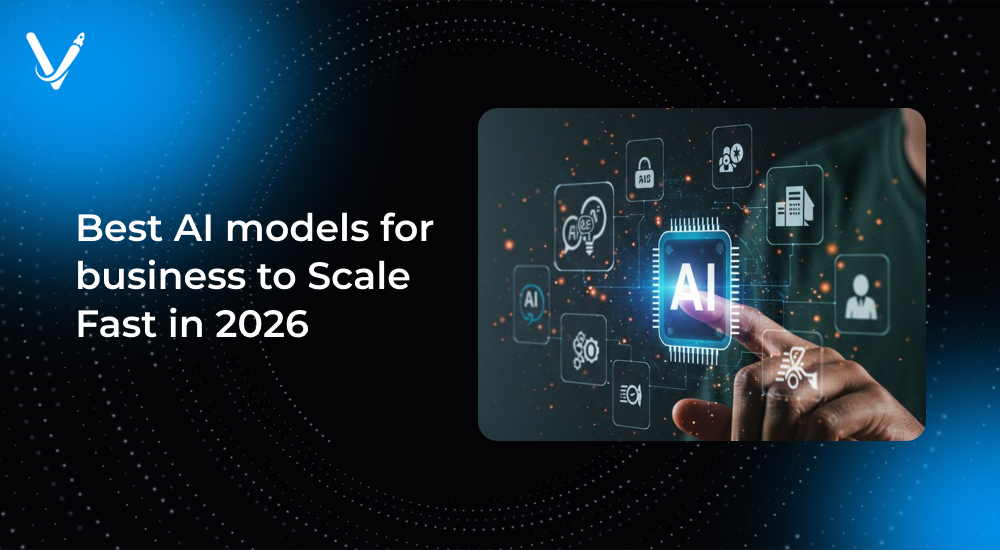
Best AI Models for Business to Scale Fast in 2026

 Mar 9, 2026







In Article:
Artificial Intelligence has moved far beyond experimentation. In 2026, it has become a fundamental technology driving business innovation across industries. From startups to global enterprises, organizations are adopting advanced AI models to automate processes, analyze data, improve customer experiences, and build smarter products, including leveraging the most advanced ai model 2026 for competitive advantage.
The rise of generative AI models has significantly accelerated this transformation. Businesses can now create AI-powered chatbots, automate content creation, generate code, and develop intelligent assistants capable of solving complex tasks.
At the same time, the AI ecosystem has expanded rapidly. Companies now have access to a wide range of solutions, including proprietary OpenAI models, Google's Gemini AI models, and a growing number of top-10 open-source AI models that offer flexibility and customization.
Not every AI model is suitable for enterprise applications. The best models used by businesses today share several important characteristics that enable organizations to operate efficiently and scale rapidly.
The best AI models deliver highly accurate outputs across a wide range of tasks such as language understanding, reasoning, coding, and data analysis. Strong reasoning capabilities allow these models to solve complex problems and provide reliable results, especially when using the most powerful ai model 2026 available in the market.
Enterprises require AI systems capable of handling thousands or even millions of requests daily. Highly scalable models allow companies to integrate AI into customer-facing products without performance issues, particularly when deploying the fastest ai model 2026 to handle real-time workloads efficiently.
Businesses often use multiple software platforms and services. The best AI models provide robust APIs and integration capabilities so they can work seamlessly with existing systems.
Enterprises must ensure that AI systems follow strict security standards and comply with regulations such as GDPR, HIPAA, and internal data governance policies.
Operational cost is a major factor in AI adoption. Companies must balance performance with cost efficiency to ensure that AI systems remain sustainable at scale.
Many organizations need AI systems tailored to their industry or specific use cases. Models that support customization and fine-tuning allow businesses to build domain-specific intelligence.
The AI ecosystem has evolved into several major categories. Each category serves different business needs and applications.
Large Language Models focus on natural language understanding and generation. They power many modern AI tools such as chatbots, AI assistants, and code generators.
Examples include OpenAI models, Gemini AI models, and several enterprise-grade conversational AI systems.
Generative AI models are designed to generate new content from training data. These models can generate text, images, videos, music, and even software code.
Businesses widely use generative AI for:
Multimodal models can process and understand multiple forms of input, such as text, images, video, and audio, simultaneously.
These models enable advanced applications such as:
The growing popularity of the top 10 open source AI models has provided businesses with greater flexibility and control over their AI infrastructure.
Open-source AI allows organizations to:
Several advanced AI models are helping businesses build intelligent systems and scale rapidly. Below are the most powerful AI models used by enterprises in 2026.
OpenAI OpenAI continues to lead the AI industry with its powerful OpenAI models. GPT-4.5 and the upcoming GPT-5 offer exceptional capabilities in reasoning, language understanding, and code generation. These models highlight openai best suited for which industries or company types 2025 or 2026, including enterprises, startups, SaaS platforms, and automation-driven businesses.
Businesses commonly use these models for:
OpenAI's ecosystem and developer tools make it one of the most widely adopted AI platforms in the world.
Gemini AI models represent Google's next-generation AI technology designed for advanced multimodal capabilities. Gemini can process text, images, audio, and video simultaneously.
Key advantages include:
Enterprises often use Gemini models for research automation, analytics, and productivity tools.
Claude 3.5 is one of the most reliable generative AI models designed for enterprise applications. It is particularly effective at handling large documents and complex instructions.
Businesses use Claude for:
Claude's focus on safety and reliability makes it popular among organizations dealing with sensitive data.
Meta’s LLaMA models have become extremely popular among developers and organizations seeking open AI solutions. LLaMA 3 is widely recognized as one of the top 10 open source AI models.
Key benefits include:
Companies often use LLaMA to build custom AI applications and internal tools.
Mistral Large is known for delivering high performance while maintaining computational efficiency. It provides strong reasoning capabilities and fast inference speeds.
Typical applications include:
Its efficient architecture makes it attractive for companies seeking powerful AI with lower infrastructure costs.
Mixtral uses a mixture-of-experts architecture that activates only specific model components for certain tasks. This improves efficiency while maintaining strong performance.
Businesses use Mixtral for:
Grok is designed to provide real-time knowledge and conversational intelligence. It focuses on delivering contextual responses and analyzing current data.
Common use cases include:
Falcon models are among the most powerful top 10 open source AI models available for enterprise deployments.
Organizations use Falcon for:
Its open architecture allows companies to build scalable AI solutions while maintaining full control over their data.
Stability AI is developed by Stability AI and focuses on providing open generative AI capabilities for developers and businesses.
It is commonly used for:
Cohere Command R is optimized for enterprise search and knowledge management systems.
Businesses use it for:
Its strong retrieval capabilities make it ideal for organizations working with large knowledge bases.
Selecting the right AI model requires careful evaluation of business goals and technical requirements.
Organizations must determine whether AI will be used for customer support, automation, analytics, or product development.
Businesses must decide between using API-based OpenAI models or deploying the top 10 open source AI models on their own infrastructure.
Operational costs such as inference usage, cloud infrastructure, and maintenance must be considered.
Companies handling sensitive information often prefer self-hosted AI models for better security control.
Enterprises test different models to determine which one provides the best balance of speed, accuracy, and reliability.
Artificial Intelligence is transforming how businesses operate and scale in 2026. The rapid development of advanced AI models, including OpenAI models, Gemini AI models, and powerful generative AI models, has created enormous opportunities for innovation.
At the same time, the rise of the top 10 open source AI models has given organizations more control over their AI infrastructure and customization capabilities.
Businesses that strategically adopt AI today will gain significant competitive advantages by automating operations, improving productivity, and delivering smarter digital experiences.
If your business is looking to integrate advanced AI models into products, platforms, or internal workflows, Vasundhara Infotech can help. Our team specializes in custom AI solutions, intelligent automation, and scalable software development designed to help businesses innovate and grow faster. Contact us today!
Copyright © 2026 Vasundhara Infotech LLP. All Rights Reserved.