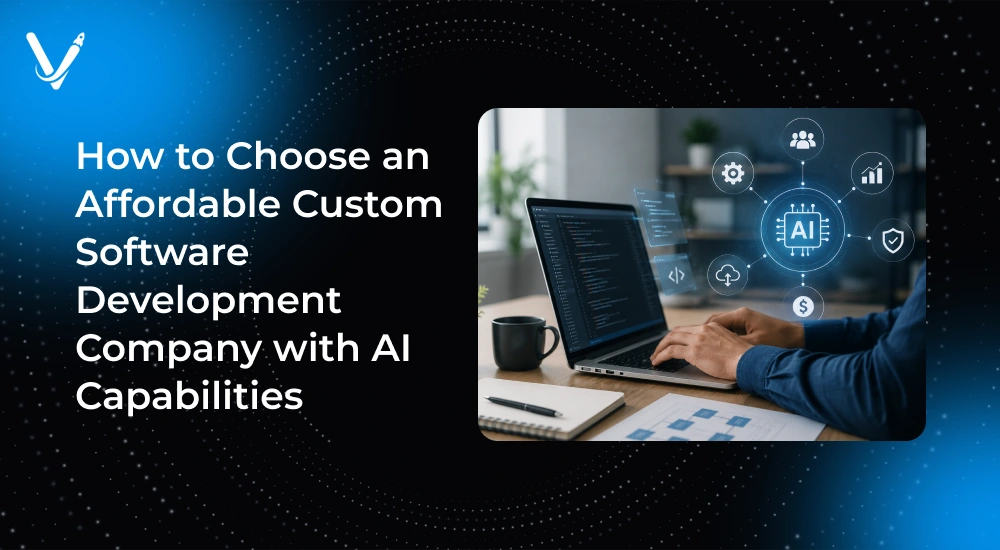
Choosing a custom software development company is one of the biggest technology decisions a business makes. The right partner builds software that fits how you work, saves time, and grows with you. The wrong one drains your budget and leaves behind code no one can maintain. Demand for tailored software keeps rising. Grand View Research valued the global custom software development market at 43.16 billion dollars in 2024. It expects that figure to reach 146.18 billion dollars by 2030, a yearly growth rate of about 22.6percent.
Two forces sit behind that growth. Off-the-shelf tools rarely fit a business perfectly. And artificial intelligence is now built into the software people use every day. Companies want custom software development services that include AI from the start, not bolted on later. Spending backs this up. Gartner forecasts that worldwide AI spending will reach about 2.59 trillion dollars in 2026, and calls 2026 the inflection year for enterprise AI. If you plan to build software now, AI capability is part of the decision.
The hard part is picking a partner. There are thousands of vendors. Some are strong engineers with weak AI skills. Some sell AI they cannot deliver. And price is confusing, because the cheapest quote often costs the most over time. This guide walks through how to choose an affordable software development company that has real AI skill, without trading away quality. For a deeper look at how tailored builds work, see Vasundhara Infotech's custom software development services.
Why Businesses Are Choosing AI-Powered Custom Software Development
AI has moved from pilot projects to daily use. McKinsey's 2025 State of AI survey found that 88 percent of organizations now use AI in at least one business function, up from 78 percent a year earlier. Around 79 percent use generative AI. Businesses are not chasing hype. They are adding AI because it changes how software performs. Here is what draws them in.
• Automation. AI handles repetitive work like data entry, sorting, and routing. Staff spend more time on judgment and less on busywork.
• Operational efficiency. Smart systems cut manual steps, reduce errors, and speed up daily processes.
• Personalization. Software adapts to each user, from product suggestions to tailored dashboards.
• Data-driven decisions. AI reads large datasets and surfaces patterns a person would miss.
• Competitive advantage. Features like forecasting and smart search are hard for rivals to copy quickly.
• Scalability. AI systems absorb rising demand without a matching rise in headcount.
The pattern is clear across industries. The World Economic Forum's Future of Jobs Report 2025 finds that 86 percent of employers expect AI and big data to reshape their business by 2030. When you build custom software today, you are also building the base for AI features you will want tomorrow. That is why so many buyers now look for custom AI software development rather than plain code.
Traditional Software vs AI-Powered Software
| Factor | Traditional Software | AI-Powered Software |
| Core logic | Fixed rules set by developers | Learns from data and improves over time |
| Automation | Basic, rule-based tasks | Handles complex, changing tasks |
| Personalization | Same experience for all users | Adapts to each user and context |
| Decisions | Reports the past | Predicts and recommends |
| Maintenance | Manual updates for each change | Models retrain as data shifts |
| Best for | Stable, simple workflows | Data-rich, fast-changing needs |
What Makes a Great Custom Software Development Company?
A strong partner is more than a team that writes code. It is a team that understands your business and stays with you after launch. Weigh these traits when you compare vendors.
• Technical expertise. Deep skill in the languages, frameworks, and cloud platforms your product needs.
• Industry experience. Work in your field, such as healthcare, finance, or retail, so they know the rules and risks.
• Development methodology. A clear, agile process with regular demos and honest status updates.
• Scalability. Architecture that supports more users and data without a rebuild.
• Security. Strong practices for data privacy, access control, and testing.
• Support and maintenance. A plan for fixes, monitoring, and upgrades after go-live.
• AI capabilities. Proven skill in machine learning, generative AI, and data work.
Vendor Evaluation Framework
| Criteria | What to Check | Green Flag |
| Technical fit | Stack, portfolio, code quality | Live products like yours |
| Domain knowledge | Projects in your industry | Named clients and case studies |
| AI skill | Shipped AI features | Models in production, not demos |
| Security | Standards and testing | SOC 2, ISO 27001, clear policy |
| Process | Agile, communication | Weekly demos and reports |
| Support | Post-launch model | Written SLA and roadmap |
How to Evaluate AI Capabilities Before Hiring a Software Development Company
Many vendors say they do AI. Fewer can prove it. Before you hire, test their AI skill with specific questions. Vasundhara Infotech's AI development services page is one example of how a partner can lay out this range of skills. Look for depth in these areas.
• Generative AI expertise. Can they build with large language models, retrieval, and safe prompts? Ask for a shipped example.
• AI agents. Can they build systems that plan and act across steps, with guardrails and human review?
• Machine learning. Can they train, test, and monitor models on your data, not just call an API?
• Predictive analytics. Can they forecast demand, churn, or risk in a way you can act on?
• Data engineering. Can they clean, join, and store data well? Good AI needs good data first.
• AI governance. Do they check for bias, track model behavior, and keep humans in the loop?
One useful test comes from the field itself. The Stack Overflow 2025 Developer Survey found that 84 percent of developers now use or plan to use AI tools, yet only 29 percent trust the output. The lesson is simple. A good AI partner treats model output as a draft to verify, not a final answer. Ask how they check accuracy before code or content ships.
Custom AI Software Development vs Traditional Software Development
It helps to see the two approaches side by side. This is not about one being better in every case. It is about matching the approach to the job.
| Factor | Traditional Development | Custom AI Software Development |
| Automation | Fixed, rule-based steps | Adapts to new patterns in data |
| User experience | Static screens and flows | Personalized, responsive to context |
| Maintenance | Manual edits per change | Models retrain as inputs change |
| Cost efficiency | Lower upfront, higher over time for complex needs | Higher upfront, strong long-term payback at scale |
| Scalability | Scales with more servers and staff | Scales logic without matching headcount |
| Advantage | Proven and predictable | Harder for rivals to copy quickly |
For simple, stable workflows, traditional development is often the smart and cheaper choice. For data-rich problems like forecasting, fraud checks, or smart support, custom AI pays back the extra effort.
Affordable Software Development Company: What Affordable Really Means
Affordable does not mean cheap. A low hourly rate can hide a high final bill. The real measure is total cost of ownership, which is what you pay across the full life of the software.
• Total cost of ownership. Add build, fixes, hosting, changes, and support. Judge the whole cost, not the quote.
• Development quality. Clean, tested code costs less to run and change later. Poor code creates constant rework.
• Long-term maintenance. Most spend comes after launch. Ask what upkeep will cost each year.
• Hidden costs. Watch for extra fees, unclear scope, and rushed work that must be redone.
• Team location. Local, nearshore, and offshore teams differ in rate, overlap hours, and coordination.
Offshore vs Nearshore vs Local
| Model | Typical Cost | Trade-off |
| Local | Highest rate | Easy overlap and in-person meetings |
| Nearshore | Middle rate | Close time zones, good communication |
| Offshore | Lowest rate | Wider time gap, needs clear process |
Many software development outsourcing companies mix these models. A common setup keeps a local lead for strategy and an offshore team for build. The goal is value. An affordable software development company gives you strong quality at a fair price and no surprises.
Questions to Ask Before Hiring a Software Development Partner
The right questions reveal how a vendor really works. Use this checklist in your first calls, and ask for proof, not just claims.
| Question | Why It Matters | Strong Answer |
| What industries do you serve? | Shows domain fit | Clients in your field |
| What AI projects have you delivered? | Tests real AI skill | Live products with results |
| How do you handle security? | Protects your data | Named standards and testing |
| What is your development process? | Shows how work flows | Agile with regular demos |
| How do you manage scalability? | Plans for growth | Cloud-native architecture |
| What support is included? | Covers the long run | Written SLA and clear scope |
AI Compliance, Security, and Governance Considerations
AI adds power and risk. A good partner plans for both. You do not need to be an expert here, but you should know these basics and check that your vendor takes them seriously.
• Data privacy. Rules like GDPR, HIPAA, and CCPA control how you collect and store data. Your vendor must follow the ones that apply to you.
• Responsible AI. Models should be fair, tested for bias, and clear about what they do.
• Security controls. Expect encryption, access limits, and regular testing as standard.
• Compliance frameworks. Standards like SOC 2 and ISO 27001 show a mature security practice.
• Human oversight. People should review important AI decisions, not just trust the output.
• Model governance. Track how models behave over time and retrain them when data drifts.
This focus is growing fast. The World Economic Forum lists networks and cybersecurity among the fastest-rising skills for the years ahead. McKinsey also notes that many firms still lack strong controls even as AI use spreads. A partner who leads with governance saves you from costly problems later.
Benefits of Working With an Enterprise Software Development Company
An enterprise software development company brings scale, process, and depth. For larger or fast-growing businesses, that structure pays off.
| Benefit | What You Gain |
| Faster time to market | Ready teams and proven playbooks shorten delivery |
| Scalable architecture | Systems built to handle growth from day one |
| Dedicated expertise | Specialists in cloud, data, security, and AI |
| AI integration | AI features planned into the product, not added late |
| Long-term support | Ongoing fixes, monitoring, and upgrades |
| Business intelligence | Reporting and analytics that guide decisions |
Software Development Outsourcing Companies vs In-House Teams
Should you build a team or hire a partner? Both work. The right pick depends on speed, budget, and how core the software is to your business.
| Factor | Outsourcing | In-House Team |
| Cost | Lower and flexible | Higher fixed cost |
| Speed | Fast start with ready teams | Slow hiring and ramp-up |
| Talent access | Wide, including rare AI skills | Limited to who you can hire |
| Scalability | Scale up or down quickly | Hard to resize fast |
| Long-term maintenance | Handled by the partner | Owned by your staff |
Many software development outsourcing companies now offer dedicated teams that feel like your own staff, with the flexibility of a partner. For most businesses, outsourcing is the faster and more affordable route to AI-ready software. In-house teams make sense when the software is your core product and you plan to invest in it for years.
Business Intelligence Software Development Services and AI
Data is only useful when it guides action. That is the job of business intelligence software development services. These services turn raw numbers into clear answers. AI makes them sharper by adding prediction and pattern finding.
• Analytics platforms. Central systems that gather data from every part of the business.
•Dashboards. Live views that show each team what matters to them.
•Predictive reporting. Forecasts for sales, demand, and risk, not just past results.
•Data visualization. Charts and maps that make complex data easy to read.
• AI-driven insights. Models that flag trends and anomalies without being asked.
A few real-world examples make this concrete. A retailer uses AI dashboards to spot which stores will run low on stock next week, then ships early. A lender uses predictive reporting to score loan risk in seconds. A software firm watches live usage data to see which features to fix first. In each case, the value is the same. People make faster, better decisions because the data is clear.
Technology Trends Shaping Custom Software Development
The way software gets built is changing fast. Knowing these trends helps you pick a partner who is ready for the next few years, not the last few.
• AI-assisted development. Developers use AI tools to write and review code faster. The Stack Overflow 2025 survey found 84 percent already use or plan to use them.
• Agentic AI. Systems that plan and act across steps are moving from labs into products, with human review.
• AI coding assistants. Tools that suggest code speed up work, though skilled engineers still verify the output.
• Cloud-native development. Apps built for the cloud scale better and cost less to run.
• DevSecOps. Security is built into the process from the start, not tested at the end.
• Data platforms. Strong data foundations make every AI feature more reliable.
• Enterprise automation. More business processes run with little or no manual work.
These trends point one way. Software and AI are merging. A partner who works this way will build you something that lasts.
How to Choose the Right Custom Software Development Company for Long-Term Growth
A launch is the start, not the finish. Choose a partner who can grow with you. Vasundhara Infotech's innovation consulting services show one way a vendor can support that longer journey. Use this simple framework to decide.
| Step | Ask Yourself |
| Business goals | What outcome must this software deliver? |
| Budget | What is our total budget across build and support? |
| AI readiness | Do we have the data and use cases for AI? |
| Technical fit | Does the vendor know our stack and domain? |
| Support model | Who maintains and improves this after launch? |
| Scalability | Can this grow with our users and data? |
Score each vendor on these six points. The best choice is rarely the cheapest or the flashiest. It is the partner who fits your goals, budget, and future.
Conclusion
Choosing a custom software development company comes down to fit, not flash. AI capabilities matter because software and AI are merging fast, and the right features can set your business apart. But skill alone is not enough. Evaluate vendors on proven work, security, clear process, and honest pricing.
Remember what affordable really means. The best value is the lowest total cost of ownership, not the lowest quote. Scalability and long-term support decide whether your software still serves you in three years. Cheap code that breaks is the most expensive kind.
The future belongs to AI-powered software. Spending is rising, adoption is near universal, and buyers now expect smart features as standard. Pick a partner who builds with that future in mind, who keeps humans in the loop, and who plans to grow with you. Define your goals, compare vendors with care, and choose the team that fits your budget and your ambition.





 Jul 9, 2026