AI coding agents are changing how startups build software. Tasks that once took hours now take minutes. Developers can generate code, debug issues, write documentation, and even refactor large repositories with AI-powered development tools.
This shift is happening fast. GitHub Copilot reportedly surpassed 1.8 million paid subscribers in 2024, while companies like OpenAI, Anthropic, and xAI continue investing heavily in AI software development. Startups are no longer asking whether AI coding assistants are useful. They are asking which AI coding stack gives them the biggest advantage.
That is where tools like Grok Build, Claude Code, and Cursor enter the conversation.
Each platform approaches software development automation differently. Some focus on deep reasoning and repository understanding. Others prioritize developer productivity and IDE workflows. For startups trying to move fast without expanding engineering costs, choosing the right stack matters.
This guide breaks down Grok Build vs Claude Code vs Cursor from a startup perspective. Instead of hype, the focus here is practical usage, workflow fit, scalability, and long-term engineering value.
What Is Grok Build?
Grok Build is xAI’s entry into the growing market of AI coding agents. While still emerging, the platform appears focused on terminal-first software development workflows and autonomous coding support.
Unlike simple autocomplete tools, Grok Build aims to act more like an engineering assistant. It can analyze repositories, execute coding tasks, suggest implementations, and potentially automate parts of development workflows.
The platform’s CLI-based experience suggests a developer-focused design philosophy. That matters because many engineering teams prefer terminal-driven workflows over browser-only interfaces.
Conceptually, Grok Build sits somewhere between:
- AI coding assistants like GitHub Copilot
- Repository-aware tools like Claude Code
- AI-native development environments like Cursor
For startups, the appeal is straightforward:
- Faster development cycles
- Reduced repetitive engineering work
- Better workflow automation
- Improved developer output
However, Grok Build is still early compared to more established AI engineering tools. That means adoption decisions should be based on team needs rather than hype alone.
Understanding Claude Code
Claude Code has gained attention because of its reasoning ability and large-context repository understanding.
Anthropic designed Claude models to handle complex instructions and long-form reasoning. In coding workflows, this becomes valuable when teams need help understanding large codebases or performing structured development tasks.
One major advantage of Claude Code is context retention. Startups working with large repositories often struggle with fragmented AI outputs. Claude performs well when developers need:
- Repository-wide analysis
- Multi-file refactoring
- Debugging workflows
- Architecture discussions
- Documentation generation
For example, a SaaS startup building an AI analytics platform may use Claude Code to:
- Review backend APIs
- Refactor authentication systems
- Explain legacy code
- Generate technical documentation
- Assist with migration planning
This makes Claude Code particularly useful for startups with growing engineering complexity.
Strengths of Claude Code
- Strong reasoning capabilities
- Excellent long-context understanding
- Helpful for complex debugging
- Better at structured engineering discussions
- Effective for backend-heavy systems
Limitations
- Less IDE-native than Cursor
- Workflow can feel slower for rapid iteration
- Some developers prefer more visual environments
When discussing Claude Code vs Cursor, the difference often comes down to reasoning depth versus workflow speed.
Understanding Cursor
Cursor approaches AI software development differently.
Instead of acting mainly as an external coding assistant, Cursor integrates AI directly into the development environment. The experience feels closer to an AI-native IDE than a standalone assistant.
That workflow integration is why many startups adopt Cursor quickly.
Developers can:
- Edit code with AI assistance
- Generate components instantly
- Refactor files inline
- Chat with repository context
- Navigate projects faster
Cursor improves developer productivity because it minimizes context switching. Engineers stay inside the coding environment while interacting with AI.
For lean startup teams, that efficiency matters.
A two-person engineering team building an MVP may use Cursor to:
- Generate frontend UI components
- Build API integrations
- Write boilerplate code
- Speed up testing
- Handle repetitive development tasks
This allows small teams to ship products faster without increasing headcount.
Strengths of Cursor
- Excellent user experience
- Fast workflow integration
- Strong for frontend development
- Great for rapid iteration
- Lower learning curve
Limitations
- May not match Claude’s reasoning depth
- Complex architectural tasks still require human oversight
- Heavy reliance on IDE workflows
Cursor works especially well for startups focused on shipping quickly.
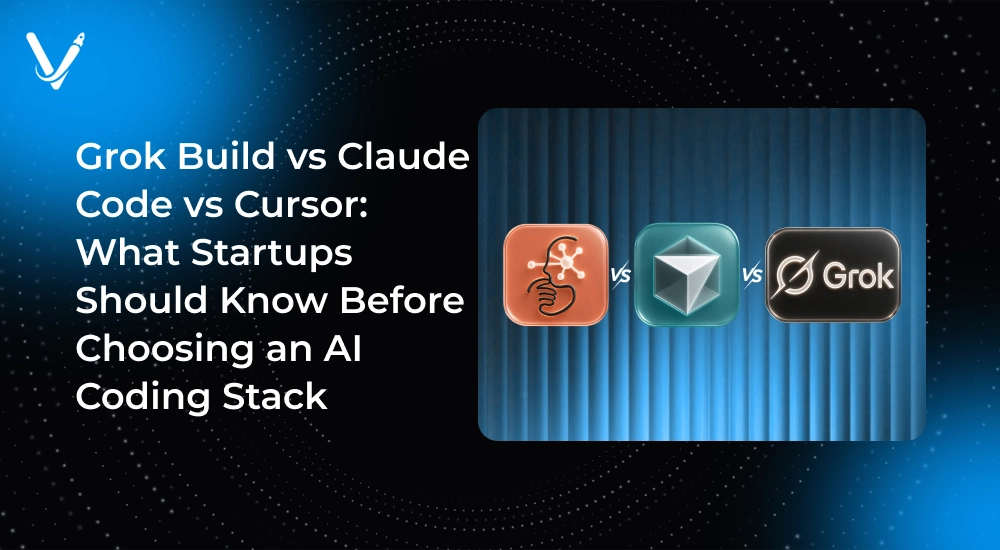
Grok Build vs Claude Code vs Cursor
Feature Comparison Table
| Feature | | | |
| Core Focus | Autonomous coding workflows | Deep reasoning & repository understanding | AI-native IDE productivity |
| Workflow Style | CLI-first | Conversational engineering assistant | Integrated development environment |
| Best For | Automation-focused teams | Complex engineering workflows | Fast MVP development |
| Repository Context | Moderate to advanced | Excellent | Strong |
| Ease of Use | Medium | Medium | High |
| Frontend Development | Moderate | Good | Excellent |
| Backend Engineering | Strong potential | Excellent | Good |
| Collaboration Workflow | Emerging | Strong documentation support | Developer-centric |
| Learning Curve | Moderate | Moderate | Low |
Ease of Use
Cursor is currently the easiest option for most startup teams.
Its interface feels familiar because developers work directly inside an IDE environment. Teams can adopt it quickly without major workflow changes.
Claude Code requires more structured prompting and workflow planning. However, it delivers stronger reasoning for complex engineering tasks.
Grok Build appears more technical and terminal-oriented. That may appeal to advanced engineering teams but could slow adoption for non-technical founders.
Automation Capabilities
This is where Grok Build becomes interesting.
The platform appears positioned toward autonomous software engineering rather than simple code generation.
If the product evolves as expected, startups could eventually automate:
- Repository maintenance
- Refactoring workflows
- Debugging tasks
- Infrastructure scripting
- Repetitive engineering operations
Claude Code also supports sophisticated automation workflows, especially for reasoning-heavy tasks.
Cursor focuses more on assisted development rather than full autonomy.
Startup MVP Development
For rapid MVP development, Cursor currently has the strongest advantage.
Why?
Because startup teams usually prioritize:
- Speed
- Iteration
- Ease of use
- Fast UI development
- Reduced workflow friction
Cursor performs extremely well in those areas.
Claude Code becomes more valuable as engineering complexity grows.
Grok Build could become attractive for AI-native startups looking to automate larger parts of development workflows.
Scalability
As startups scale, engineering priorities change.
Early-stage companies focus on speed. Growth-stage companies focus on maintainability, architecture, and system reliability.
Claude Code supports scaling better because of its repository understanding and reasoning depth.
Cursor excels during rapid product iteration.
Grok Build may become more relevant for infrastructure-heavy or automation-centric engineering teams.
Why AI Coding Agents Matter for Startups
AI coding agents are not just productivity tools anymore. They are becoming operational advantages.
Startups using AI-powered development tools can:
- Launch MVPs faster
- Reduce engineering bottlenecks
- Improve iteration speed
- Lower operational costs
- Handle more experimentation
According to GitHub research, developers using AI assistance complete tasks significantly faster than traditional workflows. That speed advantage matters in competitive startup markets.
Real Startup Impact
A startup building a health-tech dashboard might use AI coding assistants to:
- Generate frontend dashboards
- Build authentication systems
- Create API integrations
- Automate testing
- Produce documentation
Instead of hiring three additional engineers, the startup may scale efficiently with a smaller team.
That changes startup economics.
AI software development is allowing smaller companies to compete with larger engineering organizations.
The Rise of Autonomous Software Engineering
The industry is moving beyond autocomplete.
Modern AI engineering tools increasingly support:
- Multi-step reasoning
- Repository awareness
- Workflow automation
- Autonomous task execution
- Context-aware development
This shift is driving the rise of autonomous software engineering.
The goal is not fully replacing developers. The goal is reducing repetitive engineering work while increasing output quality.
Startups are already experimenting with:
- AI-generated pull requests
- Automated testing workflows
- AI-assisted debugging
- Infrastructure automation
- AI-supported deployment pipelines
Grok Build reflects this direction clearly.
Rather than functioning only as a coding assistant, it appears designed for deeper workflow automation.
That could reshape startup engineering workflows over the next few years.
What AI Still Cannot Replace
Despite rapid progress, AI coding agents still have major limitations.
System Architecture Decisions
AI can suggest implementations, but experienced engineers still make architecture decisions based on:
- scalability
- reliability
- infrastructure constraints
- security requirements
Product Strategy
AI does not understand customer psychology, business priorities, or market timing the way founders do.
Security Planning
Human oversight remains essential for:
- authentication systems
- compliance requirements
- infrastructure security
- production reliability
UX Thinking
Good products require empathy and user understanding.
AI can generate interfaces, but it cannot fully replace human-centered product design.
Creativity and Decision-Making
Startups succeed because of strategic thinking, experimentation, and execution quality.
AI improves output. It does not replace leadership.
How Startups Should Choose an AI Coding Stack
There is no universal winner in the Grok Build vs Claude Code vs Cursor discussion.
The right AI coding stack depends on startup priorities.
Choose Cursor If:
- You need fast MVP development
- Your team values IDE workflows
- Frontend velocity matters most
- You want low onboarding friction
Choose Claude Code If:
- Your product has engineering complexity
- You need repository-level reasoning
- Backend systems are critical
- Documentation and architecture matter heavily
Consider Grok Build If:
- Your team prefers terminal workflows
- Automation is a priority
- You are building AI-native systems
- You want deeper autonomous workflows
Questions Startups Should Ask
Before adopting AI developer tools, founders should evaluate:
- How technical is the team?
- How large is the codebase?
- How fast must the product ship?
- What workflows consume the most engineering time?
- Does the team prioritize automation or usability?
- Will the stack scale with future complexity?
The best choice usually depends on workflow fit rather than brand popularity.
Final Verdict
AI coding agents are rapidly reshaping software development.
Cursor currently leads in developer experience and MVP speed. Claude Code stands out for reasoning depth and repository understanding. Grok Build represents the growing shift toward autonomous software engineering and AI-driven automation.
For startups, the smartest approach is not choosing the “most powerful” tool. It is choosing the AI coding stack that aligns with team workflows, engineering maturity, and product goals.
These platforms are best viewed as productivity multipliers.
The startups that gain the most value will be the ones that combine AI-powered development tools with strong engineering leadership, clear product strategy, and thoughtful execution.
At Vasundhara Infotech, we help startups and enterprises build scalable digital products using modern AI development workflows, automation-driven engineering, and next-generation software solutions. Whether you are exploring AI coding assistants, building an MVP, or scaling a complex platform, our team helps turn ideas into production-ready products faster and more efficiently.





 May 15, 2026