


AI/ML
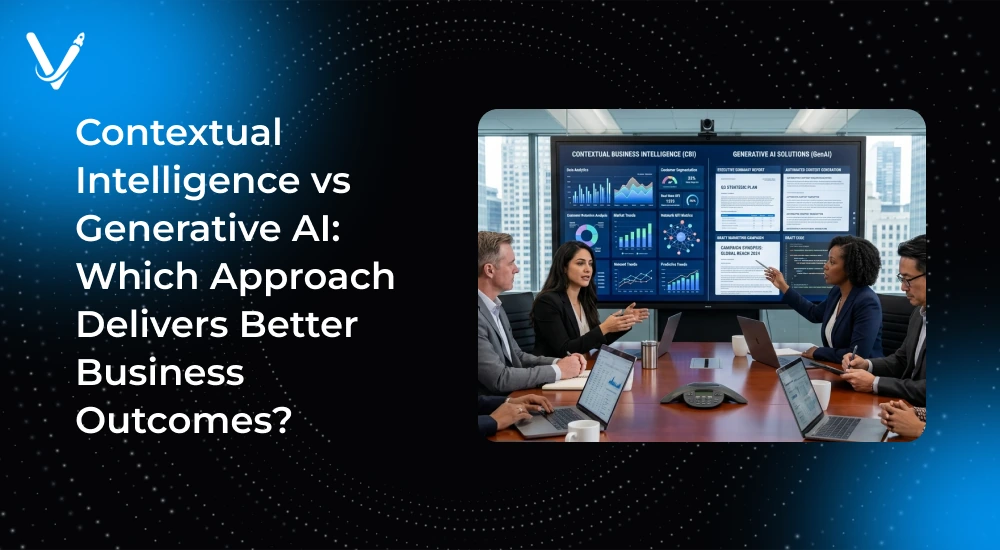
Contextual Intelligence vs Generative AI: Which Approach Delivers Better Business Outcomes?

 Jun 1, 2026





QUICK ANSWER
Quick answer: Generative AI is built to create things, like text, code, and images. Contextual Intelligence is built to read a situation and act on it using your real data. For most enterprise decisions, context-aware AI gives safer, more useful outcomes. For drafting and ideation, generative AI wins. The best systems use both.
Most teams start with the wrong question. They ask which AI tool to buy. The better question is simpler. Are you trying to make something, or decide something?
That one question splits the whole market in two. Generative AI makes things. Contextual Intelligence decides things. If you mix them up, you ship a slick demo that fails in production. We have seen it happen. The fix is to match the tool to the job.
This guide breaks down the contextual intelligence vs generative AI debate in plain terms. We will show how each one works, where each one breaks, and what the data says about results. If you want a deeper primer first, our explainer on agentic AI versus generative AI is a good starting point.
Generative AI predicts the next likely word, pixel, or line of code. It learns patterns from huge piles of data. Then it produces new content that fits those patterns. Ask it to write an email, and it writes one. Ask for a product photo, and it makes one.
This is powerful. The generative AI market was worth about 16.9 billion dollars in 2024. It is projected to hit 109.4 billion dollars by 2030, a yearly growth rate near 37.6 percent, according to Grand View Research. That growth is real, and so is the value.
But here is the catch. Generative AI does not truly know your business. It guesses based on training data, not your live systems. So it can sound confident and still be wrong. When the cost of a wrong answer is high, that guessing becomes a risk.
Pure generative models have no memory of your customer, your stock, or your rules. They can invent facts. They do not check a source unless you force them to. For a marketing draft, that is fine. For approving a loan or routing a refund, it is not.
Contextual Intelligence is AI that understands the full picture before it acts. It pulls in who the user is, what they did before, and what your data says right now. Then it makes a grounded choice. People also call this context-aware AI.
Think of it this way. Generative AI answers the question you typed. Context-aware AI answers the question you meant, based on everything it knows about the moment.
Two methods make this work. The first is context engineering. This is the practice of feeding a model the right facts, rules, and history at the right time. Good context engineering is what separates a toy from a tool.
The second is RAG AI, short for retrieval augmented generation. RAG pulls real documents from your own data before the model answers. So the reply is based on your facts, not a guess. This cuts made-up answers a lot. It also lets you show the source, which matters for trust and audits.
AI Agents take context-aware AI one step further. They do not just answer. They act. An agent can read a ticket, check your database, take a step, and then check its work. Stack several together and you get Agentic AI, which runs multi-step jobs on its own.
This is where Enterprise AI gets exciting. Agents drive intelligent automation across messy workflows. They handle the steps a human used to click through by hand. Done right, this is real AI decision making, not just text on a screen. Done wrong, it is a fast way to make bad calls at scale.
Adoption is climbing but still early. In McKinsey's 2025 State of AI survey, 23 percent of organizations said they were scaling an agentic AI system somewhere in the business, and another 39 percent were experimenting, per McKinsey. Most are not at full scale yet. The room to grow is huge.

The chart above sums up the split. Generative AI starts with a prompt and ends with content. Context-aware AI starts with your data and ends with a decision. Same family, very different jobs.
Let us talk results, since that is what pays the bills. We will look at four things: cost, accuracy, personalization, and decision quality.
Grounded systems win on accuracy. Because RAG AI checks real sources, its answers are easier to verify. That is why contextual approaches are spreading fast in analytics. Gartner predicts that by 2027, 75 percent of new analytics content will be shaped by generative AI for richer contextual intelligence, according to Gartner. The trend is clear. Context is becoming the default.
For AI personalization, context-aware AI is the stronger engine. It knows the user's history, so it tailors offers and replies to the person, not the average. On cost, agents that automate full workflows tend to save more than a chatbot that only drafts text. The savings come from finished work, not faster typing.
On AI decision making, the gap is widest. Generative AI is a creative partner. Contextual systems and agents are decision partners. When a choice needs to match a rule or a record, grounding beats guessing every time.

Use the guide above as a quick filter. If the task is open-ended creation, lean generative. If the task needs your data, your rules, and a defensible answer, lean contextual.
You rarely have to pick just one. The smartest Enterprise AI Solutions blend both. Generative AI writes the first draft. Context-aware AI checks it against your facts. An agent then takes action and logs what it did.
A word of caution. Hype runs ahead of value right now. Gartner expects more than 40 percent of agentic AI projects to be scrapped by the end of 2027, often due to unclear value, rising costs, or weak controls. The lesson is not to avoid agents. It is to start where the payoff is clear.
You do not need a moonshot to start. You need one painful, well-defined task. Here is a simple path.
This is where custom AI development pays off. Off-the-shelf tools rarely know your rules. Tailored AI agent development wires the model into your real systems and your real guardrails. If you want help scoping this, our enterprise AI solutions team does exactly that.
Grounded AI touches real customer data, so governance is not optional. If you serve EU users, GDPR rules how you store and process personal data, and people can ask what was used. In healthcare, HIPAA sets strict limits on protected health information. Many regions now also expect clear AI disclosure, so users know when a machine made or shaped a decision.
Because context-aware AI pulls from internal systems, lock down who and what it can reach. Use role-based access controls, keep audit trails of every retrieval and action, and log the sources behind each answer. Good AI agent development bakes these controls in from day one, not as an afterthought.
So, contextual intelligence vs generative AI, which delivers better business outcomes? For decisions, context wins. For creation, generation wins. Pick by the job, not the buzzword, and you will ship things that actually work.