Introduction
For most startups, the biggest constraint is not ideas. It is execution cost. Building a reliable product still demands skilled developers, long timelines, and constant iteration. Even a simple MVP can stretch budgets beyond expectations when delays, bugs, and rework start adding up.
This is where modern AI development tools are shifting the equation. Tools like Cursor AI are helping teams move faster with fewer resources. Instead of replacing developers, they are amplifying productivity. The result is simple but powerful: startups can now build, test, and launch products at a fraction of the traditional cost.
The Rising Cost of Traditional Software Development
Software development has always been resource-intensive, but costs have increased sharply over the past few years. Hiring experienced developers is expensive, especially in competitive markets. A mid-level developer can cost anywhere between $25 to $80 per hour globally, while senior engineers often exceed that range.
Beyond hiring, timelines add another layer of cost. Traditional workflows involve planning, coding, testing, debugging, and deployment, often handled by separate team members. This fragmentation slows progress and introduces inefficiencies. Even small changes can take days due to dependencies across teams.
Startups also face hidden costs such as bug fixing, technical debt, and communication gaps. Studies suggest that up to 30–40% of development time is spent on debugging and maintenance rather than building new features. When budgets are tight, these inefficiencies directly impact growth and speed to market.
What is Cursor AI and How It Works
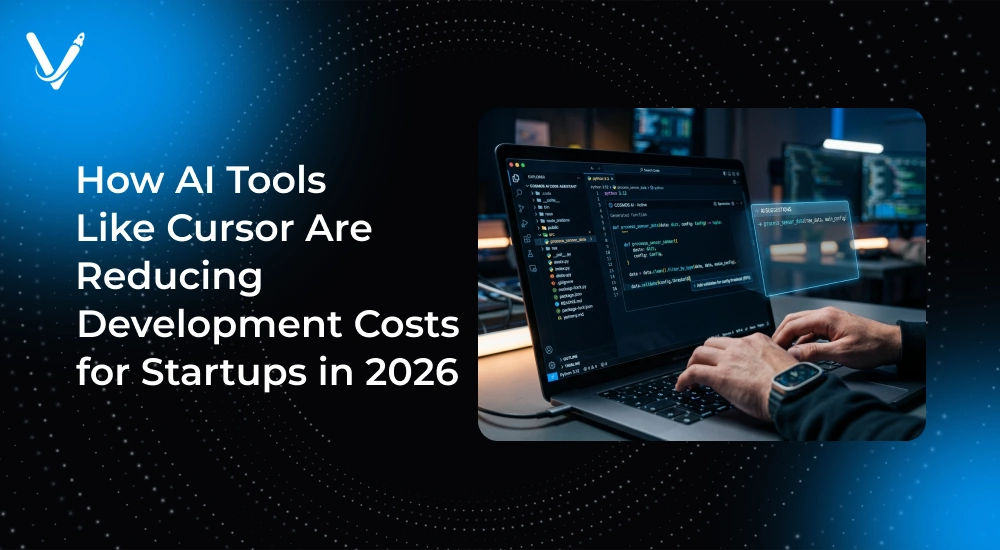
Cursor AI is an AI-powered code editor designed to work alongside developers as an intelligent assistant. Unlike basic autocomplete tools, it understands the context of an entire codebase and can generate, edit, and refactor code across multiple files.
At its core, Cursor combines natural language understanding with code intelligence. Developers can describe what they want in plain English, and the tool translates that into working code. It can also analyze existing code, identify issues, and suggest improvements in real time.
The most impactful feature is its ability to act like a collaborative partner. Instead of writing every line manually, developers guide the system, review outputs, and refine results. This changes development from a purely manual process to a hybrid workflow where AI handles repetitive and time-consuming tasks.
How AI Tools Reduce Development Costs
Faster Coding and Automation
AI development tools significantly reduce the time required to write code. Tasks that once took hours, such as setting up APIs or writing boilerplate logic, can now be completed in minutes. Developers spend less time on repetitive work and more time solving meaningful problems.
This increase in speed directly lowers project costs. When development cycles shorten, teams can deliver features faster without increasing headcount. For startups working under tight budgets, this efficiency makes a measurable difference.
Reduced Dependency on Large Teams
Traditional development often requires multiple roles, including frontend developers, backend engineers, QA testers, and DevOps specialists. With AI assistance, smaller teams can handle broader responsibilities.
A single developer supported by AI can perform tasks that previously required two or three people. This does not eliminate the need for expertise, but it reduces the number of resources needed to achieve the same output. For startups, this translates into lower payroll costs and simplified team management.
Fewer Bugs and Faster Debugging
Debugging is one of the most time-consuming aspects of software development. AI tools can analyze code patterns, detect errors early, and suggest fixes instantly. This reduces the time spent identifying and resolving issues.
In many cases, AI can prevent bugs before they occur by recommending best practices during development. As a result, teams spend less time on maintenance and more time building new features. This shift improves both productivity and product quality.
Rapid Prototyping and MVP Development
Speed is critical for startups validating new ideas. AI tools enable rapid prototyping by generating functional code quickly. Founders can test concepts, gather feedback, and iterate without investing heavily upfront.
This ability to build MVPs faster reduces financial risk. Instead of committing large budgets to untested ideas, startups can launch lean versions, learn from users, and scale gradually. It is a more efficient path to product-market fit.
Real-World Use Cases for Startups
AI in software development is not theoretical anymore. Startups across industries are already using tools like Cursor to optimize their workflows.
In SaaS platforms, teams use AI to build dashboards, authentication systems, and integrations quickly. Instead of starting from scratch, they generate base structures and customize them as needed. This approach reduces development time significantly.
Marketplace startups benefit from faster backend development. Features like user management, payment integration, and notification systems can be implemented with fewer resources. AI helps streamline these complex systems without compromising functionality.
Mobile app startups are also seeing gains. From UI components to API connections, AI tools assist in building consistent and scalable applications. This allows small teams to compete with larger companies in terms of speed and quality.
Cost Comparison: Traditional vs AI-Assisted Development
To understand the impact, it helps to compare both approaches in practical terms.
Traditional Development:
- Requires larger teams across multiple roles
- Longer timelines due to manual coding and testing
- Higher costs driven by salaries and delays
AI-Assisted Development:
- Smaller teams with enhanced productivity
- Faster delivery cycles with automated workflows
- Lower overall cost due to reduced effort and time
A typical MVP that might take 4–6 months using traditional methods can often be built in 6–10 weeks with AI support. This reduction in timeline directly translates into cost savings, often in the range of 30–50% depending on project complexity.
Limitations and Considerations
While AI tools offer clear advantages, they are not without limitations. Understanding these is important for making informed decisions.
AI-generated code still requires human oversight. Developers must review outputs to ensure accuracy, security, and scalability. Relying entirely on automation without validation can lead to issues in production.
There is also a learning curve involved. Teams need time to adapt to new workflows and understand how to use AI effectively. Without proper usage, the benefits may not be fully realized.
Another factor is cost management. While AI tools reduce development costs overall, they often come with subscription or usage fees. Startups need to balance these expenses against the value they provide.
Future of AI in Development (2026 and Beyond)
The role of AI in software development is expected to expand rapidly. Tools will become more context-aware, capable of handling larger codebases, and better at understanding complex requirements.
We are moving toward a model where developers focus more on problem-solving and architecture, while AI handles execution. This shift will redefine how teams are structured and how projects are delivered.
For startups, this means greater accessibility. Building high-quality software will no longer require large teams or massive budgets. Instead, efficiency and smart tooling will become the key differentiators.
Conclusion
The cost of building software has long been a barrier for startups. Limited budgets, long timelines, and resource constraints often slow down innovation. AI development tools are changing this reality by making development faster, leaner, and more efficient.
Tools like Cursor AI are not just improving productivity; they are reshaping how products are built. Startups that adopt these tools early gain a clear advantage in speed, cost, and scalability.
The opportunity is not just to reduce expenses, but to build better products with fewer constraints. For founders and decision-makers, the question is no longer whether to adopt AI, but how quickly they can integrate it into their development strategy.
If you are looking to turn this shift into a competitive advantage, working with the right development partner makes all the difference. Vasundhara Infotech helps startups adopt AI-driven development workflows to reduce costs, accelerate timelines, and build scalable digital products.





 Apr 22, 2026