The healthcare chatbot market was worth about 787 million dollars in 2023 and is growing more than 20 percent a year, per Grand View Research. Hospitals are a big part of that growth. They face packed schedules, long phone lines, and stretched staff. Generative AI chatbots can ease all three.
A generative AI chatbot does far more than a basic bot. It understands natural speech and holds a real conversation. For a busy hospital, that means better patient support without adding more staff.
In this guide, we cover what these chatbots do, how hospitals use them, and what it takes to build one safely. We also cover HIPAA and compliance, which matter most here. If you want expert help, our AI chatbot development team builds secure hospital bots.
Why Hospitals Need Generative AI Chatbots
Accenture has estimated that AI could save the US healthcare economy up to 150 billion dollars a year by 2026. Hospitals stand to gain a large share of that.
Hospitals run on tight schedules and thin staffing. Patients wait too long for simple answers. Phone lines stay busy. Front desks get swamped with routine questions. All of this slows care and frustrates everyone.
Here are the daily problems a chatbot can ease:
• Long phone waits that frustrate patients
• Staff stretched thin across many tasks
• Patients who want answers at any hour
• Routine questions that clog the front desk
A Hospital chatbot software development project can fix these. It handles the routine work, so staff can focus on care. That is why so many hospitals now invest in Healthcare AI chatbot development services.
What Is a Generative AI Chatbot?
McKinsey names customer operations as one of the top areas where generative AI adds value. Patient support is the hospital version of that.
A generative AI chatbot uses AI to understand and create human language. It is not just a set of fixed scripts. It works out what the patient means and writes a clear, natural reply.
This is a big step up from old bots. Here is what generative AI adds:
• It understands natural language, not just keywords
• It handles questions it has not seen before
• It replies in a clear, human way
• It works in many languages
• It can learn from your hospital’s own data
This is why generative ai for chatbot development is now the standard for serious Healthcare conversational AI solutions. A scripted bot cannot keep up with the range of patient questions a hospital gets.
How Hospitals Use Generative AI Chatbots
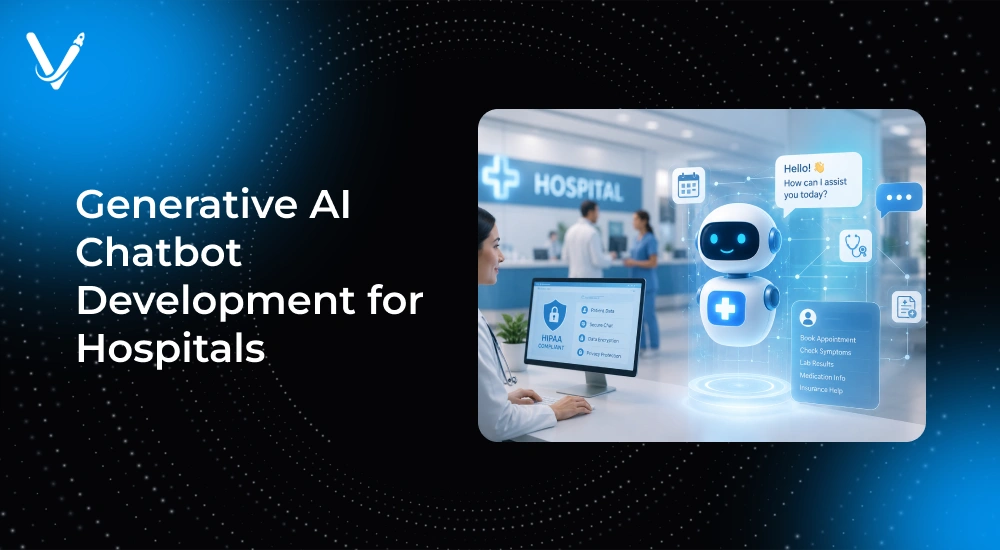
A single hospital can field thousands of patient questions a day. A generative AI chatbot can handle a large share of them. Here is where it helps most.
Patient support
The bot gives 24/7 answers to common questions about hours, services, visiting rules, and billing. Patients get help fast, without a long phone wait.
Appointment management
Patients can book, move, or cancel visits without calling. The bot syncs with your schedule in real time, which cuts no-shows and front-desk load.
Symptom checks and triage
The bot can ask about symptoms and guide the patient on next steps. It does not give a diagnosis. It points them to rest, a visit, or urgent care.
Department routing
A big hospital has many departments. The bot understands the need and sends the patient to the right team. This cuts confusion and saves time.
Patient engagement and follow-up
After a visit, the bot checks in, sends reminders, and shares care tips. A strong AI patient engagement chatbot keeps patients on track with their care plan. See real examples in our guide to custom AI development.
Key Benefits for Hospitals
The payoff goes well beyond saved time. A well-built bot helps patients, staff, and the hospital’s bottom line.
• Shorter wait times for patients
• Lower admin and call-center costs
• Round-the-clock support in many languages
• Less burnout for front-line staff
• Higher patient satisfaction scores
• Cleaner data from set intake forms
These gains add up fast across a busy hospital. This is why Enterprise healthcare chatbot development has become a priority for many health systems.
Generative AI vs Old Rule-Based Bots
Not all chatbots are equal. The gap between generative AI and old rule-based bots is large. Here is a quick side-by-side.
| Factor | Generative AI Chatbot | Rule-Based Bot |
| Understanding | Natural language | Fixed keywords |
| New questions | Handles them well | Often fails |
| Tone | Human and natural | Stiff and scripted |
| Languages | Many at once | Limited |
| Learning | Learns from data | Stays fixed |
| Best for | Complex hospital needs | Very simple FAQs |
HIPAA and Compliance for Hospital ChatbotsHealthcare data breaches are the costliest of any industry, with an average cost near 10 million dollars, per IBM. Hospitals hold huge amounts of patient data, so compliance is job one.
HIPAA is the US law that protects patient health data. If your chatbot touches that data, it must follow HIPAA. You can read the official rules at HHS.gov.
A compliant hospital chatbot needs these basics:
• Encryption. Data is locked both when stored and when sent.
• Access controls. Only the right people and systems see patient data.
• Audit logs. Every access and change is tracked.
• A signed BAA. Your vendor signs a Business Associate Agreement.
• Data minimization. The bot collects only what it truly needs.
The HHS Security Rule sets these duties, and the World Health Organization has guidance on AI in health too. Whichever partner you pick, do not take their word on safety. Test the controls. Keep a human in the loop. AI compliance is an ongoing duty, not a one-time tick box.
How to Build a Hospital AI Chatbot
A clear plan beats a rushed build. Here is a simple path for Custom AI chatbot for hospitals projects.
1. Define your top use cases, like support, booking, or triage
2. Pick a strong generative AI model and platform
3. Build HIPAA rules in from the very start
4. Connect the bot to your EHR and systems
5. Train it on your hospital’s own data
6. Test it for safety, accuracy, and tone
7. Launch small, measure, then scale what works
This path keeps risk low and builds trust with staff and patients. Start with one department or use case, prove value, then grow from there.
Choosing a Hospital AI Chatbot Development Company
Your choice of partner shapes the whole result. Look for these traits in any provider.
• Real hospital and healthcare experience, with case studies
• A clear HIPAA and security track record
• Custom build and EHR integration skills
• Clear pricing, timelines, and long-term support
A strong Hospital AI chatbot development company checks every box here. Ask for proof, not promises, and confirm they will sign a BAA. Our AI development services team helps hospitals build secure, custom bots the right way.
Conclusion
Generative AI chatbots give hospitals a real way to do more with the team they have. They ease wait times, cut admin load, and help patients any hour of the day.
Rather than replacing staff, these bots support them. They take the routine work, so care teams can focus on patients.
For hospitals, the main benefits include:
• Shorter wait times and faster answers
• Lower admin and call-center costs
• Round-the-clock, multilingual support
• Less staff burnout
• Higher patient satisfaction
At the same time, hospitals must build with care. HIPAA compliance, data security, and human oversight stay essential parts of any rollout.
Generative AI chatbots are quickly becoming a core part of patient care. Hospitals that build them well will serve patients better and stay safe.
Ready to build a secure hospital chatbot? At Vasundhara Infotech, we help hospitals build custom, HIPAA-aware generative AI chatbots and healthcare conversational AI solutions designed for real patient care.





 Jun 30, 2026