AI/ML
LLM-Powered Healthcare Chatbots Explained: Benefits, Use Cases, Features, and Implementation Guide

 Jul 21, 2026







hysician use of AI jumped from 38% in 2023 to 81% by early 2026, according to the American Medical Association's survey on augmented intelligence. Patients moved even faster. OpenAI reports more than 230 million people ask health questions on ChatGPT every week.
For years, healthcare chatbots ran on scripts. A patient picked from a menu and got a canned line. Step off the script and it broke.
Large language models changed that. They understand a full question, hold the thread of a conversation, and answer in plain language. Teams exploring AI development services now ask about LLM assistants rather than decision trees.
They now handle patient engagement, admin support, clinical knowledge lookup, and workflow automation. They also demand strong governance. In medicine, a confident wrong answer is not a small bug.
This guide covers what they are and how the architecture works. It walks through the benefits and the use cases. It also gives a step-by-step build path and the compliance work you cannot skip.
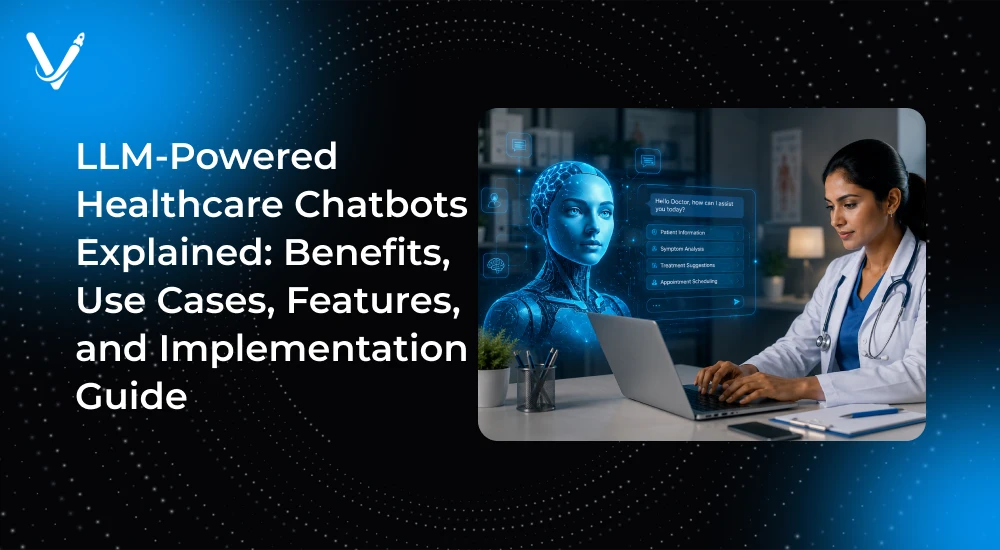
An LLM-powered healthcare chatbot is a chat assistant built on a large language model, not a fixed script.
An LLM is a model trained on huge amounts of text. Given a question, it produces an answer instead of looking one up in a list.
| Factor | Rule-Based Chatbot | LLM-Powered Chatbot |
| Responses | Fixed, pre-written replies | Generated for each question |
| Understanding | Keyword and menu matching | Understands full sentences |
| Off-script questions | Fails or repeats itself | Handles them reasonably |
| Context | Forgets each turn | Remembers the conversation |
| Setup | Every path written by hand | Trained model plus your content |
| Risk | Predictable and limited | Needs guardrails and review |
• Natural language understanding, so patients type or speak normally.
• Context awareness across a whole conversation, not one turn.
• Medical knowledge assistance drawn from approved sources.
• Human-like conversation that adjusts tone and reading level.
• Continuous learning as content and guidelines are updated.
This is why healthcare chatbots moved from menu trees to real conversation. The trade is less predictability, so validation matters more.
A safe build is never just a model with a chat window. It is a pipeline.
A patient query arrives. Language processing cleans and reads it. The LLM works out what is being asked and plans a reply.
Before writing, the system pulls matching passages from a medical knowledge base. This is retrieval-augmented generation, or RAG.
A clinical validation layer checks the draft against approved guidelines. Only then does the answer go out. Anything unclear or clinical goes to a human first.
Grounding is what separates a usable system from a liability. In one radiology study, a model invented answers 8% of the time on its own. With retrieval added, that fell to zero.
Other 2025 clinical work cut made-up answers below 6% using self-checking retrieval. Numbers shift with the setup. Treat them as a direction, not a promise.
| Feature | What It Delivers |
| Natural conversations | Patients ask in their own words, not menu options |
| Multilingual support | Answers in the patient's language without a separate build |
| Context retention | No repeating details already given earlier in the chat |
| Personalized responses | Tone and reading level matched to the patient |
| Knowledge retrieval | Answers grounded in approved medical sources |
| Appointment assistance | Booking, rescheduling, and reminders handled directly |
| Patient education | Care plans and prep steps explained in plain words |
| Workflow automation | Intake, insurance checks, and follow-up run end to end |
| EHR integration | Reads and writes real records through secure APIs |
| Voice capabilities | Phone support for patients who prefer to call |
Patients stay in a chat that understands them. A scripted bot loses people the moment they phrase something oddly.
Administrative functions now account for more than 40% of what hospitals spend delivering care, per the American Hospital Association's 2025 Costs of Caring report. Routine booking and intake questions are exactly what these systems absorb.
Answers arrive in seconds, not after a callback. Average waits to book a physician run near 31 days in major US metros. Speed at the front door matters.
Patients ask at night and on weekends. That coverage costs nothing extra once live.
Every deflected call and filled slot is money. Missed appointments cost the US system about $150 billion a year, at roughly $200 per empty slot.
Front desk teams handle exceptions, not every request. Clinical staff get more of the day back for care.
Answers shaped by the patient's own care plan, not a generic FAQ.
Challenge: High call volume across departments and a front desk that cannot keep up.
AI solution: An assistant handles booking, directions, and billing questions. Clinical queries route to staff.
Business outcome: Fewer calls reach a human and hold times fall.
Challenge: A small team juggling phones, paperwork, and reminders with no budget to hire.
AI solution: The bot books visits, collects intake forms, and sends reminders before each one.
Business outcome: Lower no-show rates and revenue recovered from slots that would have sat empty.
Challenge: Consults start cold because history is not gathered in advance.
AI solution: The bot gathers intake details and symptoms before the visit. It follows up after.
Business outcome: Shorter consults and better clinical notes.
Challenge: The same questions repeat all day and still generate callbacks.
AI solution: The bot answers from approved sources and shows them. Anything unclear goes to a person.
Business outcome: Higher first-contact resolution and less repeat contact.
Challenge: Patients cannot book outside office hours, so slots go unfilled.
AI solution: Real-time booking connected to the scheduling system, at any hour.
Business outcome: More slots get filled. Night-time bookings that used to be lost now land.
Challenge: Coverage questions clog the phone lines and cause surprise denials later.
AI solution: Eligibility checks and plan answers pulled from live data before the visit.
Business outcome: Fewer avoidable denials and less rework for billing staff.
Challenge: Clinicians hunt through long documents for protocol details.
AI solution: Grounded search over guidelines and formularies, with the source linked.
Business outcome: Faster access to protocols with a clear audit trail.
Challenge: HR and IT teams answer the same staff questions repeatedly.
AI solution: An internal assistant answering from policy documents.
Business outcome: Instant answers for staff and fewer internal tickets.
This last one is the most common first build. Healthcare AI chatbot development carries less risk when the audience is staff, not patients. That is why medical AI chatbot development services often start there.
Name the problem and the number on it. How many calls, at what cost, today? That baseline is how you prove value later.
Pick two or three high-volume, low-risk workflows. Booking and intake are the usual first wins. Avoid symptom triage at first.
Match the model to the task and budget. You rarely need the largest. Confirm the vendor will sign a Business Associate Agreement.
Gather guidelines, policies, and patient FAQs. Clean and tag them. Give every document an owner and a review date. Content with no owner goes stale quietly.
Connect through secure APIs, usually with HL7 FHIR. Read access is straightforward. Write access, where the assistant updates a real record, needs careful permissions and more testing time than most teams budget.
Encryption in transit and at rest, role-based access, and full audit logging. Build these in from the start.
Build a test set of 200 to 500 real questions with known answers. Have clinicians grade the output. Fix the weak spots before anyone outside sees it.
Launch to staff first, patients second. Staff find the gaps faster, and they forgive them.
Track escalation rate, resolution rate, and clinician corrections. Review failed chats monthly. They tell you what to fix next.
Good healthcare chatbot implementation services keep to this order. Be wary of a healthcare chatbot development company that jumps straight to the model. The conversation quality work usually sits with generative AI development services while the surrounding platform comes from custom software development.
These systems touch protected health information at every step. The rules published by HHS set the baseline for how that data must be handled in the United States.
Any vendor touching PHI needs a signed Business Associate Agreement. That includes your model provider and your hosting partner, not only the chatbot vendor.
Collect the minimum. Mask identifiers where you can. Most useful cases run fine on policy documents and guidelines alone, without patient records.
Set clear rules on what the assistant can see, how long data is kept, and who can access it.
This is the one that matters most. AI should support clinical judgment, never replace it. Guidance from the World Health Organization stresses human accountability for health AI, and no accuracy score changes that principle.
Log the question, the retrieved sources, the answer, and the timestamp. When a regulator asks what the system said in March, retrieval logs are your answer.
Tell patients they are speaking with an AI assistant. Give them a simple route to a human.
Test answers across different patient groups before launch, then keep testing. A model trained on one population can misjudge another.
Guard against prompt injection and poisoned documents. Validate everything that enters the knowledge base. This is not legal advice, so confirm your obligations with counsel.
A model can be wrong and still sound certain. Retrieval and validation cut this sharply, but never assume the risk is zero.
Guidelines change. If nobody owns updates, the assistant quietly gives outdated advice.
Connecting to the EHR and scheduling systems costs more than the AI itself. It is also where projects slip.
Model calls, storage, and content review bill every month. Budget for the run cost, not just the build.
Old PDFs, scanned forms, and duplicate policies produce poor answers. Most of the work is cleaning documents.
HIPAA in the US, GDPR in Europe, and the EU AI Act all apply differently. Build the audit trail early.
People resist tools they do not trust. Start low-risk and let results build confidence.
Assistants that plan a multi-step task, act on it, and check their own work. They book the slot instead of explaining how to book it.
Phone lines answered by an assistant that books appointments and escalates urgent calls. Most patients still reach for the phone first.
Systems that read images and documents too, such as an uploaded form or a photo of a prescription label.
Assistants that prepare visit summaries and draft notes for a clinician to review and sign. Human sign-off stays mandatory.
Support shaped by the patient's own record, pulled live rather than from a generic script.
Voice, chat, and workflow tools on one backend, sharing data and rules. The pieces ship today. Governance decides who benefits first.
Ask what they have shipped in healthcare. Clinical workflows hide traps that generic teams find the expensive way.
Ask how they handle hallucinations, grounding, and testing. If the answer is only about the model, keep looking.
A good partner raises BAAs, audit logs, and PHI handling before you do.
Ask specifically about FHIR, HL7, and your EHR vendor by name. Vague answers here predict delays.
Encryption, access control, and penetration testing should be standard practice, not upsells.
Models drift, guidelines change, and documents age. You want a partner who stays past launch. Start with a small paid pilot.
The gains can be measured. Patients engage more. Admin load drops. Replies come faster, at any hour. Each contact costs less.
The architecture is what makes them safe. Retrieval, a validation layer, and human review are not extras. They are why the system can be trusted at all.
Build it in order. Goals first, then workflows. Pick the model, build the knowledge base, connect the systems. Lock down security, test hard, deploy, then watch it closely.
Planning an LLM-powered healthcare chatbot? Put patient safety first. Then compliance, secure integration, and outcomes you can measure. And keep your clinicians involved in the calls that matter.
If you are scoping one, our team can help map the workflows, the data, and the compliance work before development begins.
Copyright © 2026 Vasundhara Infotech LLP. All Rights Reserved.