


AI/ML
GPT-5.6 Sol vs Terra vs Luna: Features, Pricing, and Use Cases Explained

 Jun 29, 2026





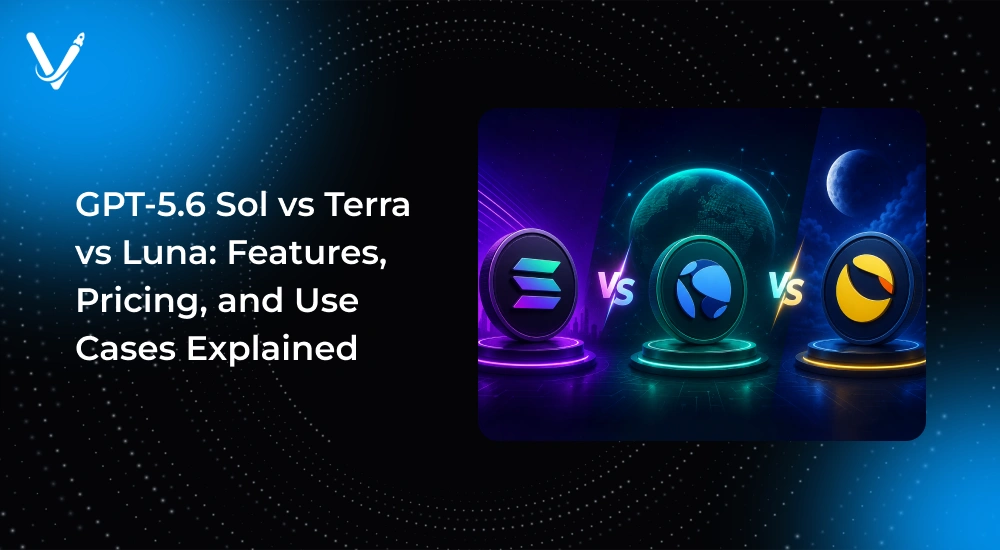
On June 26, 2026, OpenAI announced a limited preview of GPT-5.6 its next-generation model family, built as three distinct tiers: Sol, Terra, and Luna. This is not an incremental update. It is a structural redesign of how OpenAI delivers AI capability to the market.
For the first time, OpenAI has replaced version-based naming with a tier-based system. The number (5.6) identifies the generation. The name Sol, Terra, or Luna identifies a durable capability tier that can advance independently. Each tier is priced, optimised, and benchmarked for a different class of work.
For CEOs evaluating enterprise AI models, PMs building AI-powered business applications, CMOs planning AI automation tools, and VP Sales teams closing enterprise deals, the choice between Sol, Terra, and Luna is now a strategic decision with direct cost and performance implications. This guide breaks down everything you need to know.
GPT-5.6 is OpenAI's newest model generation, designed for harder tasks, higher reasoning depth, and more efficient token use than GPT-5.5. But the more significant change is structural instead of releasing one flagship model, OpenAI now ships three capability tiers simultaneously.
In the new naming system, the number identifies the generation and the name identifies the capability tier. Sol, Terra, and Luna are not just versions of the same model at different sizes they are distinct models optimised for different workloads, price points, and deployment contexts. Each tier can advance on its own cadence, meaning future generations will produce Sol, Terra, and Luna variants without a model-level naming change.
For enterprise teams evaluating large language models for business use, this creates clearer choices than the previous generation of naming conventions. You do not need to guess whether the 'mini' or 'turbo' version suits your use case. The tier system tells you directly.
All three models are priced per million tokens and are billed separately for input and output. GPT-5.6 also introduces updated prompt caching with explicit cache breakpoints, a minimum 30-minute cache life, and cache writes billed at 1.25x the uncached input rate. Cache reads continue to receive a 90% discount on the input rate.

OpenAI published benchmark results across three domains software engineering, cybersecurity, and biology. The results show meaningful differences between tiers, not just price differences.
Terminal-Bench 2.1 (coding): Sol sets a new frontier-level score on this benchmark, which evaluates command-line workflows requiring planning, iteration, and tool interaction. Sol with Ultra mode (91.9%) outperforms standard Sol (88.8%), demonstrating that the multi-agent sub-agent approach delivers measurable gains on complex coding tasks.
ExploitBench (cybersecurity): Sol matches the performance of Anthropic's Mythos Preview model on this cybersecurity benchmark while using approximately one third of the output tokens. For AI models for software development in security-sensitive contexts, this is a significant efficiency gain.
GeneBench v1 (biology/genomics): Sol outperforms GPT-5.5 on this genomics benchmark while consuming fewer tokens, showing efficiency improvements in scientific knowledge work in addition to coding and security.
New reasoning modes: Sol is the only tier in the GPT-5.6 family that unlocks Max reasoning (extended deliberation for hard problems) and Ultra mode (multi-agent sub-agent approach that splits complex projects across parallel agents). These modes are aimed at AI agent development platforms where tasks run over minutes or hours rather than seconds.
Terra is positioned as the default model for enterprise teams. OpenAI describes it as competitive with GPT-5.5 while being approximately 2x cheaper. It is designed for high-volume production environments where organisations need reliable results across large volumes of work customer support systems, internal tools, document analysis pipelines, and content generation workflows.
For business AI automation tools that run thousands of requests per day, Terra's cost structure makes it the most economically viable option in the GPT-5.6 family. It does not unlock Max or Ultra reasoning modes, but for standard professional knowledge work, the standard reasoning depth is sufficient for the vast majority of enterprise use cases.
Luna is built for speed, scale, and cost efficiency. It performs near GPT-5.5 levels on several benchmarks despite being positioned as the most affordable model in the family. For AI-powered business applications where response time and cost-per-query matter more than maximum reasoning depth summarisation, drafting, classification, routine automation Luna provides strong capability at the lowest cost in the GPT-5.6 range.
Notably, Luna outperforms Terra on Terminal-Bench 2.1 in OpenAI's own benchmark results. This suggests the tier ordering is not strictly linear across every task type, and teams should validate the right model for their specific workload rather than assuming Sol > Terra > Luna for all use cases.
Here is how all three models compare across the key capability dimensions:

Vasundhara Infotech's AI Development Services cover model evaluation, integration, and deployment for all major enterprise AI models including the GPT-5.6 family. We help teams identify the right tier for their specific product and workload before committing to production costs.
The three-tier model family is designed to match enterprise workloads to the appropriate level of capability and cost. Here is how the models map to common business use cases.
• Large-scale codebase migrations, refactoring, and architecture review where multi-step planning is required
• Cybersecurity vulnerability research, patch development, and defensive testing using the Daybreak programme
• Scientific research tools in genomics, drug target analysis, and quantitative biology
• Agentic task pipelines where Ultra mode sub-agents run parallel workstreams over hours
• Software engineering automation that requires reasoning continuity across complex, multi-file tasks
• Customer support automation at scale tens of thousands of queries per day across enterprise products
• Internal knowledge management tools and document analysis pipelines across large document libraries
• AI agent development platforms where the agent handles standard professional tasks without extended reasoning
• Business AI automation tools in HR, finance, legal, and operations where GPT-5.5 performance was sufficient
• Custom AI development solutions for SaaS products that need reliable, cost-effective inference at volume
• Real-time summarisation of long documents, meeting transcripts, and customer communications
• Routine content drafting, email generation, and classification tasks at high throughput
• Lightweight chatbots and virtual assistants where response speed matters more than deep reasoning
• AI-powered business applications where the unit economics require a cost below Terra at scale
• Prototyping and development environments where GPT-5.5 costs were a barrier to experimentation
Vasundhara Infotech has built AI-powered business applications across these categories for startups and enterprise clients. Our Innovation Consulting Services include a model selection workshop where we map your specific use case to the right AI model and help you build a cost model before development begins.
OpenAI has made compliance and safety a prominent part of the GPT-5.6 release. There are several things business decision-makers need to understand before adopting any of the three tiers in production.
Safety stack: GPT-5.6 Sol launches with OpenAI's most robust safety configuration to date. OpenAI reports spending multiple weeks on red-teaming, finding weaknesses, and hardening against real-world adversarial pressure before releasing the limited preview. In over 1,000 hours of adversarial testing, no universal jailbreak was found though this does not guarantee all harmful requests will be caught in every context.
Government coordination: The staggered release of GPT-5.6 beginning with a small group of approximately 20 trusted partner organisations before broader availability was coordinated with the US government. This is the first time a major AI release has been structured around government oversight prior to public access. Businesses evaluating AI compliance for regulated use cases should track how this framework evolves as broader access is granted.
Human-in-the-loop requirement: For any production deployment of GPT-5.6 in regulated or high-stakes workflows, a human review stage before AI-generated output reaches customers or decision-making systems remains the responsible standard. AI model output from any provider is an input to a decision, not the decision itself.
Vasundhara Infotech's Custom AI Development Solutions are built with compliance by design. Every AI integration we build includes a governance framework, logging and audit capability, human oversight checkpoints, and documentation that satisfies enterprise security review. We help companies use frontier models responsibly, not just rapidly.
GPT-5.6 introduces three genuinely distinct models rather than one flagship with smaller variants. Sol is for the hardest problems at the highest price. Terra is the practical default for high-volume enterprise work. Luna is for speed-first, cost-sensitive applications at scale.
For most businesses evaluating enterprise AI models, Terra will be the right starting point it delivers GPT-5.5 performance at half the cost, which is a straightforward improvement for any team already using GPT-5.5 in production. Sol becomes the right choice when maximum reasoning depth, Ultra mode, or frontier-level cybersecurity and coding capability are specifically required. Luna earns its place when response speed and cost-per-query are the primary constraints.
General availability is coming in the next few weeks. Now is the right time to evaluate which tier fits your use case, model your token costs, and plan your integration approach before the broader rollout begins.