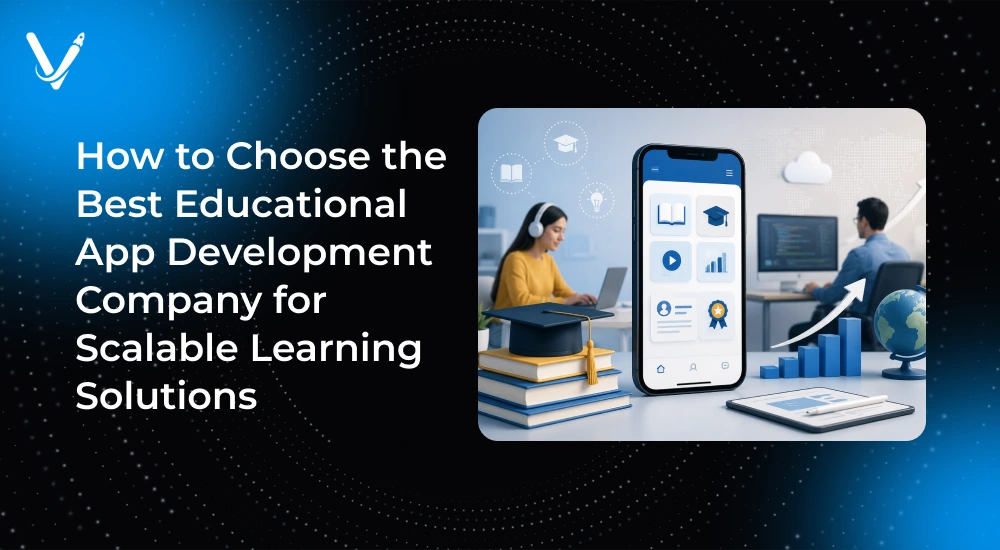
Choosing the right educational app development company is one of the biggest decisions in EdTech today. Digital learning is growing fast, and schools, startups, and companies all want apps that scale. The wrong partner can cost you time, money, and users.
The market shows why this matters. Statista data shows strong, ongoing growth in EdTech spending worldwide. Learning has moved to phones, LMS platforms, and virtual classrooms, and demand keeps rising.
But a great idea needs a great build. Scalable learning platforms need strong architecture, cloud power, security, and long-term support. That is why your choice of partner is so important. If you want expert help, our AI development services team builds custom learning apps. This guide shows how to pick the best one.
Why educational app development matters in 2026
Educational app development matters because learning has gone digital, mobile, and personal, and the demand keeps growing.
The World Economic Forum and UNESCO have both noted how digital tools are reshaping education worldwide. Learning now happens on phones, in virtual classrooms, and through smart, personalized apps. Here is what is driving the shift.
• Online learning growth. More learners study online than ever before.
• Mobile-first education. Phones are now the main way many people learn.
• Personalized learning. AI tailors lessons to each learner.
• Corporate training. Firms train staff through learning apps.
• Hybrid models. Learning blends in-person and online.
These trends all point one way. Learners want flexible, on-demand, personal education. Apps deliver that. And to serve millions of users, those apps must be built to scale from day one.
What makes a great educational app development company?
A great educational app development company brings EdTech experience, technical skill, strong design, scalable architecture, security, cloud power, and long-term support.
| Factor | Why it matters |
| Industry experience | Knows EdTech users, rules, and workflows |
| Technical expertise | Builds fast, stable, modern apps |
| UI/UX design | Makes learning easy and engaging |
| Scalability | Handles growth from hundreds to millions |
| Security | Protects student and user data |
| Cloud infrastructure | Keeps the app fast and reliable at scale |
| Post-launch support | Fixes, updates, and improves over time |
The best partners check every box here. A weak spot in any one area can hurt your app later. Scalability and security matter most, since a learning app that cannot grow or protect data will fail as you succeed.
Key features to look for
Key educational app features include user management, LMS tools, video learning, assessments, progress tracking, gamification, mobile learning, AI personalization, analytics, and many languages.
| Feature | What it does |
| User management | Handles roles for students, teachers, and admins |
| LMS features | Manages courses, content, and enrollment |
| Video learning | Delivers lessons through video |
| Assessments & quizzes | Tests learning with quizzes and exams |
| Progress tracking | Shows each learner's progress |
| Gamification | Adds points, badges, and rewards |
| Mobile learning | Works well on phones and tablets |
| AI personalization | Tailors content to each learner |
| Analytics dashboard | Shows clear data on usage and results |
| Multi-language support | Serves learners in many languages |
Not every app needs every feature. Start with what your learners need most, then grow. A good partner helps you pick the right mix. For a look at custom builds, see our guide to custom AI development.
How to evaluate education software development companies
Evaluate education software development companies by their portfolio, industry expertise, client references, technology stack, development process, and support. Use this checklist.
• Portfolio review: real EdTech apps they have shipped
• Industry expertise: proven EdTech and learning knowledge
• Client references: honest feedback from past clients
• Technology stack: modern, scalable tools that fit your needs
• Development process: clear, agile, and well-run
• Maintenance support: updates and care after launch
Score each company on these six points. Ask for a demo of a real learning app they built. A strong education mobile app development company will welcome these checks, not avoid them.
Questions to ask before you hire
| Question | What a good answer shows |
| Have you built LMS platforms? | Real, hands-on LMS experience |
| Do you have EdTech experience? | Deep knowledge of learning apps |
| What technologies do you use? | A modern, scalable tech stack |
| How do you handle scalability? | A clear plan for growth |
| What support do you offer after launch? | A real, long-term support plan |
The right questions reveal the right partner. Bring this list to every vendor call. Clear, specific answers are a good sign. Vague answers are a warning. A trusted elearning app development company will answer each one with ease and back it up with examples.
Educational app development cost breakdown
Educational app development typically costs from about $30,000 for a basic app to $250,000 or more for an enterprise LMS. These are estimates that vary by scope.
| Tier | Typical cost (est.) | What it includes |
| Basic educational app | $30k – $80k | Core features, one platform |
| Mid-level learning platform | $80k – $200k | LMS, video, integrations |
| Enterprise LMS | $200k+ | Full scale, AI, and many systems |
Cost has several parts. Development is the build. Design covers UI and UX. Cloud covers hosting and scale. Maintenance covers updates, often 15 to 25 percent of the build cost per year. Third-party integrations, like video or payments, add more. Always ask for an itemized quote.
Types of educational apps companies build
Companies build many kinds of learning apps, from LMS platforms to language apps and education marketplaces. Here are the main types and who they suit.
• LMS platforms. Manage courses and learners for schools and firms.
• Virtual classrooms. Live online classes with video and chat.
• E-learning apps. Self-paced courses learners take on demand.
• Student management systems. Track records, grades, and admin tasks.
• Corporate training platforms. Train and upskill staff at scale.
• Exam prep apps. Help learners study for tests.
• Language learning apps. Teach new languages with practice.
• Education marketplaces. Connect learners with courses and tutors.
The right type depends on your goals and users. Many platforms mix a few, like an LMS with virtual classrooms and mobile learning built in.
Custom development vs off-the-shelf
Custom educational app development gives you control and room to grow, while off-the-shelf tools are faster and cheaper to start. Here is the trade-off.
| Factor | Custom Development | Off-the-Shelf |
| Flexibility | Full, built for you | Limited |
| Cost | Higher up front | Lower up front |
| Scalability | Grows with you | May hit limits |
| Security | Built to your needs | Depends on vendor |
| Ownership | You own it | Vendor-controlled |
| Integrations | Any system you need | Limited set |
Off-the-shelf works for a fast, simple start. But custom education software development fits best when you need control, deep integration, and room to scale. Most serious learning platforms end up custom, so they can grow without limits.
AI compliance and data security
Educational apps handle student data, so they must protect privacy and follow rules like FERPA and GDPR. Compliance is a core part of any good build.
• Student data privacy. Protect learner data at every step.
• FERPA awareness. Follow US rules for student records.
• GDPR considerations. Meet EU privacy rules for user data.
• AI learning features. Use AI to personalize, but keep it safe.
• Responsible AI. Check AI output for bias and accuracy.
For apps used by children, extra care applies. Keep data safe, be clear about how it is used, and keep a human in the loop. A good partner builds compliance in from the start, not as an afterthought.
Top trends in educational app development
The top trends are AI-powered and adaptive learning, microlearning, gamification, analytics, virtual classrooms, and mobile-first design.
• AI-powered learning. AI tailors lessons to each learner.
• Adaptive learning. The app adjusts to a learner’s pace.
• Microlearning. Short lessons that fit busy lives.
• Gamification. Points and rewards boost engagement.
• Learning analytics. Clear data on progress and results.
• Virtual classrooms. Live, online learning at scale.
• Mobile-first learning. Apps built for phones first.
How to choose the right partner for growth
Choose the right EdTech partner by matching business goals, technical fit, budget, scalability, support, and innovation. Use this simple framework.
1. Business goals. Does the partner understand your vision?
2. Technical fit. Do their skills and stack match your needs?
3. Budget. Is the cost clear and fair for the scope?
4. Scalability. Can they build for millions of users?
5. Support. Will they stay with you after launch?
6. Innovation. Can they bring new ideas and AI features?
Score each partner on these six points. The one that fits your goals, budget, and growth plans, and that you trust for the long run, is the right choice.
Conclusion
Choosing the right educational app development company shapes the whole future of your learning platform. The right partner brings EdTech experience, technical skill, and a real plan for scale and support.
Focus on the key criteria: industry experience, scalable architecture, security, and long-term support. Review portfolios, check references, and ask hard questions. And keep scalability front and center, since a learning app must grow with your success, not break under it.
Looking ahead, EdTech is full of opportunity. AI, adaptive learning, and mobile-first design are reshaping how the world learns. The teams that pick the right partner and build to scale will lead the way.
Ready to build a scalable learning app? At Vasundhara Infotech, we help schools, startups, and companies build custom EdTech apps, LMS platforms, and mobile learning solutions built to grow. Start with your goals, and we will help you scale.





 Jul 8, 2026