


AI/ML
Why KPMG's Global Claude Rollout Signals the Future of Enterprise AI Adoption

 Jun 3, 2026





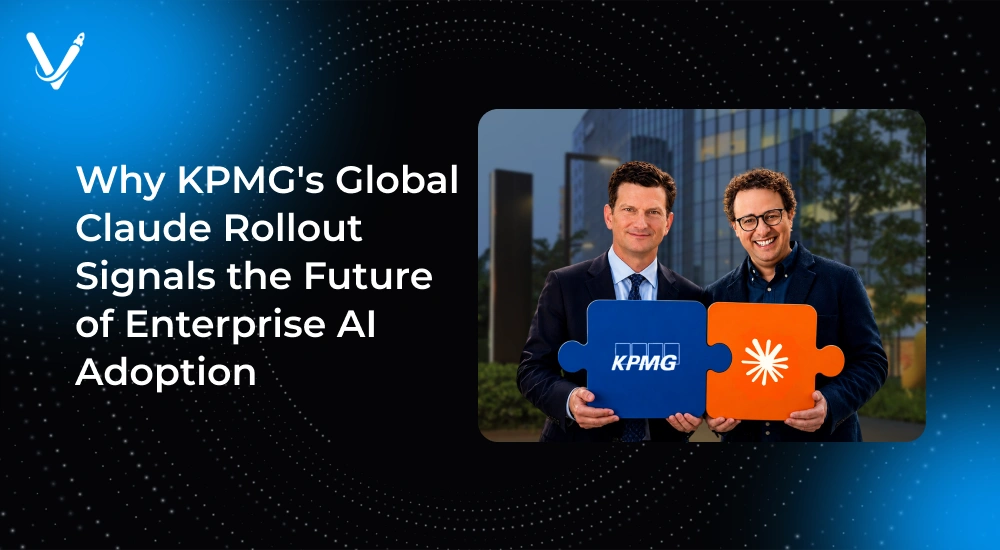
In May 2026, KPMG put Claude AI in the hands of more than 276,000 staff across 138 countries. This was not a small test. It was one of the largest enterprise AI adoption moves the consulting world has seen. For business leaders weighing their own enterprise AI solutions, the deal is worth a close look.
The reason is simple. When a Big Four firm bets its core work on one AI partner, it tells the market that the technology is ready. It also shows what a real rollout looks like at scale.
This post breaks down what KPMG did, why it matters, and what other companies can learn from it.
The KPMG Claude rollout is a global alliance between KPMG and Anthropic that puts Claude AI inside KPMG's main work platform.
On May 19, 2026, the two firms announced the deal and launched KPMG Digital Gateway Powered by Claude. Digital Gateway is KPMG's client delivery platform, built on Microsoft Azure. It holds tax content, internal tools, and client data in one place. Claude now runs inside that platform. It is not a separate chat app bolted on the side.
Every one of KPMG's 276,000 staff gets access to the Claude suite. The rollout builds on two years of Claude use inside KPMG US, including its Advisory teams and its AI and Data Labs. The first focus areas are tax clients and private equity firms.
The deal matters because it shows enterprise AI moving from pilot projects to full, daily use.
For the last two years, most firms have run small AI tests. McKinsey found that 71 percent of organizations now use generative AI in at least one function. But far fewer have scaled it across the whole business. Nearly two-thirds say they have not yet rolled AI out across the enterprise.
KPMG went the other way. It chose one AI partner and pushed Claude into the tools people use every day. That is what real enterprise generative AI looks like when a company stops testing and starts working. For other firms, it sets a clear example of enterprise AI strategy done at scale.

Claude is embedded directly into the platform KPMG staff and clients already use, so the AI sits where the work happens.
This matters for AI integration. Many companies buy AI tools and then ask staff to switch between apps. KPMG took a different path. By placing Claude inside Digital Gateway, the firm cut out that friction.
The early use cases are practical. KPMG says building an AI agent to help clients handle changing tax rules used to take weeks. With Claude inside the platform, that work now takes minutes. The firm also launched KPMG Blaze, which uses Claude Code to help clients update old IT systems faster. Across these uses, the goal is steady business process automation, not flashy demos.
The KPMG deal shows that a strong enterprise AI strategy starts with one trusted platform, not a pile of separate tools.
KPMG did not spread its bet across many vendors. It picked Anthropic AI as a core partner and went deep. This choice makes training, support, and governance easier to manage. It also helps drive AI transformation across teams, because everyone learns the same tools.
There is a workforce angle too. Giving 276,000 people access to the same AI suite is a major step in AI workforce transformation. Staff get help with research, writing, code, and analysis. The aim is to free up time for higher-value work, not to replace people. Companies that want similar results often start with AI consulting to map out where AI fits best.
A rollout this large only works with strong AI governance and clear rules for AI security and compliance.
KPMG framed the whole alliance around responsible AI. Its leaders pointed to security, trust, and governance as the base for scaling Claude to clients and staff. The work is guided by KPMG's own Trusted AI framework. The firm also plans to use Claude in cybersecurity, where it helps find and fix weak spots in systems.
For any global rollout, the rules matter. The EU AI Act sets risk-based duties for AI systems used in Europe. GDPR governs how personal data is handled across the EU. In the United States, the CCPA gives California residents rights over their data. In India, the DPDP Act sets rules for processing personal data. A firm working in 138 countries has to plan for all of these at once. Strong governance is what keeps a large rollout safe and legal.

Other companies can learn that enterprise AI works best when it is built into daily tools, backed by clear rules, and led from the top.
Here are the main lessons:
These lessons apply to firms of all sizes. A small business can use the same playbook with custom AI-powered applications that fit its own workflow.
The KPMG rollout points to a future where generative AI for business is a normal part of daily work, not a side project.
The pattern is already spreading. Anthropic signed a similar alliance with PwC, which is training tens of thousands of staff on Claude. As more large firms make these moves, AI becomes the default way work gets done in many fields.
The future of enterprise AI will likely reward firms that act now. Those that build AI into their core systems, train their people, and govern it well will pull ahead. The KPMG deal is an early sign of where the whole market is heading.