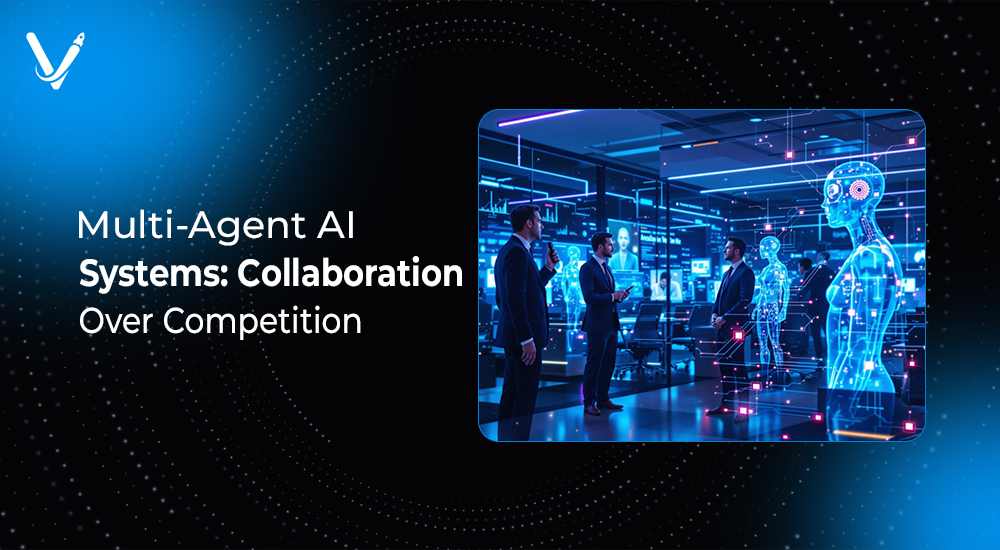
Artificial Intelligence has reached a turning point. No longer is it just about building one powerful model to solve one problem. The next wave of innovation lies in networks of intelligent agents that work together, share knowledge, and coordinate actions. This is the world of multi-agent AI systems—ecosystems where each participant has a role, but their collective intelligence is greater than the sum of their parts.
In the early days of AI, competitive setups dominated research and development. Agents were pitted against each other in chess tournaments, simulated environments, or adversarial scenarios to determine which was “best.” While this approach advanced certain capabilities, it often overlooked the massive potential of cooperation.
Today, the world’s most pressing challenges—climate change, supply chain disruptions, disaster management, complex robotics—require collaborative intelligence, where agents support each other to achieve shared objectives. This article explores what multi-agent AI systems are, why collaboration is replacing competition, how they work in practice, and what the future holds for this transformative approach.
Understanding Multi-Agent AI Systems
Before diving into why collaboration matters, let’s understand the fundamentals. Multi-agent AI systems consist of multiple autonomous entities, known as agents, that can sense their environment, make decisions, and perform actions. These agents may:
- Share the same capabilities (homogeneous systems) or have specialized roles (heterogeneous systems).
- Operate in a single shared space or across distributed environments.
- Focus on reactive behavior (responding to changes) or proactive strategies (planning ahead).
Why Multi-Agent Systems Stand Out
Unlike a standalone AI model, multi-agent systems thrive on interaction. Agents can coordinate, negotiate, and adapt—qualities essential in dynamic, unpredictable situations. They mirror social and natural ecosystems: just as ants coordinate to build colonies or human teams collaborate to manage projects, AI agents can work in unison to achieve complex outcomes.
Core Components
Agents – The autonomous decision-makers.
Environment – The shared operational space.
Communication Protocols – Rules for information exchange.
Coordination Mechanisms – Methods to synchronize actions.
Learning Models – Algorithms that help agents improve individually and collectively.
The Shift from Competition to Collaboration
For much of AI’s history, competition drove innovation. Reinforcement learning frameworks often rewarded individual success, and many benchmarks were based on one agent outperforming another. This worked well for games, adversarial training, and certain optimization problems—but fell short in real-world scenarios where shared success matters more than individual wins.
In contrast, collaborative AI systems prioritize mutual benefit. Agents pool their knowledge, optimize tasks collectively, and adapt to changes faster. The competitive mindset still has its place in specific contexts, but collaboration has emerged as the dominant strategy in applications where scale, adaptability, and resilience are essential.
Example:
In autonomous vehicle networks, a competitive approach might push each car to reach its destination first—creating chaos. A collaborative system, however, allows vehicles to share route, speed, and hazard data, ensuring smoother traffic flow and reduced accidents.
Why Collaboration Matters in Multi-Agent AI
The power of collaborative multi-agent AI comes down to its ability to solve problems more effectively than isolated systems.
Enhanced Problem-Solving
Complex challenges require diverse skills. Just as a diverse human team can solve problems faster by bringing varied perspectives, a set of AI agents with different strengths can collaborate to produce better outcomes.
Increased Efficiency
Task allocation across agents reduces redundancy and speeds up execution. Workflows become more streamlined, as agents focus only on the areas where they can provide maximum value.
Resilience and Fault Tolerance
Collaboration builds redundancy into the system. If one agent fails, others can adapt and fill the gap without the whole system breaking down.
Knowledge Sharing and Better Learning
When agents share experience, learning accelerates. Agents avoid repeating mistakes and adopt effective strategies faster.
Real-World Applications of Collaborative Multi-Agent AI
Collaboration isn’t just a theory—it’s already driving breakthroughs across industries.
Autonomous Vehicles
Cars equipped with AI can communicate with other vehicles and traffic infrastructure. This “vehicle-to-everything” (V2X) approach helps reduce congestion, avoid collisions, and optimize fuel consumption.
Supply Chain Management
AI agents can coordinate production schedules, inventory levels, and shipping routes across multiple stakeholders, minimizing delays and reducing costs.
Smart Energy Grids
In a collaborative smart grid, AI agents representing power plants, storage units, and consumers work together to balance demand and supply in real time.
Healthcare Systems
AI can coordinate patient data, diagnostic tools, and treatment planning across hospitals and research institutions, enabling faster diagnosis and personalized care.
Disaster Response
Drones, rescue robots, and sensor networks—each controlled by specialized AI agents—can share data and coordinate rescue operations more efficiently in emergencies.
How Collaborative Multi-Agent Systems Work
Collaboration in AI is built on structured design principles.
Communication Strategies
Agents can use:
- Direct messaging for instant coordination.
- Centralized communication hubs for structured task assignment.
- Decentralized blockchain-based protocols for transparent, tamper-proof information sharing.
Task Allocation
Dynamic allocation ensures each agent handles tasks best suited to its capabilities. For example, in a warehouse, some robots may be optimized for heavy lifting, others for sorting, and others for navigation.
Joint Learning
Using multi-agent reinforcement learning (MARL), agents learn not only from personal experiences but also from others—shortening the time needed to master complex tasks.
Challenges in Building Collaborative Multi-Agent AI
While collaboration is powerful, it’s not without hurdles.
Scalability
The more agents in a system, the harder it becomes to coordinate without bottlenecks.
Communication Overhead
Excessive information sharing can overwhelm the network, slowing decision-making.
Trust and Incentive Alignment
Agents must have incentives to act in ways that benefit the collective. This becomes complex in open or semi-open environments.
Security Risks
Malicious agents can introduce false data, undermining trust in the system.
Future Trends in Collaborative Multi-Agent AI
The next decade will see transformative advancements.
Human-AI Teams
Multi-agent systems will increasingly include humans as active participants, creating hybrid intelligence ecosystems.
Edge Computing Integration
Processing data closer to where it’s generated will allow agents to collaborate in real time without relying on centralized servers.
Cross-Industry Networks
AI agents from different sectors—healthcare, finance, energy—may collaborate to address large-scale global issues.
Conclusion: Towards an AI-Powered Collaborative Future
The future of AI is collective intelligence. Collaborative multi-agent systems are set to revolutionize how machines and humans work together. Their ability to solve complex problems, adapt quickly, and scale effectively makes them indispensable in a rapidly evolving world.
At Vasundhara Infotech, we help businesses harness these advanced AI capabilities to build solutions that thrive on collaboration—just like your teams do. If you’re ready to explore what multi-agent AI can do for you, let’s build that future together. Get in touch with us.



 Aug 10, 2025